
Tesla Maintenance Schedule by Mileage: What to Service and When (Model 3, Y, S & X)
Tesla's headline promise is that the car needs no annual service, no oil changes, no spark plugs and no timing belts. That is true — and it is also the single most expensive sentence in the owner's manual, because owners who read it as "nothing needs doing" are the ones who arrive at a workshop with seized calipers, a clogged cabin filter and a five-year-old brake fluid reservoir.
The Tesla maintenance schedule is not a package. It is a short list of individual jobs, each with its own interval, split by generation, and the rest of the car runs on condition monitoring. For anyone who supplies Tesla parts — a distributor, an independent workshop, or an owner ordering online — that structure is the whole story: it decides which parts move, at what mileage, and how often the same customer comes back.
This guide sets out the official intervals, converts them into mileage bands, and lists the parts each interval actually consumes for Model 3, Model Y, Model S and Model X.
Why the Tesla schedule looks nothing like a combustion car
Three design decisions change the entire service picture:
- No combustion, no fluids to burn. No engine oil, no oil filter, no spark plugs, no fuel system, no timing belt, no emissions test. The largest recurring line item on a petrol car simply does not exist.
- Regenerative braking does most of the stopping. Friction brakes are used for low-speed and emergency stops, which is why Tesla pads routinely last well past 60,000 miles. The paradox: parts that are rarely used are the parts that corrode. Rotors rust and caliper slide pins seize from disuse, especially where roads are salted.
- Condition monitoring replaces the calendar. Fluid levels, coolant and most wear items are checked by the vehicle rather than replaced on a schedule. Tesla is explicit that its published list is not exhaustive — brake pads, low-voltage battery, fluids and refrigerants are all replaced by condition, not by date.
The practical consequence for parts demand is that a Tesla does not generate steady, predictable volume the way a combustion car does. It generates spiky demand: filters and wipers on a rhythm, brake hardware and suspension items on a mileage curve, and a long tail of electrical failures by generation.
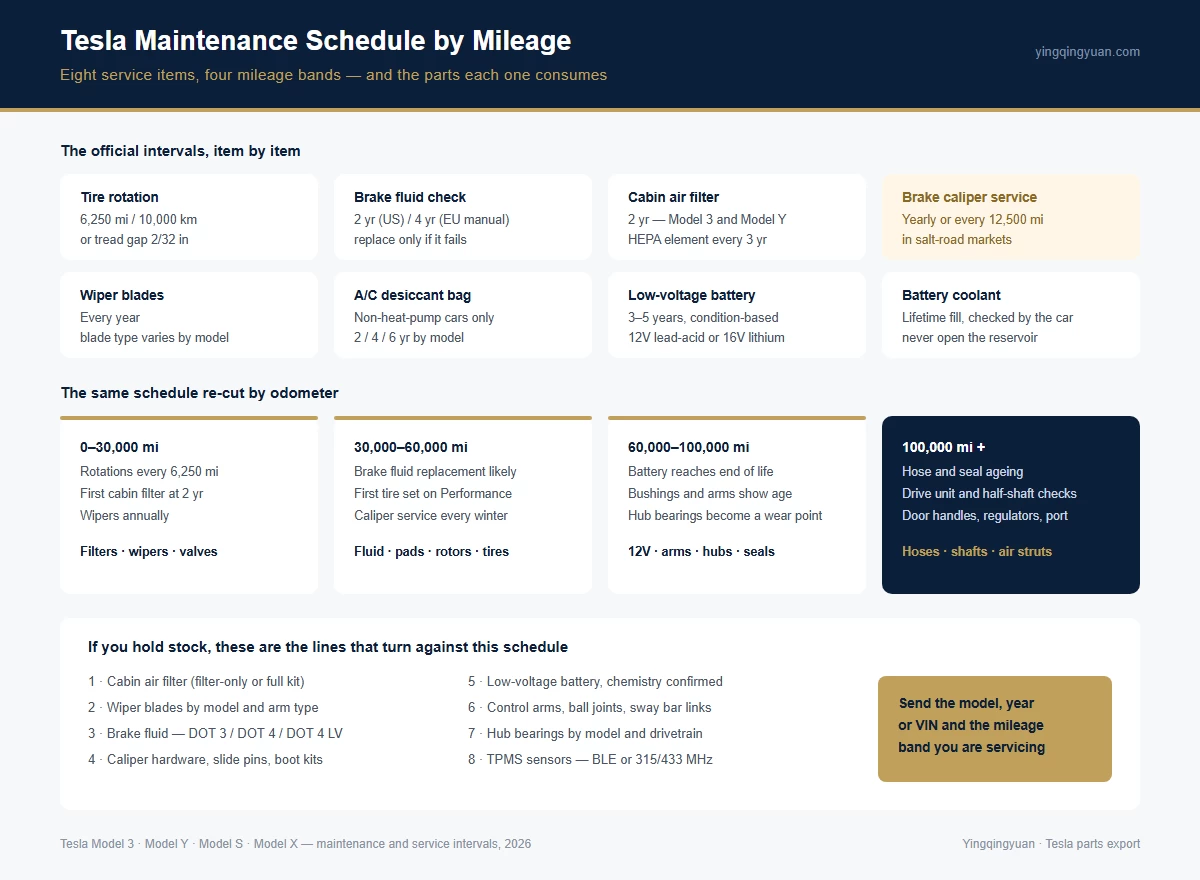
The official service intervals at a glance
Intervals differ slightly between Tesla's regional documentation, model year and even individual markets, and Tesla revises them periodically. The table below reflects the intervals Tesla's owner's manuals and support documentation currently describe; always confirm against the maintenance summary on the car's own touchscreen before committing to a schedule.
| Service item | Interval | Applies to |
|---|---|---|
| Tire rotation | Every 6,250 mi (10,000 km), or when front-to-rear tread depth differs by 2/32 in (1.5 mm) or more — whichever comes first | All models; staggered Performance setups cannot be rotated front to rear |
| Brake fluid health check | Every 2 years in US support documentation; every 4 years in the European owner's manual. Towing vehicles should have the fluid replaced every 2 years | All models |
| Cabin air filter | Every 2 years (Model 3/Y); up to 3 years on newer Model S/X. Dusty, smoky or high-salt markets justify annual replacement | All models |
| HEPA / carbon filters | Every 3 years where fitted | Model S/X and HEPA-equipped trims |
| Wiper blades | Every year, or when streaking | All models |
| Brake caliper clean & lubricate | Every year or 12,500 mi (20,000 km) in salt-road markets. Model Y built after February 2025: cleaning only, no lubrication | Cold-weather and salted-road markets |
| A/C desiccant bag | No scheduled replacement on heat-pump cars. Otherwise: 2012–2020 Model S every 2 years; 2015–2020 Model X every 4 years; 2017–2023 Model 3 without a heat pump every 6 years | Non-heat-pump cars only |
| Battery coolant | Lifetime fill under normal use. Do not open the reservoir — damage caused by opening it is not covered by warranty | All models |
| Low-voltage battery | Condition-based; lead-acid units typically 3–5 years, 16V lithium units longer | All models |
| Wheel alignment | As needed: uneven wear, pulling to one side, or after fitting new tires | All models |
Two of these deserve emphasis because they are the two most commonly mis-sold items on a Tesla invoice.
Brake fluid is checked, not automatically changed. The check measures moisture content; replacement happens only if the fluid fails. That said, glycol-based fluid absorbs atmospheric moisture over time regardless of mileage, and many independent workshops replace on a four-year calendar basis even when a test strip looks acceptable. For a towing vehicle, Tesla's own guidance is replacement rather than testing.
Brake caliper service is the winter item. This is the one scheduled job that northern markets genuinely cannot skip. Salt and moisture collect behind pads that barely move, the slide pins stop sliding, and the result is a dragging caliper, a hot wheel and a scored rotor. The fix is inexpensive if caught early and expensive if not — which makes it a reliable parts sale in every market with a real winter.
The same schedule translated into mileage bands
Owners think in miles, not in item names. This is the same schedule re-cut by odometer, which is also the most useful way to forecast parts demand if you serve a local Tesla fleet.
| Mileage band | What comes due | Parts that move |
|---|---|---|
| 0–30,000 mi (0–48,000 km) |
Tire rotations every 6,250 mi; first cabin filter at 2 years; wiper blades annually; brake fluid check somewhere in this window | Cabin filters, wiper blades, TPMS service kits, brake fluid, tire valves |
| 30,000–60,000 mi (48,000–96,000 km) |
Brake fluid replacement becomes likely; HEPA filter on S/X; first meaningful tire replacement on Performance cars; brake caliper service every winter | Brake fluid, filters, tires, brake pads, caliper hardware and slide pin kits, rotors where rusted |
| 60,000–100,000 mi (96,000–160,000 km) |
Low-voltage battery reaches end of typical life; suspension bushings and control arms start to show age; hub bearings become a known wear point; A/C desiccant bag on non-heat-pump cars | 12V/16V low-voltage battery, control arms, ball joints, sway bar links, hub bearings, A/C desiccant and seals |
| 100,000+ mi (160,000 km+) |
Coolant hose and seal ageing; drive unit and half-shaft inspection; window regulators, door handles and charge-port mechanisms; air suspension on S/X | Coolant hoses and clamps, seals, half-shafts, door handles, window regulators, charge-port assemblies, air struts and compressor |
Two caveats on the bands above. First, climate moves everything forward: a car in a salted-winter market runs the brake and suspension columns years ahead of a car in a warm, dry one. Second, a high-mileage car is not automatically an expensive car — a 120,000-mile Model 3 with original pads and intact bushings is common. The band is a probability distribution, not a work order.
What actually fails, and at what mileage
Independent workshops that service Tesla vehicles report a fairly consistent pattern of failure by system. It is worth separating genuine design wear from the noise of anecdote.
- Front suspension and steering (60,000–100,000 mi). The heaviest, most consistent repair category on higher-mileage Model 3 and Model Y cars. Control arm bushings, ball joints and sway bar links develop clunks and play. See our suspension and steering parts guide for the wear points and how to spec them.
- Brake rotors from disuse. A Tesla rotor that has never been properly bedded can rust in a season and then pulse under braking. Pads last, rotors do not necessarily. Rotor and caliper specifications vary by trim — our brake parts guide lists them by model.
- Low-voltage battery (3–5 years). The classic failure that strands a car: slow unlocking, a blank screen, then a car that will not wake. On later builds this is a 16V lithium unit rather than a lead-acid 12V, and the two are not interchangeable without software support. Details in our electrical parts guide.
- Hub bearings (80,000–120,000 mi). A drone or hum that changes with steering load. Bolt patterns, torque figures and hub assemblies are covered in our wheels, tires and hub bearings guide.
- Thermal system parts. Heat-pump cars eventually need compressor, manifold or coolant-line attention; PTC cars fail in the heater assembly instead. The split is by generation, not by model name — see the cooling and HVAC parts guide.
- Air suspension on Model S and Model X. Compressors, valve blocks and struts. Ride-height faults in cold weather are usually mechanical, not electronic.
Parts to stock if you serve Tesla owners
If you are choosing what to hold as inventory rather than ordering per job, these are the lines that turn fastest against the schedule above. They are also the lines where a wrong generation or wrong trim is easiest to ship by accident, so every row carries a confirmation question.
| Part | Triggered by | Confirm before ordering |
|---|---|---|
| Cabin air filter (and HEPA kit) | 2-year interval, or any dusty/smoky climate | Model and trim; filter-only versus full kit |
| Wiper blades | Annual | Blade length and arm type by model |
| Brake fluid (DOT 3 / DOT 4 / DOT 4 LV compatible) | 2–4 year check or replacement | Never DOT 5 silicone — incompatible with the system's seals |
| Brake pads and rotors | Condition, and rotor corrosion | Rotor diameter and caliper type by trim |
| Caliper hardware, slide pins, boot kits | Annual salt-market caliper service | Standard versus Performance caliper; Model Y post-Feb 2025 variant |
| Low-voltage battery | 3–5 years, condition-based | Lead-acid 12V or 16V lithium; software support if converting |
| Control arms, ball joints, sway bar links | 60,000–100,000 mi | Generation and whether the car is a refreshed platform |
| Hub bearings | 80,000–120,000 mi | Model, year and drivetrain |
| A/C desiccant bag and seals | Non-heat-pump cars only | Heat pump fitted or not (Controls > Software > Additional Vehicle Information) |
| TPMS sensors | Wheel-set changes and sensor failure | Bluetooth (2021+) or 315/433 MHz (pre-2021) |
DIY versus workshop: what owners can actually do
Part of the reason Tesla consumables matter commercially is that a meaningful share of them are owner-installable, which shifts the buying decision from a workshop's parts counter to a direct order. The line falls fairly cleanly:
| Item | DIY? | Why |
|---|---|---|
| Cabin air filter | Yes — the highest-volume DIY job on any Tesla | Accessible behind the footwell panel; no special tools |
| Wiper blades | Yes | Standard push-tab fitment |
| Tire rotation | Yes with a jack and torque wrench | Requires correct lug torque and, on some cars, a configuration reset |
| 12V / 16V low-voltage battery | Possible, with care | Requires correct chemistry and a software-supported part |
| Brake fluid replacement | Not recommended | Needs pressure bleeding and correct fluid specification |
| A/C desiccant and refrigerant work | No | Requires evacuation and recovery equipment |
| Any high-voltage work | No | Requires certified training and insulated tooling — see our high-voltage parts guide |
The DIY column matters more than it looks. Filters, wipers, wheel hardware and low-voltage batteries are exactly the categories where owners buy direct and in small quantities — and where a supplier's ability to confirm the right generation in one exchange decides whether the order happens at all.
The generation splits that change the parts list
Model name and model year do not determine the parts list. Four splits do, and every one of them cuts across a schedule interval:
| Split | Break point | Service items affected |
|---|---|---|
| Heat pump vs PTC heater | Model 3 from 2021; all Model Y; refreshed Model S/X from 2021. Earlier cars use a resistive PTC heater | A/C desiccant schedule, compressor, coolant lines, cabin heater assembly |
| TPMS generation | 2021+ Bluetooth (BLE) sensors; pre-2021 radio-frequency 315/433 MHz | Any wheel-set change, winter tire packages, sensor replacement |
| Low-voltage chemistry | Lead-acid 12V on earlier builds; 16V lithium on later builds | Battery replacement, mounting hardware, terminal harness |
| Refreshed platform (Highland / Juniper) | Model 3 from 2024; Model Y from 2025 | Filters, brakes, suspension, interior, lighting and body items all diverge |
A VIN check settles all four in one step. Our VIN decoding and part number guide explains how to read the generation out of the VIN and the part number, and the Model 3 and Model Y fitment checklist is the pre-order version of the same exercise.
Frequently asked questions
Does a Tesla really need no annual service?
Correct — Tesla does not require an annual service, and the car has no oil, spark plugs, timing belt or transmission fluid to change. What it does have is a short list of items with their own intervals: tire rotation, brake fluid checks, cabin and HEPA filters, wiper blades, annual brake caliper service in salt markets, the A/C desiccant bag on non-heat-pump cars, and a low-voltage battery every few years. The list is short, but it is not empty.
How often should I rotate the tires on a Tesla?
Every 6,250 miles (10,000 km), or sooner if front-to-rear tread depth differs by 2/32 in (1.5 mm) or more. Rotation matters more on a Tesla than on a combustion car because weight and instant torque accelerate wear, and all-wheel-drive cars wear unevenly front to rear. Staggered Performance wheel setups cannot be rotated front to back.
Why does my Tesla need brake service if I barely use the brakes?
Precisely because you barely use them. Regenerative braking keeps the friction brakes cool and lightly loaded, so pads last a long time — but the caliper slide pins and pad abutment surfaces stop moving, and road salt and moisture collect where the pads sit. The result is seized calipers and rusted rotors rather than worn pads. Tesla recommends cleaning and lubricating the calipers annually or every 12,500 miles in salted-road markets.
How often should brake fluid be changed?
Tesla's documentation varies: US support material describes a health check every 2 years, while the European owner's manual states a check every 4 years, with replacement only if the fluid fails. Vehicles used for towing should have the fluid replaced every 2 years. Because glycol fluid absorbs moisture over time, many independent workshops replace on a four-year calendar. Use DOT 3, DOT 4 or DOT 4 LV compatible fluid — never DOT 5 silicone.
When does the cabin air filter need replacing?
Tesla's interval is every 2 years for Model 3 and Model Y, and up to 3 years on newer Model S and Model X. In dusty, smoky or heavily salted markets, annual replacement keeps cabin fogging and odour under control. HEPA and carbon filter elements, where fitted, are typically a 3-year item.
How long does the low-voltage battery last?
Typically three to five years for lead-acid units, with 16V lithium units lasting longer. Failure presents as slow unlocking, a blank or slow screen, and eventually a car that will not wake. Tesla's service position on a suspect lithium unit is to recover and retest before condemning it.
Can I service a Tesla at an independent workshop?
Yes for tires, brakes, suspension, cabin filters, low-voltage batteries and most mechanical work. Tesla publishes service manuals and wiring diagrams, and independent shops can access the diagnostic software through a subscription. High-voltage battery and drive unit work still requires certified high-voltage training, and some software-gated functions remain Tesla-only. For the parts side of that decision, see our OEM vs aftermarket sourcing guide.
Which collections should I browse?
By system and model:
- Tesla Model 3 brake parts and Tesla Model Y brake parts
- Tesla Model 3 cooling and HVAC parts and Tesla Model Y cooling and HVAC parts
- Tesla Model 3 electrical parts
- Tesla Model 3 wheels, tires and hub parts and Tesla Model Y wheels, tires and hub parts
Related Tesla parts guides
- Tesla winter prep guide — the seasonal version of this schedule
- Tesla brake parts guide — pads, rotors, calipers and rotor sizes by model
- Tesla suspension and steering parts guide
- Tesla VIN decoding and part number guide
- Wholesale Tesla replacement parts — what to confirm before building a service line
Send us the model, model year or VIN, and the mileage band you are servicing, and we will confirm the exact parts for each interval — filters, brake hardware, suspension wear items and low-voltage battery — before you order. One confirmed list beats three shipments and two returns.