
Tesla High-Voltage System Parts Guide: PCS, HV Cables, Connectors & Safety Hardware (Model 3, Y, S & X)
Every Tesla parts catalogue has a category most buyers avoid quoting: the high-voltage chain. The pack gets the headlines, but the parts that actually fail, get replaced and generate repeat orders sit around it — the Power Conversion System, the high-voltage cables and busbars, the DC input assembly, and the safety hardware that has to be replaced every time the pack is opened.
2026 has pushed this category into the mainstream repair channel. The first large wave of Model 3 and Model Y cars is now past its original warranty, the independent high-voltage service sector has matured, and high-voltage wiring and connector ageing has become one of the most discussed failure modes on older Model Y cars. Demand is real.
This guide covers the five sub-assemblies, the part variants that decide fitment, the safety hardware that is single-use, and what to confirm before you order.
What "high voltage" actually covers on a Tesla
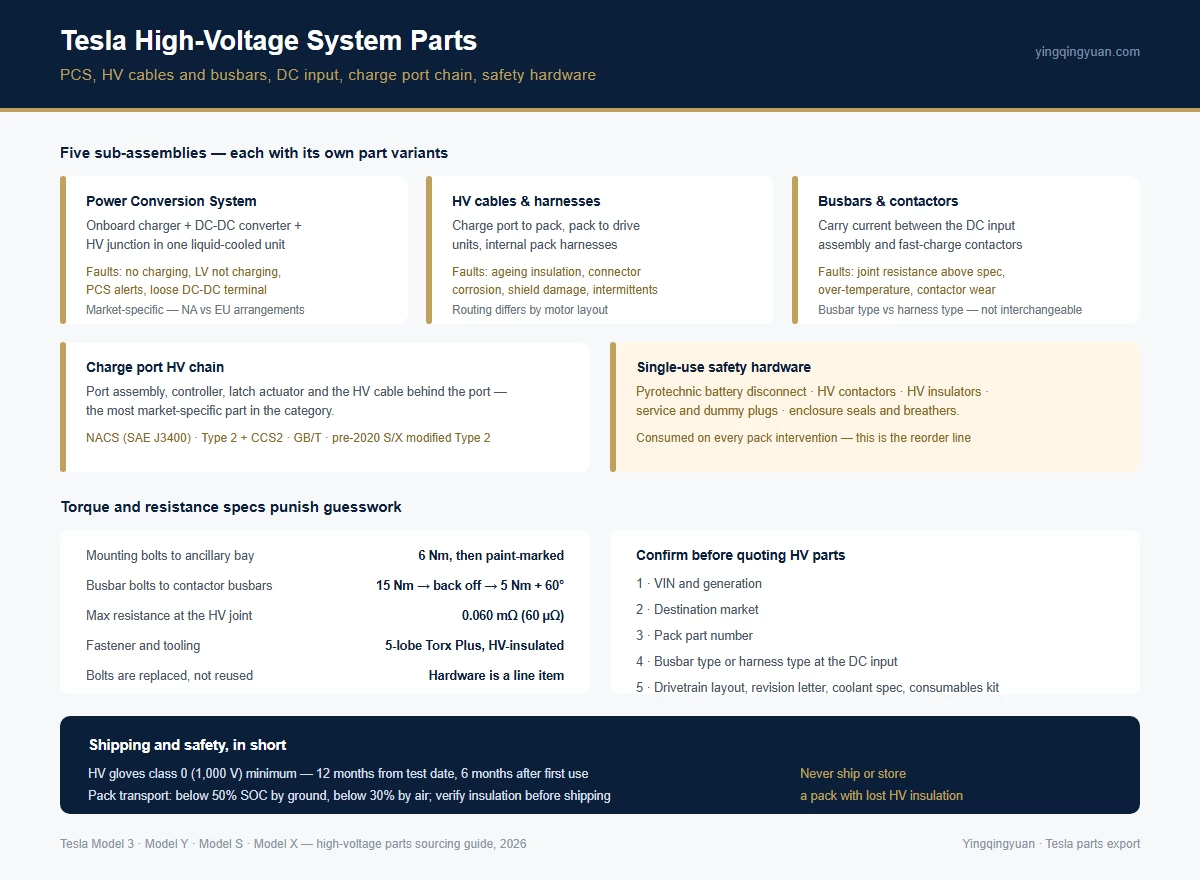
Tesla's high-voltage (HV) system is the orange-cabled network that moves energy between the pack, the drive units, the charger and the charge port. It is not one part. For sourcing purposes it breaks into five sub-assemblies, each with its own part variants and its own fitment rules.
| Sub-assembly | Function | Typical fault / demand driver |
|---|---|---|
| Power Conversion System (PCS) | Combines the onboard AC charger, the DC-DC converter and the HV junction in one liquid-cooled unit | Charging faults, low-voltage system not charging, PCS alerts |
| HV cables and harnesses | Charge port to pack, pack to drive units, DC input assembly, internal pack harnesses | Ageing insulation, connector corrosion, shield damage, intermittent faults |
| Busbars and fast charge contactors | Carry current between the DC input assembly and the fast-charge contactors | High resistance at the joint, over-temperature, contactor wear |
| Charge port HV chain | Charge port assembly, controller, latch and the HV cable behind it | Latch faults, failed charging, ice and water ingress |
| Safety hardware | Pyrotechnic battery disconnect, contactors, HV insulators, service plugs, seals and breathers | Single-use items consumed on every pack intervention |
The most important commercial point in this table: the last row is a consumables line. Safety hardware is replaced, not reused, so a workshop that does one pack job needs a kit of fasteners, seals, insulators and breathers — not just the headline component.
The Power Conversion System is the biggest single part in this category
The PCS is where most high-voltage repair spend lands, because it packs three functions into one replaceable unit: the onboard charger, the DC-DC converter that feeds the low-voltage system, and the HV junction. It is liquid-cooled, which means it is also part of the thermal system.
How PCS faults present
- Charging will not start, or stops early, often with a charge-port fault message that points at the port rather than the PCS.
- The low-voltage system stops charging correctly — DC-DC faults show up as 12V or 16V accessories behaving oddly, lights dimming, or the low-voltage battery repeatedly going flat. This is the classic "the car has a dead battery but the battery is fine" case.
- PCS alert codes such as PCS_a084, which indicates an abnormal voltage behaviour on the DC link. Tesla's own service literature ties a number of PCS alerts to CAN communication loss between the PCS and the front vehicle controller, DC-DC regulation faults, and DC output current exceeding threshold.
- A known mechanical fault. Tesla issued a campaign bulletin for certain Model 3 cars covering a loose screw securing the 12V DC-DC positive terminal inside the PCS; the published correction is inspection and, where symptoms are present, PCS replacement. It is a useful reminder that not every PCS fault is electronic.
The part variant that catches buyers out
PCS units are not universal. The unit is specified by current rating and by market: a North American car and a European car do not use the same onboard charger arrangement, because European cars charge on three-phase AC infrastructure while North American cars charge on single-phase. The unit also carries a revision letter, and revisions are not backwards-compatible in every direction.
The practical rule: a PCS must be matched on market, current rating and revision, and it must be ordered together with its coolant circuit consumables. Supplying a working PCS for the wrong market produces a car that charges incorrectly or not at all.
Related reading: our Tesla electrical parts guide covers the low-voltage side of the same chain, and the cooling and HVAC guide covers the coolant circuits the PCS shares.
HV cables, busbars and the DC input assembly
Tesla's service documentation describes two arrangements at the pack's DC input: a busbar type and a harness type. They are not interchangeable, and the procedure to replace one differs materially from the other. This single distinction — busbar or harness — is the first question to ask on any DC input order.
Specifications worth knowing
High-voltage joints are torque-critical and resistance-critical. Tesla's published figures for the DC input assembly on Model 3 illustrate why this category punishes guesswork:
| Item | Published figure | Why it matters for parts |
|---|---|---|
| Mounting bolts (DC input assembly to ancillary bay) | 6 Nm, then marked with a paint pen | Bolts are replaced, not reused, on several HV procedures |
| Busbar bolts (DC input to fast charge contactor busbars) | Pre-torque 15 Nm, back off half a turn, retorque 5 Nm + 60° | A two-stage sequence — a single-pass torque is wrong |
| Maximum resistance at the HV joint | 0.060 mΩ (60 µΩ) | Above this, the joint is cleaned and retested; the fastener is the serviceable item |
| Fastener type | 5-lobe Torx Plus external, insulated tools | Special tooling and HV-insulated sockets are required |
Two consequences for buyers. First, fasteners are a line item — several HV procedures specify new bolts and discard the old ones, so a complete HV order includes hardware. Second, high resistance at a joint is often solved by cleaning and refastening rather than replacing the cable, which means the diagnosis determines the part. Selling a cable for a joint-resistance fault creates a return.
Cable routing is not universal
HV cable and harness part numbers vary by pack size, drive-unit configuration (single or dual motor) and generation. A harness that fits a rear-wheel-drive Model 3 will not fit a dual-motor car, and pack-side connections changed across production. Confirm pack part number and drivetrain layout before quoting.
Related reading: our chassis and drivetrain parts guide covers the drive-unit end of the HV chain.
The charge port HV chain
The charge port sits at the boundary between the vehicle and the outside world, which is why it fails more often than any other HV component and why it is the most market-specific part in the entire category.
- Connector standard by market. North American Teslas use the Tesla connector, standardised as NACS (SAE J3400), and are physically the same shape before and after the standard was introduced. European cars use Type 2 for AC and CCS2 for DC fast charging; older European Model S/X used a modified Type 2 for DC and can be retrofitted to CCS2. Chinese cars use GB/T. The port assembly, the controller and the HV cable behind it all follow that standard.
- The latch and actuator. "Will not charge" complaints are frequently a latch or actuator fault rather than a power fault — a much cheaper repair, and a different part.
- Water and ice ingress. Seal and connector corrosion shows up as intermittent charging faults, and is a leading cause of port replacement in cold and wet markets.
- HV cable behind the port. The charge-port-to-pack HV cable is a separate part number from the port assembly and is often overlooked until the port is already off the car.
For a component-level walk-through of the charge port and its low-voltage control side, see the Tesla electrical parts guide.
Safety hardware: the single-use items that generate repeat orders
This is the part of the HV category that is easiest to undersell and easiest to convert into recurring revenue. Every pack intervention consumes hardware.
- Pyrotechnic battery disconnect (the "pyro fuse"). A one-shot device that isolates the pack in a crash. Once deployed — whether by an accident or by a service procedure — it must be replaced. It cannot be reset or reused. Any pack work or collision repair on a Tesla should be quoted with one.
- HV battery contactors. The fast-charge and pack contactors that carry and interrupt pack current. Contactor wear is a common cause of "will not charge" and isolation faults.
- HV insulators. Insulator kits for the pack's ancillary bay and the penthouse area. Tesla notes that on new-generation cars the pack cover volcano bracket and fasteners may be absent, and that insulators should be installed if not present. These are consumable items on every pack intervention.
- Service plugs, dummy plugs and caps. Used to make a system safe and to keep connectors clean during service. Low unit cost, high turnover, and useless to the customer if the workshop does not have them on the shelf.
- Seals, breathers and enclosure hardware. Pack enclosure seals, probe-lid seals and Nitto-style breathers are replaced whenever the enclosure is opened, because a leaking enclosure fails the air-leak test.
The commercial takeaway: a workshop attempting its first HV pack job needs a consumables kit, not a single part. Build the kit once and it reorders.
Shipping, storage and safety compliance
High-voltage parts, and especially anything containing or connected to a pack, carry handling and transport obligations that buyers must plan for.
| Requirement | Published limit |
|---|---|
| HV glove rating for handling HV cables, busbars and fittings | Class 0 minimum (1,000 V), with leather protectors and a glove tester |
| HV glove service life | Up to 12 months from the test date, but only 6 months after first use |
| State of charge for transport by ground | Below 50% |
| State of charge for transport by air | Below 30% |
| State of charge for storage | Discharge below 25% recommended where transport mode is unknown |
| Insulation integrity before shipment | Must be verified — a pack with lost HV insulation must not be shipped or stored |
Regional rules differ, so always confirm the destination market's requirement rather than applying a single number globally. For documentation and freight questions on HV and oversized parts, see our Tesla parts packaging and international shipping guide.
What to confirm before ordering high-voltage parts
| # | Confirm | Why |
|---|---|---|
| 1 | VIN and generation | Pack, harness and PCS variants change across production |
| 2 | Destination market | PCS rating and charge-port standard are market-specific |
| 3 | Pack part number | Determines harness and DC input arrangement |
| 4 | Busbar type or harness type at the DC input | The two arrangements are not interchangeable |
| 5 | Drivetrain layout (single or dual motor) | HV cable routing differs |
| 6 | Revision letter of the current unit | Revisions are not universally backwards-compatible |
| 7 | Coolant specification | PCS and pack share the thermal circuit |
| 8 | Consumables kit | Bolts, seals, insulators, breathers and the pyro disconnect |
Frequently asked questions
What is the PCS on a Tesla, and why is it so expensive?
PCS stands for Power Conversion System. It combines three functions in one liquid-cooled unit: the onboard AC charger, the DC-DC converter that supplies the low-voltage system, and the high-voltage junction. Because it replaces three separate components, it is the most expensive single part in the high-voltage chain — and because it is liquid-cooled, it is also part of the thermal system, so a replacement job includes coolant and bleeding.
Can a PCS from another market be fitted?
No. The PCS is specified by market and current rating. European cars are built around three-phase AC charging; North American cars are built around single-phase. Fitting the wrong unit produces incorrect or absent charging even though it physically mounts.
Is the pyrotechnic battery disconnect reusable?
No. It is a one-shot device. Once it has deployed, it must be replaced — it cannot be reset or reused. Any pack intervention or collision repair involving the pack should be quoted with a new disconnect.
My car reports a charge-port fault but the port looks fine. Is it the PCS?
It can be. Charge-port fault messages frequently accompany PCS faults, and DC-DC regulation faults inside the PCS show up as low-voltage symptoms rather than charging symptoms. Diagnose before ordering: the port assembly, the port controller, the latch actuator and the PCS are four different parts, and only one of them is at fault.
Do HV cables need replacing when the joint resistance is high?
Not necessarily. Tesla's procedure for high joint resistance is to remove the fastener, clean the contact areas with isopropyl alcohol, refit and measure again against a maximum acceptable value of 0.060 mΩ. The cable is replaced only if the joint cannot be brought back into specification — which is why the diagnosis determines the part.
How should high-voltage parts be shipped?
Any pack or pack-connected assembly must be shipped at a state of charge below 50% by ground and below 30% by air, with insulation integrity verified first, and with regional rules checked. A pack that has lost high-voltage insulation must never be shipped or stored. Non-pack HV components are far simpler, but must still be packed to protect connectors and cable routing.
Which collections should I browse?
- Tesla Model 3 electrical parts and Tesla Model Y electrical parts
- Tesla Model S electrical parts and Tesla Model X electrical parts
- Tesla Model 3 chassis and drivetrain parts
Related Tesla parts guides
- Tesla electrical parts guide — the low-voltage, charge-port and sensor side of the same system
- Tesla cooling and HVAC parts guide — the coolant circuit the PCS and pack share
- Tesla collision repair and ADAS calibration guide — where the pyro disconnect and HV isolation typically enter the job
- Tesla Model S and Model X parts guide — how the 2026 production end affects HV part supply
- How to vet a Tesla parts supplier — traceability and documentation for safety-critical components
- Tesla VIN decoding and part number guide — settling revision letters from the VIN
Send us your VIN list, the destination market and the fault description, and we will confirm PCS rating, DC input arrangement, connector standard and the consumables the job needs before you order. High-voltage parts are the least forgiving category in the catalogue — one confirmed order beats a returned PCS.