
Tesla OEM vs Aftermarket Parts: A 2026 Sourcing Guide for Distributors and Repairers
"Is it OEM?" is the question every Tesla parts buyer asks, and it is rarely the question that actually matters. What matters is which of five distinct part types you are being offered, what it is made to, and whether the category you are buying in tolerates anything other than factory-original hardware.
This guide separates the part types properly, sets out what Tesla itself says about each, covers the service-policy change that landed in 2026, and gives distributors a category-by-category view of where aftermarket supply is a sound decision and where it is not.
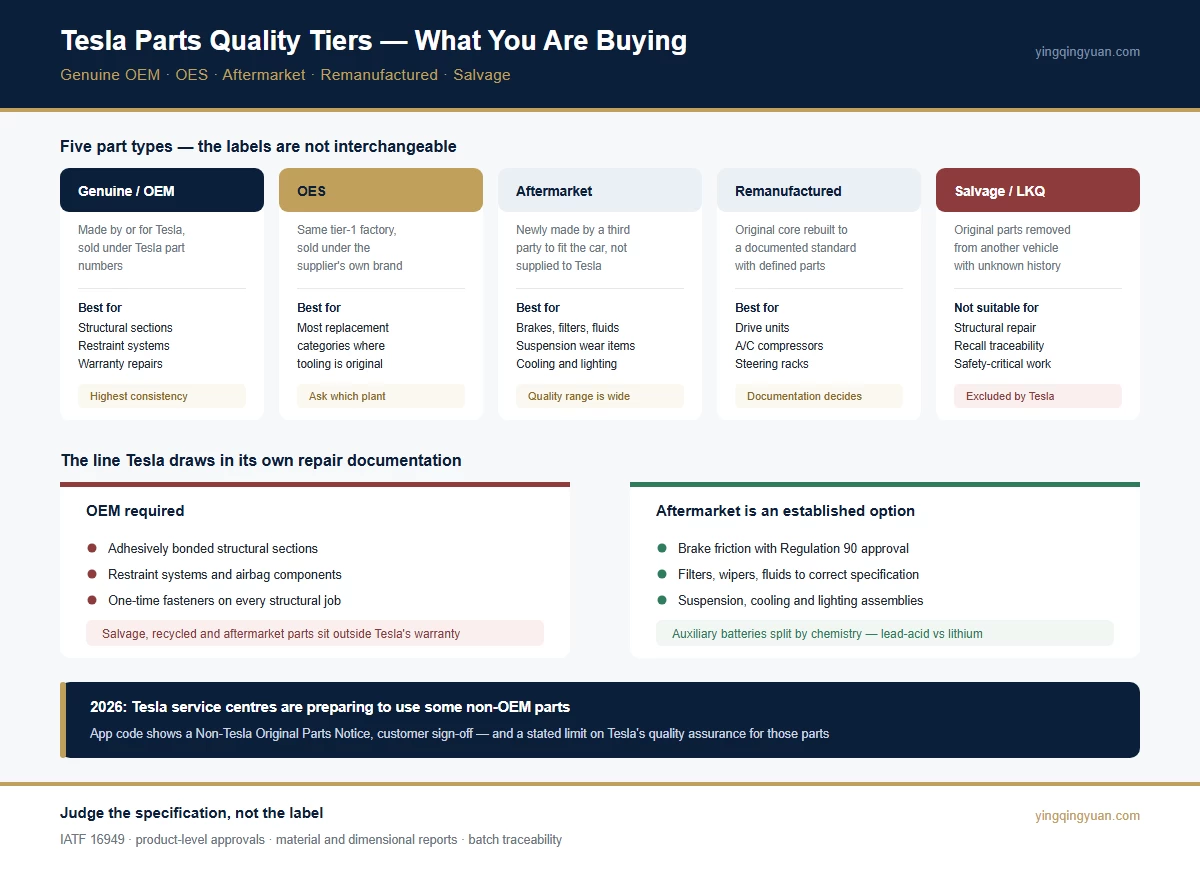
The Five Part Types — and Why the Labels Get Abused
| Type | What it actually is | Typical sourcing reality |
|---|---|---|
| Genuine / OEM | Made by or for Tesla, sold through Tesla's parts channel under Tesla part numbers | Highest consistency, highest price, availability depends on Tesla's stock |
| OES (original equipment supplier) | The same tier-1 factory that made the part for Tesla, selling it under its own brand — often the same tooling and line | Frequently the best value in the market; the difference is branding and packaging, not necessarily the part |
| Aftermarket | Newly manufactured by a third party to fit the vehicle, not supplied to Tesla | Enormous quality range — from certified production comparable to OES down to untested copies |
| Remanufactured / refurbished | An original core rebuilt to a documented standard with defined replacement components | Common for drive units, compressors and steering racks; the standard is only as good as the documentation |
| Salvage / recycled (LKQ) | Original parts removed from another vehicle | Cheap, unpredictable, and explicitly excluded from structural repair |
The abuse happens in the middle of that table. "OEM quality", "OEM standard" and "OEM supplier" are marketing phrases with no defined meaning. A supplier who genuinely holds the original tooling will say so and name the plant. One who does not will reach for the phrase instead.
What Tesla Itself Says
Tesla's public position is unusually blunt, and every distributor should understand it before selling into Tesla repair work.
- Tesla does not test alternative or aftermarket parts. Its repair documentation states that Tesla only sells parts it has safety-tested, and that it does not test alternative or aftermarket components — so it cannot confirm their effect on safety.
- Salvage, recycled and aftermarket parts are outside Tesla's warranty. Tesla's documentation notes that such parts are not covered by its warranty and may affect cover on related components.
- Structural repair must use new OEM parts and approved fasteners. Tesla bodies are assembled with structural adhesive rather than conventional welding throughout, so structural components are not designed to be removed and reused. One-time fasteners — rivets, bolts, screws — must be replaced on every structural job, with OEM or Tesla-approved hardware.
- Collision-safety components are singled out. Tesla specifically warns that aftermarket fenders, hoods, bumpers and doors can compromise crumple behaviour and the operation of restraint-system sensors.
That is a manufacturer recommendation about its own warranty and its own repair standards. It is not a general statement that aftermarket parts are unsafe — a distinction that gets lost in forum arguments and matters enormously in commercial practice.
What Changed in 2026
In 2026, code strings found in a Tesla mobile app release indicated that Tesla service centres are preparing to use some non-OEM parts in customer repairs — a notable departure from a historically closed parts ecosystem. The same release revealed the mechanism: a formal Non-Tesla Original Parts Notice, with disclosure banners and a customer sign-off confirmation before the work is completed.
The accompanying customer-facing language is revealing. It states that non-Tesla original parts listed on the final invoice are not covered by Tesla's published quality assurance. In other words, the disclosure is genuine and the trade-off is stated openly.
Two things are worth noting for anyone sourcing Tesla parts commercially. First, the expected categories are everyday consumables — auxiliary batteries, cabin filters, wiper blades and brake pads — rather than high-voltage drive components. Second, no formal activation date had been announced as of late 2026, so treat app strings as a strong signal of direction rather than a live policy.
Strategically, the direction matters more than the timing. When the manufacturer's own service network starts describing aftermarket supply as an acceptable option for consumables, the credibility argument that independent parts channels have fought for years stops being the main obstacle.
Where Aftermarket Is Sound, and Where OEM Is Mandatory
| Category | Aftermarket position | What to insist on |
|---|---|---|
| Brake pads and rotors | Well established | Regulation 90 approval, friction-material data, batch traceability |
| Filters, wipers, fluids | Well established | Correct specification (especially coolant and drivetrain fluid), not just correct dimensions |
| Auxiliary batteries | Established, with a hard split | Chemistry must match the car — lead-acid and lithium low-voltage systems are not interchangeable |
| Suspension and steering wear parts | Established | Material certificates, corrosion testing, one-time fasteners supplied with the part |
| Cooling and HVAC components | Established | Correct refrigerant and oil compatibility; leak-test evidence |
| Lighting assemblies | Established, market-specific | Homologation for the destination market and correct generation tooling |
| Body panels and bumpers | Conditional | Dimensional reports and material grade; acceptable for cosmetic repair, not for bonded structural sections |
| Structural sections, adhesively bonded | Not acceptable | New OEM parts and approved fasteners only — this is the line Tesla draws in writing |
| Restraint systems and airbag components | Not acceptable | OEM only, with a documented repair procedure |
| High-voltage battery internals | Specialist only | Certified technicians, documented process, no grey-market cells |
How to Judge an Aftermarket Supplier's Quality Claim
Quality in this market is not a claim, it is a paper trail. Ask for documentation, not adjectives:
- Quality system certification — IATF 16949 for automotive production, ISO 9001 as the floor.
- Product-specific approvals — Regulation 90 for brake friction, the relevant ECE or SAE standard for lighting, recognised specifications for fluids.
- Material and dimensional evidence — material certificates, dimensional reports, hardness and salt-spray results.
- Batch traceability — a production batch code marked on the part or its packaging, and a supplier able to trace that batch through their records.
- Tooling statement — whether the part comes from original tooling, reverse-engineered tooling or generic tooling. All three exist; only one of them should be described as OES.
- Counterfeit indicators — packaging with blurred print, castings with rough finish, prices far below the market, and part numbers that do not cross-reference to anything in the electronic parts catalogue.
Two operational habits prevent most of the damage. Photograph and record the batch code on every delivery, and keep a defect record per supplier per category. After two or three orders that record tells you more than any certificate.
What This Means for Distributors
- Split your catalogue deliberately. Run aftermarket on wear and replacement categories, and be honest with customers that structural, restraint and high-voltage work needs OEM or certified supply.
- Sell on the specification, not the label. "Regulation 90 approved, IATF 16949 plant, batch traceable" converts better than "OEM quality" — and it survives scrutiny.
- Disclose on the invoice. Tesla's own service network is moving to a written non-original-parts notice. Adopt the same practice before your customers ask for it.
- Cover the software step. A physically correct part can still leave a feature inactive if pairing is required. Say so up front.
- Hold the fasteners. One-time bolts and rivets are a margin opportunity and the reason a job stops halfway. Stock them with the parts that need them.
For the fitment discipline that has to sit underneath all of this, see how to check Tesla aftermarket part fitment. For order-level terms, see wholesale Tesla replacement parts: what buyers should confirm.
Frequently Asked Questions
Are OES parts the same as OEM parts?
Often they are the same part from the same line, sold under the supplier's brand rather than Tesla's packaging. That is what makes OES attractive — but the term is widely abused, so the useful question is which plant and which tooling, not which acronym.
Do aftermarket parts void a Tesla warranty?
Not automatically. In the United States, warranty law prevents a manufacturer from voiding cover simply because an aftermarket part was fitted; the manufacturer has to demonstrate that the part caused the specific failure being claimed. Structural repair is the practical exception, where Tesla's own procedures require new OEM parts and approved fasteners.
Can I use aftermarket parts for collision repair on a Tesla?
For cosmetic outer panels in many markets, yes. For anything structural, no. Tesla bodies are bonded with structural adhesive and use one-time fasteners, and Tesla's documentation is explicit that replacement parts must be new and OEM for that work.
Is Tesla really going to use non-OEM parts in its own service centres?
App code found in 2026 shows the disclosure and sign-off workflow being built, which points strongly in that direction for common consumables. No official activation date had been announced at the time of writing, so confirm the current position before quoting it to customers.
How can I tell a genuine Tesla part from a counterfeit?
Check that the part number cross-references correctly, look at casting and moulding quality, compare pricing against the market, and inspect packaging print quality. Traceability is the real test — a genuine supply chain can tell you which batch a part came from.
What is the biggest mistake distributors make on Tesla parts?
Buying on price in a category where the part carries a safety or software dependency. Brake pads and filters tolerate a wide supplier range. Bonded structural components, restraint parts and anything requiring pairing do not.
Related Tesla parts guides
- Wholesale Tesla replacement parts: what buyers should confirm — the commercial checks that sit alongside the technical ones
- How to submit a Tesla parts inquiry — what to send so a quote comes back right the first time
- Tesla body parts buyer's guide — where the OEM-only rule bites hardest
- Tesla brake parts guide — the category where approved aftermarket supply is most mature
Send us the categories you buy, your destination markets and your monthly volumes, and we will tell you which parts we manufacture, which we source as OES, and which we would advise you to buy genuine. A straight answer on the limits of our own supply is more useful than a catalogue that claims to cover everything.