
Tesla Wheels, Tires & Hub Bearings: Bolt Patterns, Torque & Fitment (Model 3, Y, S & X)
Wheels and hub bearings look like the simplest category in the Tesla parts catalogue — five studs is five studs. In practice it is one of the most error-prone, because the models split into two different bolt patterns, TPMS sensors broadcast on different frequencies by market, and wheel bearing hub assemblies differ across generations and drivetrain layouts.
This guide gives professional buyers the reference data for Tesla Model 3, Model Y, Model S and Model X: bolt patterns, centre bores, torque specifications, TPMS compatibility and the hub assembly details that decide whether the part bolts on or comes back.
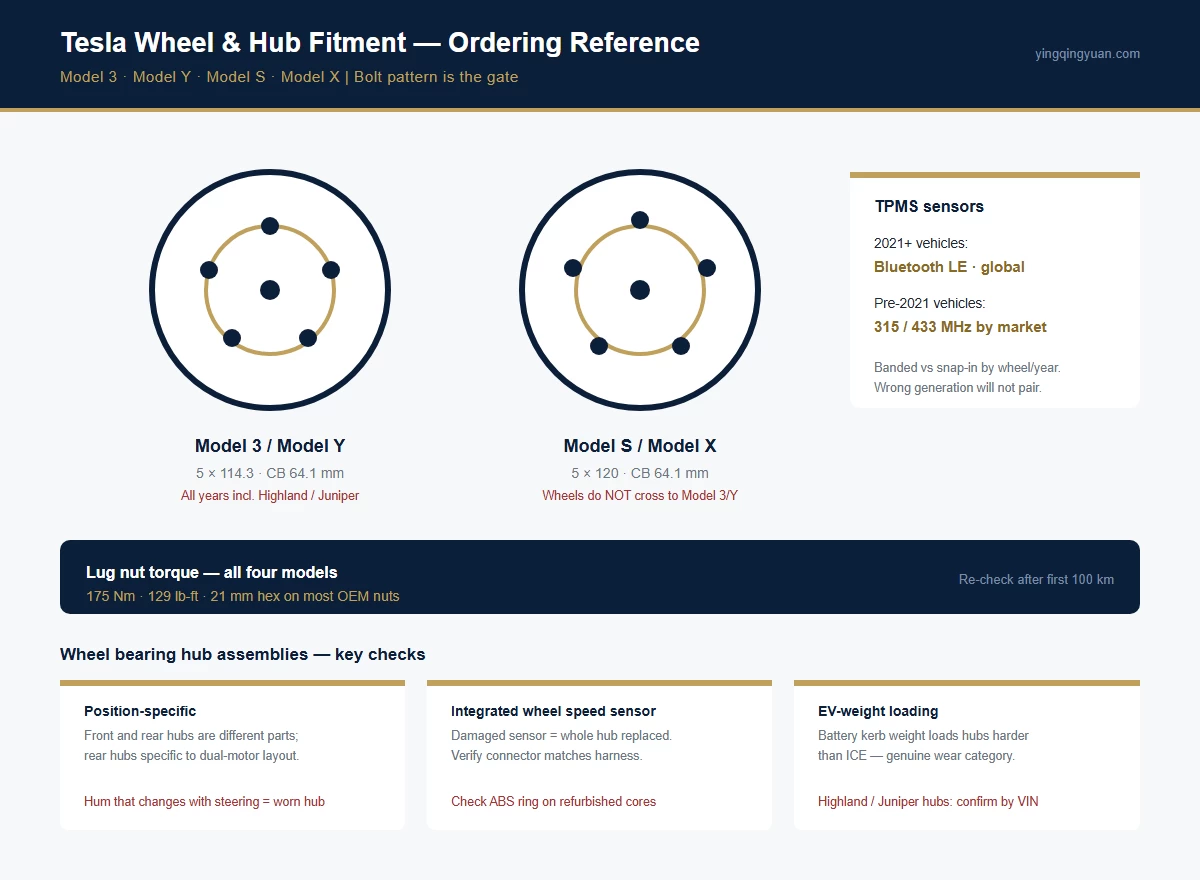
Bolt Patterns and Centre Bores — The Reference Table
| Model | Bolt pattern | Centre bore | Notes |
|---|---|---|---|
| Model 3 | 5 × 114.3 | 64.1 mm | All years and trims including Highland |
| Model Y | 5 × 114.3 | 64.1 mm | All years and trims including Juniper |
| Model S | 5 × 120 | 64.1 mm | Original and Palladium refresh |
| Model X | 5 × 120 | 64.1 mm | Confirm wheel load rating for the heavier vehicle |
The trap is obvious once stated: a wheel that fits Model 3 and Model Y will not bolt to a Model S or Model X, and vice versa. Cross-model listings for "Tesla wheels" should always be checked against the pattern above. Centre bore is consistent at 64.1 mm, so hub-centric rings are not needed between Tesla models — the bolt pattern is the gate.
Lug Nut Torque and Hardware
- Wheel nut torque on Model 3, Y, S and X is 175 Nm (129 lb-ft) — consistent across the current range.
- Tesla wheels use a 21 mm hex socket on most OEM nuts; aftermarket wheels may ship with different hardware.
- Aero wheel covers are not wheels. Many "wheel" orders for Model 3 and Model Y are actually cover and cap sets — confirm which the customer needs.
- Torque should be verified after the first 100 km on any newly installed wheel, particularly on staggered Performance setups.
Tire Sizes and Staggered Setups
Tesla uses a wider range of tire sizes than a single model badge suggests, and dual-motor Performance cars often run staggered setups — wider rear tires with a different part number. Common fitments include 18–20 inch on Model 3, 19–21 inch on Model Y, and 19–22 inch on Model S and X. What matters for parts buyers:
- Tires are size-and-position specific. A staggered car needs its rear size, not the front size.
- Load ratings are EV-critical. The vehicle's kerb weight means the load index must match or exceed OEM spec — it is not a free choice.
- Rolling resistance affects range. Customers notice; low-RR tires are worth stocking alongside standard.
TPMS Sensors — Three Generations, One Check
Every Tesla wheel takes a tire pressure sensor, and the sensors are not interchangeable across generations:
| Generation | Technology | Consequence |
|---|---|---|
| 2021+ vehicles (Model 3/Y and refresh S/X) | Bluetooth LE (BLE) sensors | Globally identical — no market split, but a BLE sensor will not pair with an older car |
| Pre-2021 vehicles | RF sensors at market frequencies | North America 315 MHz; Europe/Asia 433 MHz — wrong frequency will not register |
Also confirm the sensor type — banded versus snap-in configurations vary by wheel and year, and a complete set of four is the sensible order unit. A mismatched sensor is usually only discovered once the car is on the lift, which is exactly the conversation a distributor wants to avoid.
Wheel Bearing Hub Assemblies
Hub bearings are the core mechanical part in this category and a genuine Tesla wear item — the vehicle weight loads them harder than an ICE equivalent. Key sourcing points:
- Hubs differ by drivetrain position. Front and rear hub assemblies are different parts, and on dual-motor cars the rear hubs are specific to the driven rear axle layout.
- Hub assemblies usually integrate the wheel speed sensor. A damaged sensor can mean replacing the whole hub — order accordingly and check the connector matches the harness.
- ABS ring condition matters on cores — for anyone buying refurbished hubs, the tone ring and sensor surface are the inspection points.
- Refresh generations changed parts. Highland and Juniper hubs are not automatically interchangeable with earlier units; confirm by VIN.
The classic symptom of a worn hub is a hum that changes with steering load — diagonally quieter one way, louder the other. It is one of the most common "mystery noises" a Tesla workshop diagnoses.
OEM vs Aftermarket for Wheels, Hubs and Sensors
| Route | Best for | Watch for |
|---|---|---|
| New OEM wheels | Insurance repairs, matching factory finish | Cost; long lead time on staggered sizes |
| Aftermarket wheels | Upgrades, winter sets, fleet replacement | Verify load rating, offset (ET) and 64.1 mm bore; quality varies widely |
| Aftermarket hub assemblies | Out-of-warranty service work | Sealed-unit quality varies; verify sensor connector compatibility |
| TPMS sensors (programmable) | Multi-market distributors | Programmable sensors reduce the frequency-split problem to one SKU family |
8 Things to Confirm Before Ordering
- Model and generation — bolt pattern follows the model family, not the badge year.
- Bolt pattern and centre bore — 5×114.3 for Model 3/Y, 5×120 for Model S/X.
- Wheel or cover — Model 3/Y aero covers are often what the customer actually wants.
- Staggered setup — position-specific sizes on Performance cars.
- Tire size and load index — must match OEM or exceed it.
- TPMS generation and type — 2021+ cars use Bluetooth LE sensors; pre-2021 cars use 315/433 MHz RF by market. Banded vs snap-in by wheel.
- Hub position and sensor integration — front/rear differ; sensor connector must match.
- Lug hardware — socket size, nut style and torque spec for aftermarket wheels.
Frequently Asked Questions
Do all Teslas have the same bolt pattern?
No. Model 3 and Model Y use 5×114.3; Model S and Model X use 5×120. Wheels do not cross between these two groups. Centre bore is 64.1 mm on all four models.
What is the lug nut torque on a Tesla?
175 Nm (129 lb-ft) across Model 3, Y, S and X. Use a torque wrench, and re-check after the first 100 km on new wheels.
Are Tesla TPMS sensors interchangeable between the US and Europe?
For 2021 and newer vehicles, yes — those cars use Bluetooth LE sensors that are identical worldwide. For pre-2021 cars, no: North American vehicles use 315 MHz RF sensors and European/Asian market vehicles use 433 MHz. A sensor of the wrong type or frequency will not register with the car, so always match the sensor to the vehicle's build year first, market second.
How do I know if a Tesla wheel bearing is bad?
The typical symptom is a speed-proportional hum or droning that changes when the car sways side to side — quieter turning one direction, louder the other. Confirmation is by wheel play and by listening with a chassis ear or stethoscope on the suspected corner.
Can I reuse TPMS sensors when replacing wheels?
Usually, if the sensors are undamaged and within battery life, and the new wheels accept the same sensor type (banded vs snap-in). Given the labour involved in demounting and re-mounting tires, many shops fit new sensors with new wheels as standard practice.
Stocking and Sourcing Tesla Wheels, Tires and Hubs
This category rewards suppliers who get the reference data right. Bolt pattern, TPMS frequency and hub position are all binary pass/fail checks — the order either bolts on or it does not — which makes verified fitment information your strongest sales tool.
Browse our Tesla wheels, tires and hub range by model:
- Tesla Model 3 wheels, tires and hub parts
- Tesla Model Y wheels, tires and hub parts
- Tesla Model S wheels, tires and hub parts
- Tesla Model X wheels, tires and hub parts
Send us your VIN list and destination market, and we will confirm bolt pattern fitment, TPMS frequency and hub position before you order. One verified shipment beats three corrections.