
Tesla Parts by Market: US vs EU vs China Spec Differences (2026 Sourcing Guide)
This is the most expensive mistake in cross-border Tesla parts trade: quoting a part by model and model year, when the thing that actually decides fitment is the market the car was first sold in.
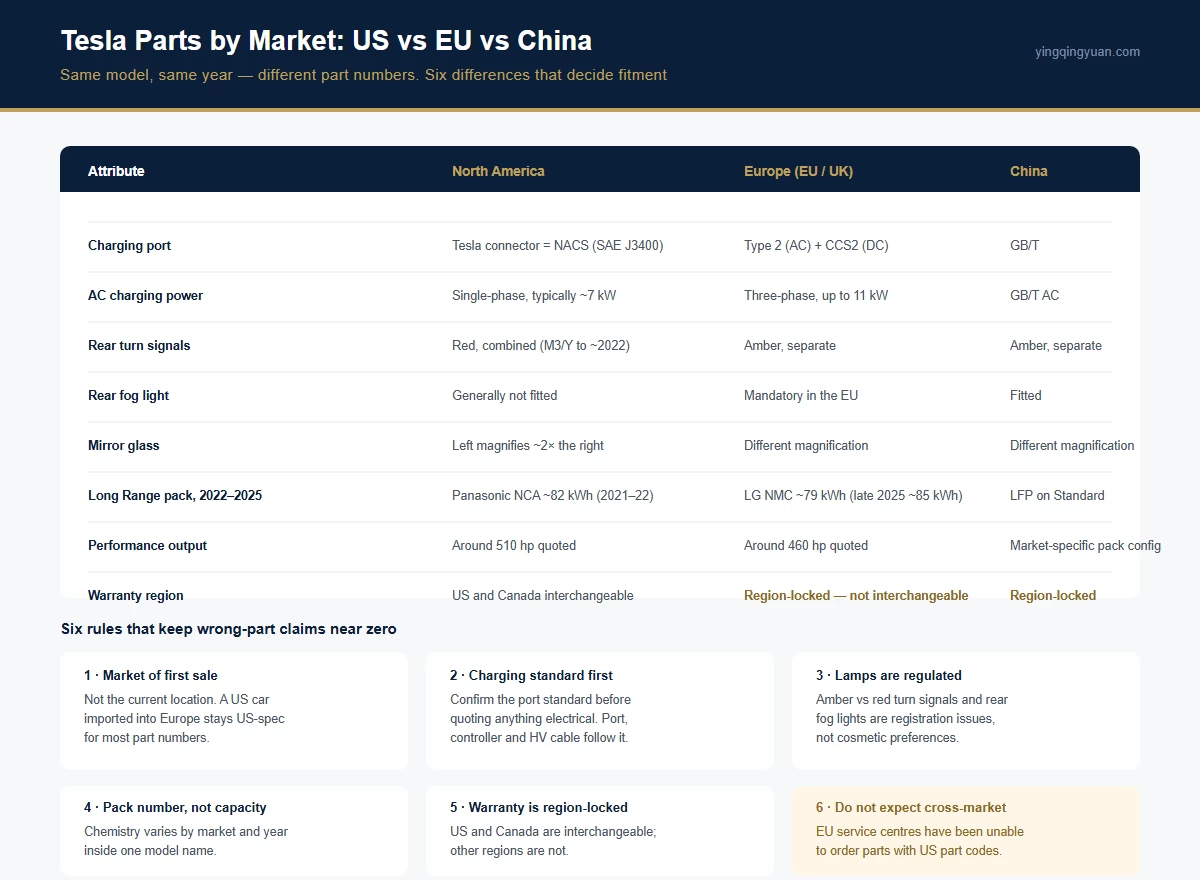
A US-spec Model 3 and an EU-spec Model 3 of the same year are, in meaningful ways, different cars. The charge port is physically different. The rear lamps are different colours. The mirror glass has different magnification. The battery chemistry is often different. Tesla's own service network cannot order US part codes through a European service centre — and if the manufacturer's system will not cross markets, a distributor's catalogue certainly will not.
This guide is written for distributors, exporters and repairers who source across borders. It covers the six differences that decide part numbers, and the practical rules that reduce wrong-part claims to near zero.
1. Charging standard: NACS, CCS2 and GB/T
The charge port is the clearest and most expensive market split, because the port, its controller and the HV cable behind it are all standard-specific.
| Market | AC charging | DC fast charging | Notes |
|---|---|---|---|
| North America (US / Canada) | Tesla connector — physically identical to NACS (SAE J3400) | Same connector | One plug for both. Single-phase AC at home, typically around 7 kW |
| Europe (EU / UK) | Type 2 (Mennekes), three-phase | CCS2 (Combo 2) | Since May 2019 Tesla has used CCS2. Three-phase AC up to 11 kW. Older pre-2020 Model S/X used a modified Type 2 for DC and are CCS2-retrofittable |
| China | GB/T | GB/T | A separate standard again — neither NACS nor CCS2 compatible |
| Japan | Type 1 (J1772) legacy | CHAdeMO legacy, now declining | Relevant for imported stock and older fleets |
What this means for parts: the charge port assembly, the charge port controller and the high-voltage cable behind the port must all be specified by market. The onboard charger arrangement differs too — European cars are built around three-phase AC infrastructure, North American cars around single-phase. It is not a plug adapter question at the component level.
2. Lighting: the most visible and most regulated difference
Lighting is where market specification becomes legally visible. A car that cannot pass inspection does not sell, and this is where exporters lose money on otherwise correct parts.
| Item | North America | Europe / China |
|---|---|---|
| Rear turn signals | Red, combined with the brake lamp on Model 3/Y built up to roughly the end of 2022 | Amber, separate |
| Rear fog light | Generally not fitted | Mandatory in the EU — some US cars have no rear fog at all |
| Adaptive / matrix high beam | Enabled later | Enabled earlier on EU cars, though the hardware is often the same |
| Headlamp unit | FMVSS-aligned beam pattern | UNECE-aligned beam pattern |
The practical consequences are concrete. A US car with red rear turn signals can be turned back at a European border during registration; owners commonly fit amber film, or replace the lamp. A US Model S imported into the EU has needed an original rear fog lamp purchased and fitted to register — a small part with a disproportionate registration cost.
For distributors, this makes rear lamp assemblies, rear fog lamps and headlamp units a market-specific line, not a universal one. Our Tesla headlight and tail light replacement guide covers the units by model.
3. Mirrors and glass
Mirror differences are subtle, cheap to get wrong, and immediately visible to the customer.
- Mirror glass magnification. On a US car, the left mirror magnifies roughly twice as much as the right and gives a narrower view. This is a known complaint, and European mirror glass is a common retrofit. Left-hand and right-hand glass are different parts, and the market changes the specification.
- Power folding. Regional content differs within the same trim. On the Model Y Standard, for example, the North American specification does not power-fold the mirrors while the European specification does — and the European car also includes FM radio where the US car does not.
- Auto-dimming. Present on some trims in some markets and absent in others; treat it as a confirmable option rather than a standard feature.
Quoting a mirror assembly therefore requires the market, the side, the trim and whether power fold and auto-dim are fitted.
4. Battery chemistry and powertrain output
This is the difference buyers least expect, and it matters most on high-value orders. Battery chemistry is determined by market and year — not by mileage, and not reliably by model name.
| Market and variant | Typical chemistry / capacity | Sourcing note |
|---|---|---|
| Europe, Long Range, 2022–2025 | LG NMC, around 79 kWh (2021 was a transition year; from late 2025 a newer LG of roughly 85 kWh) | Do not confuse with the US pack of the same model year |
| US, Long Range, 2021–2022 | Panasonic NCA, around 82 kWh | Known module imbalance risk; relevant for used pack sourcing |
| China and Europe, Standard | LFP | Different service parts and behaviour in cold weather |
| US, Standard | Varies by year — NCA until 2021, then LFP; some Texas-built Model Y AWD Standard used 4680 cells | Confirm by VIN and pack part number, never by model name |
Output figures diverge too. The same Performance variant has been quoted at roughly 460 hp in EU specification against around 510 hp in US specification, reflecting different pack configurations rather than a software setting. For drive-unit and pack-level parts, that means the part number follows the market.
Because European-market Model 3 cars have been shipped from Shanghai while Berlin has assembled Model Y packs on site, the "market" of a car and the origin of its pack are two different things. Both matter.
5. Trim content differences within the same model
The Model Y Standard is the clearest recent example of how much content varies by market inside a single trim name. The North American and European specifications differ in ways that change real part numbers:
- Lighting and exterior: the Standard deletes the full-width front light bar in favour of single-piece LED headlamps, loses adaptive high beam, and drops the full-width rear light bar. Front bumper and lamp part numbers follow.
- Mirrors and audio: the European car adds power-folding mirrors and FM radio; the US car does not.
- Filtration: the Standard does not include HEPA filtration or Bioweapon Defense Mode — a different cabin filter part than higher trims.
- Wheels: 18-inch Aperture wheels in place of the 19-inch Crossflow, with the latter optional in some markets.
- Interior: conventional headliner over the glass roof, manual second-row seat folding, no rear touchscreen, textile and vegan-leather mix seating, manual steering wheel adjustment, and a pass-through centre console instead of the extended-storage unit.
For interior and trim sourcing, our Tesla interior parts guide covers the seat, screen and console differences in detail.
6. Thermal calibration and climate specification
Thermal management thresholds are calibrated to regional climate expectations as well as to certification requirements. European documentation, for instance, describes the battery thermal management system activating cooling at around 48 °C and heating at around −7.5 °C — deliberate engineering choices tied to the market rather than universal constants.
In practice this affects HVAC part numbers, coolant specifications and control calibration. A car built for a cold market and a car built for a hot market can share a model name while differing in the thermal parts that fail most often. This is why we ask for the destination market on every HVAC order.
The rules that actually prevent wrong-part claims
Six rules, in order of importance:
| # | Rule | Why it matters |
|---|---|---|
| 1 | Ask for the market of first sale, not the current location | A car imported into Europe from the US is still a US-spec car for most part numbers |
| 2 | Confirm the charge-port standard before quoting anything electrical | Port, controller and HV cable all follow the standard |
| 3 | Treat lamps as market-specific, not model-specific | Amber vs red turn signals and rear fog lights are registration issues |
| 4 | Confirm pack part number, not just battery capacity | Chemistry varies by market and year within the same model |
| 5 | Assume warranty is region-locked | Tesla's factory warranty applies where the car was first sold; US and Canada are interchangeable, other regions are not |
| 6 | Do not rely on a service centre to cross markets | European service centres have reportedly been unable to order parts carrying US part codes |
Rule five deserves emphasis for anyone buying or selling imported cars. The warranty position is not a parts question, but it drives the economics of the whole transaction: a US car may not be accepted at a European service centre even for paid work, and cases are documented where an HV inspection was required first, or the car was refused outright. Buyers should verify the warranty region before committing to an import.
Frequently asked questions
Can I use US-spec parts on a European Tesla?
Sometimes physically, rarely safely or legally. Charging components are standard-specific and will not work. Lighting is regulated — a US car with red rear turn signals can be refused registration in Europe, and a rear fog light is mandatory in the EU. Battery and drive-unit parts follow the market too. The correct approach is to spec the part by the car's market of first sale, not by the model name.
Is NACS the same as the older Tesla connector?
Physically the same shape. Tesla's proprietary North American connector became the NACS standard, now formalised as SAE J3400. The significance is that other manufacturers have adopted the same connector, not that the shape changed for Tesla cars. European Teslas never used it — they use Type 2 and CCS2.
Why do US Teslas have red rear turn signals and European ones amber?
Different regulatory frameworks. North American rules have permitted red rear turn signals combined with the brake lamp; European rules require amber and separate. On Model 3/Y built up to roughly the end of 2022, the US cars used the combined red arrangement. It is one of the most common conversion issues when importing a US car into Europe.
Does the battery really differ by market?
Yes, and it is one of the biggest surprises for buyers. European Long Range cars in 2022–2025 typically used LG NMC packs of around 79 kWh, while US Long Range cars of 2021–2022 often used Panasonic NCA packs of around 82 kWh with a known module imbalance risk. Standard cars in China and Europe use LFP, while US Standard chemistry varies by year. Always confirm by pack part number.
Will a Tesla service centre in Europe work on a US-spec car?
Frequently not. Reports describe European service centres unable to order parts carrying US part codes, and in some cases refusing US-market cars outright — even for paid work, and sometimes requiring an HV inspection first. Warranty applies in the region of first sale: the US and Canada are interchangeable, other regions are not.
How should an exporter handle market specification?
Quote by market of first sale as the primary attribute, with model and year secondary. Require the VIN, the market of first sale and the intended use. For charging and lighting parts, treat market specification as a hard requirement rather than a preference. Our supplier vetting checklist covers the documentation you should demand from an upstream supplier on the same basis.
Which collections should I browse?
- Tesla Model 3 lighting parts and Tesla Model Y lighting parts — market-specific lamp assemblies
- Tesla Model 3 electrical parts — charge port and charging chain by standard
- Tesla Model 3 body parts — bumpers and panels that vary with trim content
Related Tesla sourcing guides
- Tesla OEM vs aftermarket parts: a 2026 sourcing guide — what the tiers actually mean for compliance and warranty
- How to vet a Tesla parts supplier: 12-point checklist
- Tesla parts packaging and international shipping — freight and documentation for cross-border orders
- Tesla electrical parts guide — the charge port standards in component detail
- Tesla Model S and Model X parts guide — market specification on a discontinued platform
- Tesla VIN decoding and part number guide — reading the plant code that indicates the market of build
Send us the VIN, the market the car was first sold in and the part you need, and we will confirm the regional specification before you order. In cross-border Tesla parts, the market is the part number — everything else is secondary.