

Tesla VIN Decoding & Part Number Guide: How to Identify the Right Part (Model 3, Y, S & X)
Every Tesla parts return we see traces back to the same root cause: someone ordered by model and year instead of by VIN. Two Model Ys built eleven months apart can carry different suspension hardware, different computers and different sensor suites — and the catalogue will happily show you the same group photo for both.
This guide covers the two skills that fix that: reading a Tesla VIN properly, and reading a Tesla part number properly. Between them they tell you which generation of the car you are actually supplying, and which revision of the part belongs on it.
Why "Model 3, 2022" Is Not Enough
Tesla does not run traditional model years with a single annual changeover. It ships running changes — sometimes several in a year — and different factories introduce them on different dates. A Shanghai-built Model Y and a Berlin-built Model Y of the same nominal year can sit on opposite sides of a hardware cut-off.
Those cut-offs decide real parts. Whether the car has ultrasonic parking sensors or camera-only park assist, whether it is on HW3 or HW4, whether the front structure is multi-piece or a single large casting, and which suspension tune it left the factory with are all VIN-decidable. Get one wrong and the part physically fits but does not work.
Reading the 17 Characters
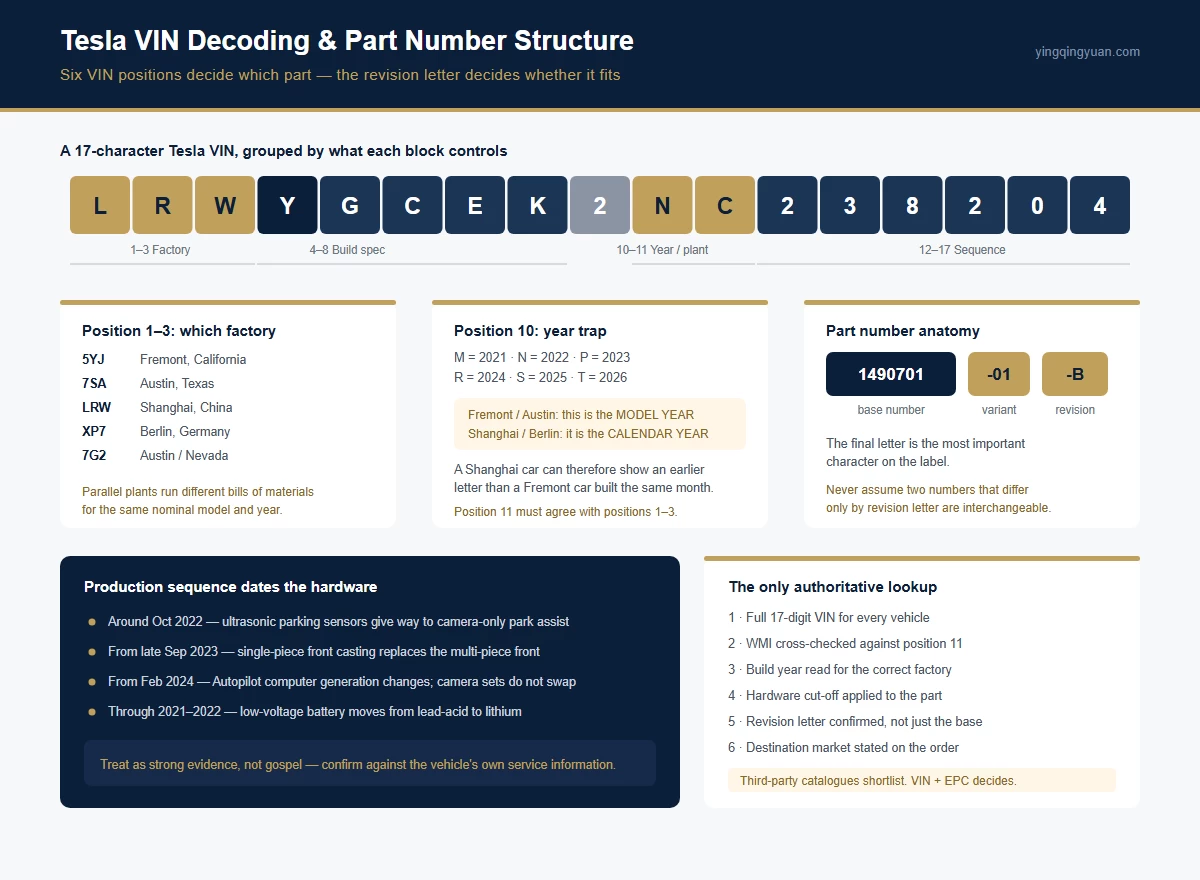
A Tesla VIN follows the ISO 3779 standard and carries six positions that matter to a parts buyer. The full breakdown, using Tesla's published service-manual tables:
| Position | Encodes | Values you will see |
|---|---|---|
| 1–3 | World Manufacturer Identifier (WMI) | 5YJ = Fremont · 7SA = Austin · LRW = Shanghai · XP7 = Berlin · 7G2 = Austin/Nevada (Cybertruck, Semi) · SFZ = UK (original Roadster) |
| 4 | Model line | 3 = Model 3 · S = Model S · X = Model X · Y = Model Y · C = Cybertruck |
| 5 | Body type / drive side | Codes differ per model line — always use the table for that model's service manual, not a generic one |
| 6 | Restraint system | Airbag and seatbelt configuration (internal codes) |
| 7 | Battery / fuel type | E = electric (or NMC on Shanghai cars) · F = LFP |
| 8 | Motor / drive unit | Codes are model-line specific. Model S/X use 5 = dual motor, 6 = tri-motor (Plaid). Model 3/Y use letter families for single, dual and Performance |
| 9 | Check digit | Mathematically derived from all other digits |
| 10 | Model year / build year | L = 2020 · M = 2021 · N = 2022 · P = 2023 · R = 2024 · S = 2025 · T = 2026 |
| 11 | Assembly plant | F = Fremont · C = Shanghai · A = Austin · B = Berlin · N = Nevada · 1 = UK |
| 12–17 | Production sequence | Six digits, sequential within the build run |
Three Traps That Cost Buyers Money
1. Position 10 means different things in different factories
On cars built at Fremont and Austin, position 10 is the model year. On cars built at Shanghai and Berlin, position 10 reflects the calendar year of manufacture. These are not the same thing, and a Shanghai car can show an earlier position-10 letter than a Fremont car built in the same month. If you are comparing two VINs for a customer and the letters differ, that is not necessarily a different model year — check the WMI first.
2. Position 11 must agree with positions 1–3
Position 11 is a redundant plant code. C must come with LRW, B with XP7, F with 5YJ, A with 7SA. A VIN where the two disagree has been re-stamped, mistyped, or copied wrongly off a document. Do not quote parts against it — ask for a photo of the door-jamb label instead.
3. The production sequence dates the hardware
The six-digit sequence number, read against Tesla's production timeline, tells you which side of a hardware change the car sits on. The cut-offs that matter most for parts:
| Change | Approximate timing | What it affects |
|---|---|---|
| Park assist hardware change (ultrasonic sensors removed in favour of camera-only) | Around October 2022 | Bumper sensors, brackets, bumper covers with and without sensor cut-outs |
| Front structure change to large single-piece casting | From late September 2023 (Shanghai) | Front-end structural parts and repair cost after a front impact |
| Autopilot computer generation change (HW3 to HW4) | From February 2024 (Shanghai) / around May 2024 (Berlin) | Camera sets, computer modules, some wiring — the two are not interchangeable |
| Low-voltage battery chemistry change (lead-acid to lithium) | Through 2021–2022, not on a clean model-year boundary | Battery, mounting, connectors |
Treat these as strong evidence, not gospel. Confirm against the vehicle's own service information before you commit stock. The point is that you can tell a customer "send the VIN" with a reason, instead of treating it as a formality.
The Anatomy of a Tesla Part Number
Tesla part numbers follow a consistent structure. Take 1490701-01-B, the BLE tyre pressure sensor:
| Segment | Meaning | Example |
|---|---|---|
| Base number (first 7 digits) | Identifies the component itself and its position in the assembly tree | 1490701 |
| Variant / version (2 digits after the dash) | Distinguishes configuration, market and internal version branches of the same base component | -01 |
| Revision letter (final letter) | Engineering revision level. The most important single character on the label | B |
The rule that matters: two part numbers that differ only in the revision letter must never be assumed interchangeable. That is not Tesla being difficult for the sake of it. A revision letter changes when the part itself changed — material, geometry, supplier, or the software it has to talk to.
A live example from 2026 makes the point. Tesla Model Y L rear suspension springs have been recorded in repair documents as 2188477-00-B, while earlier builds used the same base number ending in -00-A. Same base, different revision, different build standard. A distributor quoting the -00-A number against a later car is quoting a part that may not meet the specification the car was built to.
Why the Same Component Has Several Part Numbers
Buyers new to Tesla often read multiple part numbers for "the same" component as a data problem. It is not — it is a deliberate design outcome. Five causes, in rough order of how often they bite:
- Build year and running changes. Tesla does not wait for a model year to change a part.
- Refresh milestones. Highland (Model 3) and Juniper (Model Y) refreshed large portions of the car, and many parts do not cross the boundary.
- Hardware and software changed together. When a component has to be recognised by the car's software, the part number and the software version move as a pair.
- Parallel production plants. Shanghai, Berlin, Fremont and Austin do not always run identical bills of materials for the same nominally identical car.
- Market and country differences. This is the one B2B buyers most often underestimate — see below.
Why a part number changes by market
A car sold in the Gulf, a car sold in Germany and a car sold in China can carry different part numbers for the same visible component, because the part has to satisfy different regulation, climate and homologation requirements. Lighting, restraint systems, charging hardware, emissions-adjacent components and labelling all diverge. When a customer sends a VIN, the VIN gives you the market context as well as the build context — which is exactly why it is worth asking for.
Three Ways to Find a Part Number — and What Each Is Worth
| Method | What it is good for | Authority level |
|---|---|---|
| VIN + official electronic parts catalogue (EPC) | Arriving at the correct number for a specific car | Authoritative — the only method that resolves build-specific and market-specific branches |
| Physical label on the old part or its packaging | Replacing a part you already have in hand; reverse-matching an installed component | Confirms, does not decide — the fitted part may itself have been superseded |
| Third-party catalogues, PDFs and spreadsheets | Finding the category quickly, understanding how an assembly is built up, shortlisting candidates | Directional only — never the basis for a final ordering decision |
Used in that order, the three methods complement each other. Used in reverse — picking a number off a PDF and hoping — they are how wrong parts get shipped.
Pre-Order Confirmation Checklist
- Full 17-digit VIN for every vehicle line on the order, not a sample. Mixed orders need mixed confirmation.
- WMI checked against position 11 to catch re-stamped or mistyped VINs early.
- Build year read correctly for the factory — model year vs calendar year depending on WMI.
- Hardware cut-off checked for sensor, computer and structure changes that affect the part.
- Revision letter confirmed on every part number, not just the base number.
- Destination market stated so market-specific branches can be resolved.
- Left- or right-hand drive confirmed where the component is handed.
- Old part label photographed where the customer is replacing an existing component — it resolves ambiguity faster than anything else.
Frequently Asked Questions
Can I identify a Tesla's exact specification from the VIN alone?
Almost. The VIN reliably gives you the factory, model line, drive configuration, battery chemistry family, build year and production sequence, and from the sequence you can place many hardware cut-offs. What the VIN cannot always tell you is software-dependent features — paid software upgrades and subscription features in particular may not be visible from the VIN. For those, the vehicle's own screen or the owner's account is the reference.
Are different revision letters of the same part interchangeable?
Do not assume so. A revision change means something about the part changed. Sometimes the later revision supersedes the earlier one and fits both. Sometimes it does not. This has to be confirmed per part number, not generalised.
Why does the same part have a different number for a different country?
Market-specific regulation, homologation, climate and equipment requirements. Charging hardware, lighting and restraint components are the clearest examples. A VIN carries the market context, which is why a VIN-based lookup is the only one that resolves it.
Is a third-party Tesla parts catalogue reliable enough to order from?
For narrowing down a category and understanding an assembly, yes. For a final order decision, no. Third-party data goes stale fastest exactly where it matters most — revision letters and running changes.
What is the single most useful thing a customer can send?
The full VIN, plus a photograph of the label on the part being replaced if there is one. Those two together resolve the large majority of fitment questions before an order is placed.
Continue Reading
- How to check Tesla aftermarket part fitment — the practical VIN and build-date checks for any order
- Tesla Model 3 and Model Y parts fitment checklist — the model-specific version of the same workflow
- Tesla OEM vs aftermarket parts: a 2026 sourcing guide — what the revision-letter discipline means for sourcing decisions
- Tesla parts packaging and international shipping — freight and documentation once the part is confirmed
Send us the VIN list for your order and we will decode each car, confirm the hardware generation and quote the correct revision number before you commit stock. It takes one message and it removes the most expensive error in this business.