
Tesla Brake Parts Guide: Pads, Rotors, Calipers & Rotor Sizes (Model 3, Y, S & X)
Tesla brakes behave nothing like the brakes on a combustion car. Regenerative braking does most of the slowing, which means friction pads can last well over 100,000 km — but it also means the rotors sit unused for long stretches and corrode. The result is a parts demand profile that surprises buyers who are new to EV service: fewer pad replacements than expected, more rotor and hardware replacement than expected.
This guide covers what professional buyers should confirm when sourcing Tesla brake parts for Model 3, Model Y, Model S and Model X — rotor dimensions by model, pad compound selection, the electric parking brake trap, and the small hardware items that stop a brake job from being completed.
Why Tesla Brakes Wear Differently
On a conventional car, the friction brakes do all the work and wear predictably. On a Tesla, the drive motors handle the majority of deceleration through regeneration, and the friction brakes only engage for harder stops, low-speed final stopping and emergency braking.
Two consequences follow, and both affect what you should stock:
- Pads last a very long time. Low annual mileage cars may go years without a pad change. Demand exists, but it is not the high-turnover consumable it is on ICE vehicles.
- Rotors corrode and pit. Friction surfaces that rarely get used develop surface rust, then pitting and uneven deposits. This produces vibration, noise and reduced braking performance — and the fix is usually rotor replacement, not resurfacing.
Stock accordingly: for a Tesla-focused catalogue, rotor and hardware coverage matters at least as much as pad coverage.
Rotor Sizes by Model — The Table to Order From
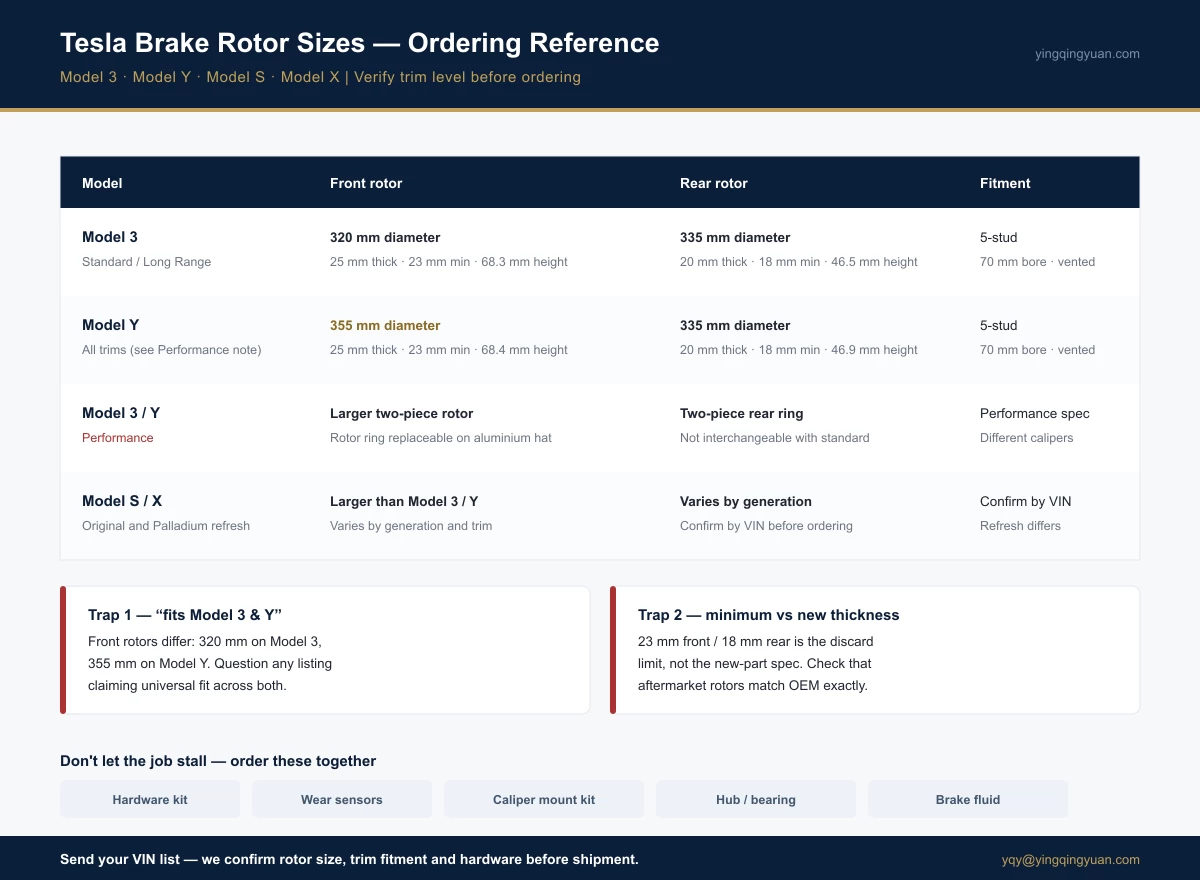
Rotor dimensions are not interchangeable between models. These are the reference figures to check a listing against before you buy.
| Model | Front Rotor | Rear Rotor | Fitment |
|---|---|---|---|
| Model 3 (standard / Long Range) | 320 mm dia, 25 mm thick (23 mm min), 68.3 mm height | 335 mm dia, 20 mm thick (18 mm min), 46.5 mm height | 5-stud, 70 mm centre bore, vented |
| Model Y | 355 mm dia, 25 mm thick (23 mm min), 68.4 mm height | 335 mm dia, 20 mm thick (18 mm min), 46.9 mm height | 5-stud, 70 mm centre bore, vented |
| Model 3 Performance | Larger two-piece rotor with separate rotor ring | Two-piece rear rotor ring | Performance-specific; rings sold separately |
| Model S / Model X | Larger diameter than Model 3/Y; varies by generation and trim | Varies by generation and trim | Confirm by VIN; refresh models differ from earlier cars |
Two traps to note. First, the front rotor is smaller on Model 3 than on Model Y — 320 mm versus 355 mm — so a "Model 3/Y brake rotor" listing that claims universal fit across both models should be questioned. Second, minimum thickness (23 mm front, 18 mm rear) is the discard limit, not the new-part specification. Buyers comparing aftermarket rotors should check that the new-part thickness matches the OEM figure exactly.
Pads: What Actually Matters on an EV
Because Tesla brakes see less heat cycling than ICE brakes, pad selection leans toward different priorities than a performance car.
- Ceramic compounds are common for daily-driven Teslas: quieter, lower dust, gentle on rotors. A sensible default for road use and a good stocking choice for distributors serving repair shops.
- Semi-metallic compounds offer stronger initial bite and better fade resistance under repeated hard use, at the cost of more dust and rotor wear. Relevant for track use and some Performance applications.
- EV-specific formulations are marketed heavily but should be evaluated on the same criteria as any other pad: friction rating, temperature range, dust characteristics and rotor compatibility.
Pads are sold per axle, and front and rear pads are different parts. Confirm that any listing states axle position explicitly.
Calipers and the Electric Parking Brake Trap
Rear calipers on Tesla vehicles integrate an electric parking brake. This is the detail that most often turns a straightforward brake order into a technical support conversation:
- Rear calipers are not a simple mechanical replacement. The parking brake function is electrically actuated, and service procedures require the system to be put into a specific mode before the caliper is retracted or removed.
- Connector type and actuator configuration can differ between generations and trims, even on the same model.
- Buyers should specify whether they need a bare caliper, a caliper with actuator, or a complete corner assembly.
Front calipers are mechanically conventional, but Performance models use different calipers — often with distinguishing paint finishes — and are not interchangeable with standard-trim parts.
Performance vs Standard Brakes Are Not Interchangeable
Performance variants of Model 3 and Model Y use larger, often two-piece rotors and different calipers. The rotors on Performance models can be serviced as a rotor ring on a reusable aluminium hat, which is a distinct part from a one-piece rotor.
For suppliers, this creates two separate SKU families under the same model name. For buyers, it means "Tesla Model 3 brake rotors" is an incomplete specification — trim level must be included.
The Parts That Get Forgotten
A brake job that arrives 90 percent complete still stops the shop. Include these in the quotation:
- Brake hardware kit — anti-rattle clips, shims, abutment hardware
- Pad wear sensors where fitted
- Caliper mounting bolts and slide pins
- Brake caliper mounting kits — commonly sold separately from the caliper itself
- Rotor retaining screws
- Brake fluid to the correct specification
- Wheel bearing hub assemblies — frequently replaced at the same time as rotors on higher-mileage cars
That last item is a cross-sell worth building into your catalogue: hub and bearing work and brake work naturally overlap, and a supplier who carries both saves the shop a second order.
OEM vs Aftermarket for Brake Parts
Brakes are a safety-critical, well-standardised category where quality aftermarket supply is genuinely competitive — but the bar is high.
| Route | Best For | Watch For |
|---|---|---|
| New OEM | Warranty-sensitive repairs, late-model vehicles | Highest cost; longest lead time |
| Aftermarket (quality brand) | High-volume service work, distributors, fleet maintenance | Must match rotor dimensions and thickness exactly; verify friction rating |
| Used OEM | Rarely appropriate for friction parts | Rotors and pads are wear items — avoid used friction components |
A useful rule for buyers: aftermarket is a strong choice for rotors, pads and hardware, provided specifications are documented. For calipers with integrated parking brake actuators and for ADAS-adjacent electronic components, verified OEM-grade supply is the safer route.
8 Things to Confirm Before Ordering
- VIN and trim level. Standard, Long Range and Performance take different brake parts.
- Axle position. Front and rear rotors and pads are different parts.
- Rotor dimensions. Diameter, thickness, minimum thickness, height and centre bore.
- Rotor construction. One-piece or two-piece with a replaceable ring.
- Caliper configuration. Bare caliper, with actuator, or complete corner.
- Electric parking brake compatibility. Rear calipers must match the vehicle's EPB system.
- Hardware kit inclusion. Confirm whether clips, shims and bolts are included.
- Wear sensors and hub assemblies. Order the adjacent parts in the same shipment.
Frequently Asked Questions
How often do Tesla brake pads need replacing?
Because regenerative braking does most of the deceleration, pads commonly last well over 100,000 km and sometimes the life of the vehicle. Rotor corrosion, not pad wear, is usually the reason a Tesla needs brake work.
Why do my Tesla brakes squeal or vibrate?
On low-use friction brakes, the most common causes are surface corrosion, uneven pad deposits on the rotor, and sticking slide pins or hardware. In many cases the remedy is rotor and hardware replacement rather than a pad change.
Are Model 3 and Model Y brake rotors the same?
No. Model 3 uses a 320 mm front rotor while Model Y uses 355 mm. Rear rotors are both 335 mm. Always verify against the model and trim, not a combined listing.
Can I replace Tesla rear brake pads myself?
The pads themselves are accessible, but rear calipers integrate an electric parking brake that requires the system to be placed in a service mode before retraction. Attempting to force the caliper without following the procedure risks damaging the actuator.
Do Tesla brake parts need coding after replacement?
Mechanical brake components generally do not require coding. However, if the repair involves systems tied to the vehicle's electronics — parking brake actuators or sensors — a service-mode routine may be required. Confirm the procedure for the specific model before quoting labour.
Stocking and Sourcing Tesla Brake Parts
Brakes are a maintenance staple for any workshop serving Tesla vehicles, and a category where getting the specification right matters more than getting the lowest unit price. Rotor dimensions, trim level and parking brake configuration have to match — every time.
Browse our Tesla brake range by model:
- Tesla Model 3 brake parts — pads, rotors, calipers and hardware
- Tesla Model Y brake parts — including Performance-spec components
- Tesla Model S brake parts
- Tesla Model X brake parts
Send us your VIN list or OEM part numbers and we will confirm rotor dimensions, trim fitment and the matching hardware kit before you order. One verified shipment beats three corrections.