
Tesla Winter Prep Guide: Cold-Weather Parts Checklist (Model 3, Y, S & X)
Every autumn the same orders arrive, and every autumn the same returns follow them. Winter is the season when Tesla parts buyers get caught out most often — not because the parts are unusual, but because cold weather exposes exactly the generation splits that a model name hides.
A heat pump car and a PTC heater car of the same model year need different HVAC parts. A 2021 car needs Bluetooth TPMS sensors for its winter wheel set; a 2019 car needs 433 MHz ones. A winter wheel package that fits a Model Y Standard may not clear the brakes on a Performance.
This guide walks through the six systems that actually need attention before winter, what changes between generations, and what to confirm before you order — for Model 3, Model Y, Model S and Model X.
Why winter orders go wrong: the four splits that matter
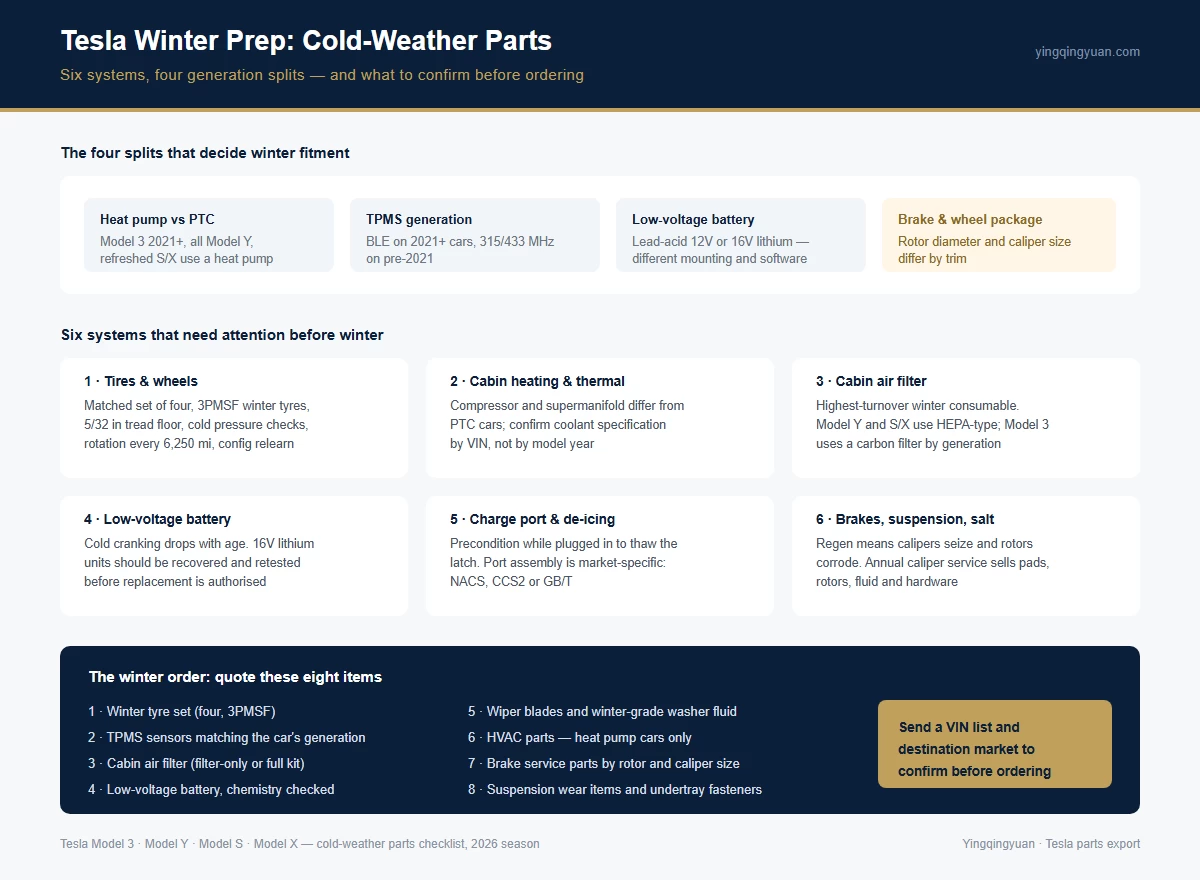
Before looking at individual parts, understand the four generation splits that decide winter fitment. Every ordering mistake in this category traces back to one of them.
| Split | What changes | Parts affected |
|---|---|---|
| Heat pump vs PTC heater | Model 3 from 2021, all Model Y (including Juniper), refreshed Model S/X from 2021 use a heat pump. Earlier Model 3 (2017–2020) and pre-refresh Model S/X use a resistive PTC heater. | Compressor, supermanifold/Octovalve, coolant lines, cabin heater assembly, coolant type |
| TPMS generation | 2021+ cars use Bluetooth (BLE) sensors. Pre-2021 cars use radio-frequency sensors in 315 MHz or 433 MHz market variants. | Winter wheel set sensors, valve stems, receiver modules |
| Low-voltage battery chemistry | Lead-acid 12V on earlier builds; 16V lithium-ion on later builds from 2021–2022. | Low-voltage battery, mounting bracket, terminal harness |
| Brake and wheel package | Standard, Long Range and Performance cars use different rotor diameters, caliper sizes and factory wheel offsets. | Wheels, tires, brake pads and rotors, wheel covers |
None of these track the model year cleanly, and none of them can be inferred from the model name alone. A VIN check settles all four.
Tires and wheels come first
Tesla's own position is direct: if the car will be driven in cold temperatures or where snow and ice may be present, winter tires are recommended, and summer or all-season tires do not provide adequate traction in those conditions. Performance summer compounds lose grip below roughly 40 °F (4 °C), snow or not — which means the advice applies well beyond the snow belt.
What to get right on a winter wheel set
- Four tires, matched set. Tesla specifies a complete set of four at the same time, with the same diameter, brand, construction and tread pattern on all four wheels. Look for the three-peak mountain snowflake (3PMSF) symbol, not just the word "winter".
- TPMS sensors by generation. BLE sensors for 2021+ cars, 315/433 MHz for pre-2021. This is the single most common mistake on winter wheel packages — the wheels fit, the car cannot read the sensors, and the customer blames the wheels.
- Calipers and offsets. A wheel that clears a Standard brake package may not clear a Performance caliper. Confirm rotor diameter and factory offset before shipping a set.
- Configuration update. After fitting winter tires, the tire configuration has to be updated in the vehicle (Service > Wheel & Tire > Tires). This lets the car relearn faster — aggressive winter tires can temporarily reduce regenerative braking until it does. Reset the configuration again when the set comes off.
Pressure, tread and torque
Tire pressure falls as ambient temperature drops — roughly one psi for every 10 °F. Pressures must be checked when the tires are cold, against the door-pillar label rather than a generic figure. The commonly cited working limits:
| Item | Working figure | Note |
|---|---|---|
| Tread depth floor | 5/32 in (4 mm) for snow and slush | Below this, winter performance drops sharply |
| Pair matching | Replace or match when tread difference reaches 2/32 in | Tesla's rotation guidance uses the same threshold |
| Rotation interval | Every 6,250 miles (10,000 km) | Staggered setups cannot be rotated front to back |
| Lug nut torque | 129 lb-ft (175 Nm) on Model 3 and Model Y | Confirm the figure for your specific S/X platform and year |
| Tire age | Replace at six years regardless of tread | Relevant for imported used cars that sat in storage |
Related reading: our Tesla wheels, tires and hub bearings guide covers bolt patterns, centre bores and hub assemblies in full.
Cabin heating and thermal parts
This is where the heat pump split bites hardest, and where winter demand is highest.
Cars with a heat pump (Model 3 from 2021, all Model Y, refreshed Model S/X) move heat rather than generating it, which is why they lose noticeably less range in the cold than PTC cars. That efficiency comes from a more complex assembly: the compressor, the supermanifold (often called the Octovalve on newer cars), the coolant circuits and the refrigerant charge all differ from the earlier resistive design.
Practically, this means:
- Compressor and manifold parts are not interchangeable between heat pump and PTC cars, even within the same model name.
- Coolant specification matters. Tesla moved to newer-generation coolant formulations on later cars; mixing or substituting causes long-term damage to the thermal system. Confirm by VIN.
- PTC cars are a different, simpler parts list. If you are stocking for 2017–2020 Model 3 or pre-refresh Model S/X, the winter HVAC demand sits in the heater assembly and its associated components, not the heat pump chain.
Cabin air filter
Cabin air filters are the highest-turnover winter consumable and an easy attach item for any order. Model Y and Model S/X use HEPA-type filtration on most trims; Model 3 uses a standard carbon filter, with the exact part varying by generation. Winter matters because salt dust, road grit and moisture load the filter faster, and a clogged filter fogs the cabin more readily. Model Y filter kits are available as a filter-only item or as a full kit with the associated hardware.
Wipers and washer fluid
Wiper blades should be replaced before the first freeze, and washer fluid must be rated for local winter temperatures — summer fluid freezes in the lines and can crack the reservoir. Wiper Service Mode should be used to park the blades away from the glass before defrosting, so frozen blades are not dragged across the windscreen.
Related reading: our Tesla cooling and HVAC parts guide covers the heat pump, compressor and condenser in detail.
Low-voltage battery and cold-start behaviour
Cold reduces the usable capacity of any battery chemistry, and the low-voltage battery is the one that strands cars. The chemistry split matters here as much as anywhere:
- 16V lithium-ion (later builds). More capacity and better cold behaviour than lead-acid, but Tesla's service position is that a low or suspect unit should be recovered and retested before it is condemned — so workshops order fewer of these than expected.
- Lead-acid 12V (earlier builds). Conventional group sizes and terminal layouts, but cold cranking performance drops sharply with age. This is the classic winter failure.
- Conversion caveat. When a car is switched between chemistries, the vehicle software must support it. Supplying the correct part to a car on older firmware still produces a fault.
A battery maintainer or a scheduled top-up is worth recommending to any customer who parks outdoors. For a deeper look at the low-voltage and charge-port chain, see our Tesla electrical parts guide.
Charge port, ice and the winter charging chain
A frozen charge port is the most common winter complaint that is not a parts failure at all — but it does sell parts, and knowing the difference protects your reputation.
- Precondition while plugged in. Warming the cabin and pack on grid power costs nothing from the battery and, importantly, preconditioning thaws ice around the charge-port latch.
- Defrost first, never force. Use the vehicle's defrost function and allow time for ice to release. Prying a frozen handle or port damages paint and mechanism. Hot water on the port is not the answer either.
- Snow and ice on the latch. If the connector will not release or lock, the latch mechanism and its actuator are the parts to inspect. Charge-port assemblies are market-specific — NACS in North America, CCS2 in Europe, GB/T in China — so the port, controller and HV cable behind it must be specified by destination market.
- Cold charging is slower. Expect reduced regenerative braking, reduced acceleration and slower charging until the pack warms. This is normal behaviour, not a fault.
Brakes, suspension and road salt
Regenerative braking means Tesla friction brakes are used far less than on a combustion car — and that is exactly why road salt causes trouble. Calipers that rarely actuate seize, and rotors that rarely get wiped develop surface corrosion.
- Annual brake service. Tesla recommends cleaning and lubricating brake calipers in cold-weather markets. This is a service item that sells pads, rotors, caliper hardware and brake fluid.
- Rotor and pad sizes vary by trim. Performance packages use larger rotors and different calipers. See our Tesla brake parts guide for sizes by model.
- Suspension bushings stiffen in the cold. Aged control-arm bushings and ball joints that feel acceptable in summer often become noisy in winter. Our suspension and steering parts guide covers the common wear points.
- Model S/X air suspension. Cold weather exposes compressor and valve-block wear on air-sprung cars. Ride height faults in winter are usually the compressor or a leaking strut, not the control module.
- Underbody hardware. Undertrays, splash shields and their fasteners corrode and seize. Order clips and fasteners with the panel, not after the fact.
The eight-point winter parts checklist
Use this as a quoting template. It covers the highest-turnover winter items and the questions that prevent returns.
| # | Item | Confirm before ordering |
|---|---|---|
| 1 | Winter tires (set of four) | Factory wheel size, brake package, 3PMSF rating |
| 2 | TPMS sensors for the winter set | BLE (2021+) or 315/433 MHz (pre-2021) |
| 3 | Cabin air filter | Model, trim and whether it is a filter-only or full kit |
| 4 | Low-voltage battery | Lead-acid or 16V lithium; software support if converting |
| 5 | Wiper blades and winter washer fluid | Blade length and arm type by model |
| 6 | HVAC parts (heat pump cars) | Heat pump vs PTC; coolant specification |
| 7 | Brake service parts | Rotor diameter and caliper type by trim |
| 8 | Suspension wear items | Generation; air suspension vs coil on S/X |
Frequently asked questions
Do I really need winter tires on a Tesla?
Tesla's guidance is that winter tires are recommended whenever the car is driven in cold temperatures or where snow and ice may be present, and that summer and all-season tires do not provide adequate traction in those conditions. Performance summer compounds lose grip below roughly 40 °F. If your market sees sustained cold, a dedicated winter set is the correct recommendation — and it is also a repeat parts sale every season.
Why can't I reuse the TPMS sensors from my summer wheels?
You can, if the sensors match the car's generation. The problem is mixing generations: a 2021+ car uses Bluetooth sensors and cannot read the older 315/433 MHz units. When you sell a winter wheel package for a 2021+ car, specify BLE sensors or the customer will return the set.
Is a heat pump car better in winter?
Yes, meaningfully. A heat pump moves heat instead of generating it, so it draws far less energy from the pack to warm the cabin. Model 3 from 2021, all Model Y and refreshed Model S/X have heat pumps. Earlier cars use resistive PTC heaters, which are simpler but less efficient — and use a different parts list.
Why does my Tesla charge more slowly in the cold?
A cold pack accepts charge more slowly, and the car may also limit regenerative braking and acceleration until it warms. Preconditioning while plugged in reduces this by warming the pack on grid power. It is normal behaviour rather than a component failure.
Does cold weather damage the battery pack?
Cold reduces usable range and charging speed but does not by itself destroy the pack; the battery management system protects it. Prolonged storage at very low state of charge is the bigger long-term risk — which is why imported cars that sat for months at low charge deserve extra scrutiny.
What should be in a winter service quote for a Tesla?
At minimum: winter tire package with correct sensors, cabin filter, wiper blades and winter washer fluid, a low-voltage battery health check, brake caliper service, and an inspection of suspension bushings and undertray fasteners. Add HVAC parts only if the car is a heat pump model and there is an actual fault — this is a maintenance quote, not a repair quote.
Do you supply winter parts for imported cars?
Yes, and market specification is the first thing we confirm, because an imported car may combine a North American powertrain with European lighting and a different charge-port standard. Send the VIN and the market the car was first sold in, and we will confirm the charge-port standard and thermal parts before quoting. See our OEM vs aftermarket sourcing guide for how market specification affects what you can legally and safely fit.
Which collections should I browse?
Start with the collection for your model:
- Tesla Model 3 wheels, tires and hub parts and Tesla Model Y wheels, tires and hub parts
- Tesla Model 3 cooling and HVAC parts and Tesla Model Y cooling and HVAC parts
- Tesla Model 3 electrical parts
- Tesla Model 3 brake parts
Related Tesla parts guides
- Tesla Model 3 and Model Y parts fitment checklist — the pre-order checks that prevent winter returns
- Tesla VIN decoding and part number guide — how to settle heat pump, TPMS and battery splits from the VIN
- Tesla cooling and HVAC parts guide
- Tesla wheels, tires and hub bearings guide
- Wholesale Tesla replacement parts: what buyers should confirm — for distributors building a seasonal line
Send us your VIN list, the destination market and the lowest winter temperature you expect, and we will confirm the tire package, TPMS generation, cabin filter and thermal parts before you order. Winter is a short window — one confirmed order beats a returned set in January.