
Tesla Model 3 and Model Y Parts Fitment Checklist
The Model 3 and Model Y are the two highest-volume Teslas on the road — which makes them the two most important part numbers on any buyer's list. They also share enough DNA that buyers assume parts interchange freely. They don't.
A bumper that fits a 2022 Model 3 will not fit a 2024 Model 3 Highland. A taillight from a 2023 Model Y won't fit a 2025 Model Y Juniper. And within each generation, Tesla makes quiet running changes that catch out even experienced buyers.
Whether you're stocking a workshop, quoting a repair, or placing a wholesale order, this checklist is the fastest way to confirm Model 3 and Model Y parts fitment before money changes hands.
First: Know the Generations
Every Model 3 and Model Y fitment question starts with one thing: which generation is the vehicle? The facelifts changed so much that many parts are simply not interchangeable across the split.
Model 3 Generations
| Generation | Build period | What changed |
|---|---|---|
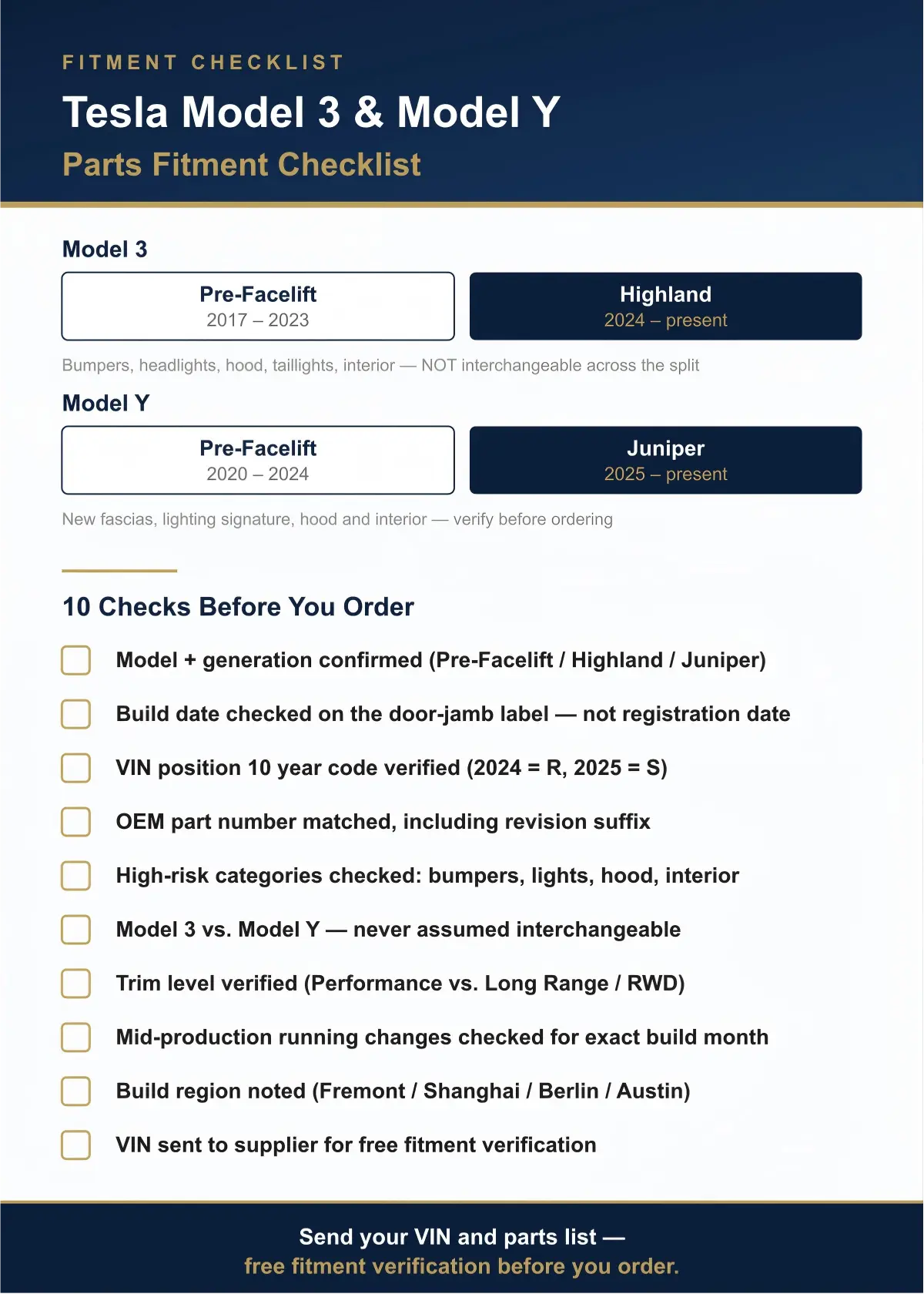
| Pre-Facelift | 2017 – 2023 | Original design. Several mid-cycle changes, including console and trim updates. |
| Highland | 2024 – present | New front/rear bumpers, headlights, hood, taillight bar, and a redesigned interior. |
Model Y Generations
| Generation | Build period | What changed |
|---|---|---|
| Pre-Facelift | 2020 – 2024 | Original design. Running changes include console revisions and charge port door updates. |
| Juniper | 2025 – present | New front/rear fascias, lighting signature, hood, and interior updates. |
Important: Use the build date, not the registration date. A car registered in early 2024 may have been built in late 2023 — which puts it on the wrong side of a split. Check the certification label on the driver's side door jamb.
The 10-Point Fitment Checklist
1. Confirm model and generation first
Before anything else: is it a Model 3 or Model Y, and is it Pre-Facelift, Highland, or Juniper? "It's a 2023 Model 3" answers 90% of fitment questions on its own. Get this wrong and nothing else in the checklist matters.
2. Check the build date, not the model year
The door-jamb label shows the month and year of manufacture. Cars built within a few weeks of a facelift changeover are the single biggest source of fitment mistakes. When in doubt, trust the door jamb.
3. Read the VIN year and plant codes
Position 10 of the VIN encodes the model year: 2020 = L, 2021 = M, 2022 = N, 2023 = P, 2024 = R, 2025 = S, 2026 = T. Position 11 shows the assembly plant. A VIN is the most reliable way to confirm generation when the paperwork is unclear — and sharing it with your supplier lets them verify fitment precisely.
4. Match the OEM part number
Tesla part numbers (format 1234567-00-X) are the gold standard for fitment. Find the number on the old part (molded, stamped, or printed), on the packaging, or through a VIN-based parts catalog lookup — then confirm the replacement part covers that number. Pay attention to dash suffixes (-00-X, -01-X, -02-X): they mark revisions, and newer revisions typically supersede older ones.
5. Watch the parts that changed most at the facelifts
These categories are where cross-generation mistakes happen most:
- Front & rear bumpers and bumper reinforcements
- Headlights and taillights (the Highland and Juniper lighting signatures are completely different)
- Hoods and front fenders
- Front interior — center console, screen bezel, dashboard trim
- Door handles and exterior trim
6. Don't assume Model 3 parts fit Model Y
They're built on the same platform family, but the Model Y has different body dimensions, a liftgate instead of a trunk, different glass, and its own part numbers. Some small components interchange; most visible parts don't. Always check the part number, not the platform.
7. Check the trim level where it matters
Performance variants differ from Standard Range / Long Range in wheels, brakes, suspension, and badges. A Performance part may physically fit a Long Range car but look or perform differently — confirm the variant before ordering those categories.
8. Account for mid-production running changes
Even inside one generation, Tesla changes parts without announcements — control arms, window trim, charge port doors, and console components have all changed partway through production years. If the vehicle was built near a known changeover, verify the specific part number for its exact build month.
9. Note the build region for subtle variations
Model 3s and Model Ys are built in Fremont, Shanghai, Berlin, and Austin. For the same model and year, subtle regional variations can exist — most often in trim, lighting sub-variants, and market-specific equipment. European-spec and North American-spec cars occasionally need different part revisions.
10. Let the supplier verify by VIN
The final check costs nothing: send the VIN (or the customer's VIN) with the parts list. A Tesla parts exporter verifies fitment against VINs every day and can flag a mismatch in minutes — before the part is packed, shipped, and claimed.
Quick Reference: What Differs by Generation
| Part category | Cross-generation fit? | Notes |
|---|---|---|
| Bumpers, front & rear | No | Completely restyled at each facelift; also check parking sensor count. |
| Headlights / taillights | No | New lighting signatures at Highland and Juniper; non-interchangeable. |
| Hoods & fenders | No | Sheet metal contours changed with the front-end redesign. |
| Center console & dash trim | No | Interior redesigned at both facelifts. |
| Door mirrors & handles | Rarely | Verify by part number — sub-variants exist within generations. |
| Control arms & suspension | Verify | Subject to running changes; confirm by build month and part number. |
| Wheels (5×114.3) | Usually yes | Bolt pattern shared — but check width, offset, and trim-specific sizing. |
| Brake components | Verify | Performance vs. non-Performance differ. |
Frequently Asked Questions
Do Model 3 Highland parts fit a pre-facelift Model 3?
No. The Highland's bumpers, headlights, hood, taillights, and interior are new designs. Pre-facelift and Highland parts are not interchangeable for those categories.
Will a 2024 Model Y part fit a 2025 Juniper Model Y?
For most exterior and interior categories, no — the Juniper brings new front and rear fascias, lighting, and interior updates. Mechanical parts are more likely to carry over, but always confirm by OEM part number.
Are Model 3 and Model Y parts interchangeable?
Only some small components. The Model Y is longer and taller with a liftgate, so body panels, glass, and lighting are specific to each model. Check the part number rather than assuming platform compatibility.
How do I know which generation a car is if the paperwork is unclear?
Check the build date on the driver's door jamb label and the year code in VIN position 10. For cars built near a changeover, the build date is definitive.
Can I send a VIN to confirm fitment before ordering?
Yes — and you should. A Tesla parts supplier can verify the exact part numbers installed on a specific VIN and confirm compatibility for the parts you plan to order, in minutes and at no cost.
Verify Before You Order — Free
Send us the VIN (or your customers' VINs) together with your Model 3 and Model Y parts list. Our team confirms fitment generation by generation, part number by part number — so every order you place fits the first time.
Message us with your VIN and parts list for a free fitment verification and quotation.