
Tesla Model 3 Highland & Model Y Juniper Parts Compatibility Guide (Model 3 2017–2026, Model Y 2020–2026)
The most expensive mistake in the Tesla aftermarket is not buying a cheap part. It is buying the right part for the wrong generation — a set of floor mats for a 2022 Model Y, shipped to the owner of a 2025 Juniper; a headlight for a 2023 Model 3 that will never bolt to a 2024 Highland; a console organiser that physically will not drop into the redesigned tunnel.
The cause is simple. Tesla calls both cars "Model 3" and "Model Y" regardless of year. The community names for the refreshed platforms — Highland for the 2024+ Model 3 and Juniper for the 2025+ Model Y — are not official Tesla designations, but they are the only practical way to talk about a platform change that rewrote a large part of the parts catalogue.
This guide explains how to identify which generation a car actually is, which systems changed, and — the part most buyers get wrong — what still carries over from the pre-refresh cars.
First, identify the generation — two visual checks
Tesla's own documentation will not give you a generation code, so identification has to be done on the car. Two front-end checks resolve it in seconds, and both are visible from a photograph, which makes them usable for remote orders.
| Model | Legacy (pre-refresh) | Refreshed platform | Quickest check |
|---|---|---|---|
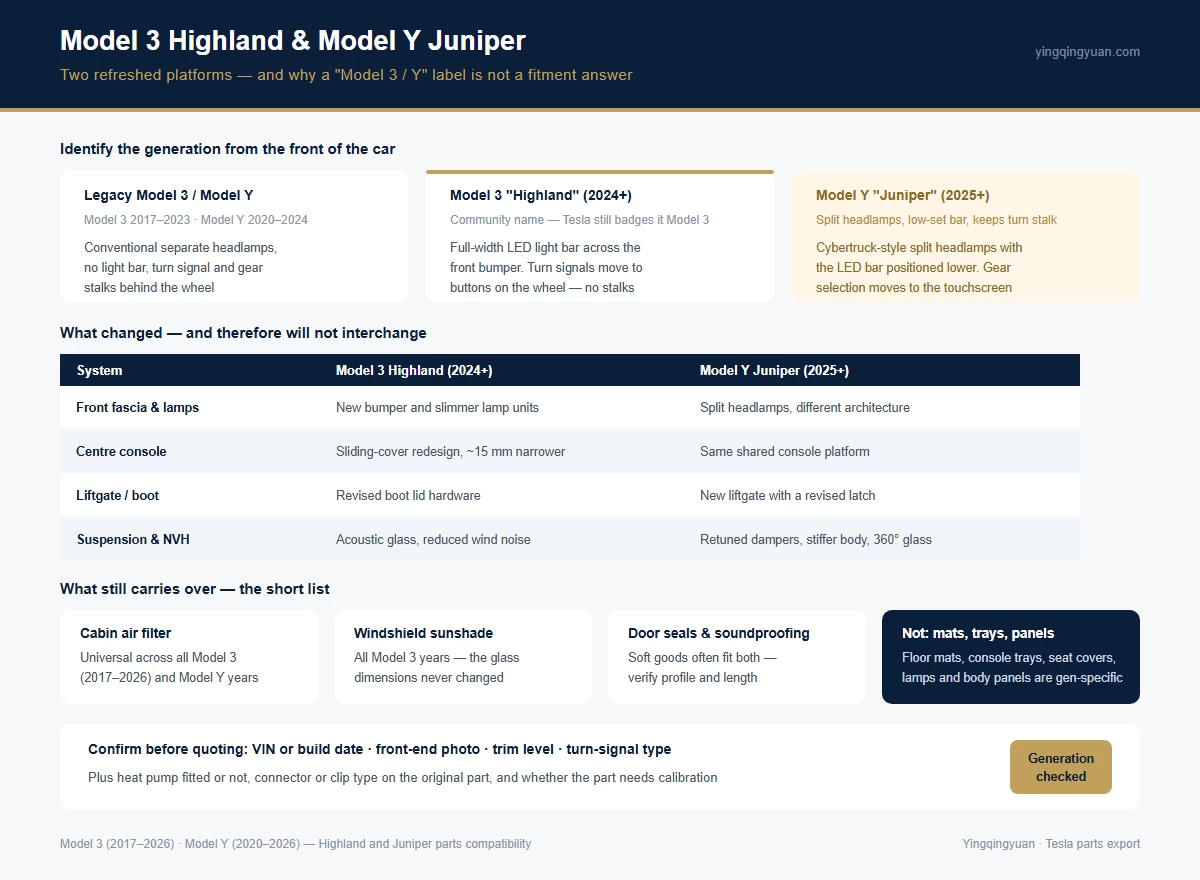
| Model 3 | 2017–2023 — traditional headlamp units, no light bar | 2024–2026 "Highland" — full-width LED light bar running across the front bumper, slimmer headlamps | Full-width LED bar across the nose = Highland |
| Model Y | 2020–2024 — traditional headlamps unchanged since launch | 2025–2026 "Juniper" — Cybertruck-style split headlamps with the LED light bar positioned lower, separate from the lamp units | Split headlamps with a low-set bar = Juniper |
There is a second, interior check that is equally reliable. Highland removed the steering-column stalks, moving turn signals to buttons on the steering wheel. Juniper took the opposite decision: it keeps the turn-signal stalk and moves gear selection to the touchscreen. If a car has turn-signal buttons, it is a Highland Model 3. If it has a turn-signal stalk but no gear stalk, it is a Juniper Model Y.
For anything mechanical, do not rely on either check. Build date from the VIN is the authoritative source, and our VIN decoding and part number guide covers how to read it.
What changed on the outside
Exterior parts are the largest single source of fitment failures, because a redesigned front or rear end changes mounting points, not just appearance. A bumper that "looks close" will not align, and a lamp housing with a different connector will not talk to the car.
| System | Model 3 Highland change | Model Y Juniper change |
|---|---|---|
| Front fascia and bumper | New front bumper with full-width LED light bar; revised lamp units | New front end with split headlamps and a lower-mounted light bar |
| Headlamps | Slimmer, revised internal design and connector | Split design, a different architecture from both legacy Model Y and Highland |
| Turn signals | Moved to steering-wheel buttons (stalks deleted) | Turn-signal stalk retained |
| Rear lighting | Revised tail lamp design | New tail light bar treatment |
| Liftgate / trunk | Sedan boot lid; revisions to closure hardware | Redesigned liftgate with a new latch mechanism |
| Glass and NVH | Acoustic glass updates; a marked reduction in wind noise | 360-degree acoustic glass including the panoramic roof, plus revised door seals |
| Wheel arches | Revised arch geometry | Revised arch geometry — legacy mud flaps and arch trim do not follow |
The practical rule on exterior parts: treat every panel, lamp and trim piece as generation-specific until proven otherwise. Even where a part physically fits, the connector, clip layout or calibration requirement often differs, and lamps are the clearest example — see our headlight and tail light replacement guide for what to check before ordering lighting, and the body parts buyer's guide for panels, bumpers and closures.
Interior and console: the biggest compatibility breaker
If exterior fitment fails loudly, interior fitment fails quietly — the part arrives, looks reasonable, and does not seat. The centre console is the single largest cause.
Both refreshed platforms adopt a redesigned console with a sliding cover and a different internal layout, replacing the open-top, piano-black design of the legacy cars. Dimensional change is the reason parts do not interchange: 3D-scan comparisons of the refreshed console against the legacy unit put the new cavity roughly 15 mm narrower and about 22 mm deeper, which is more than enough to defeat a tray, divider or organiser that was moulded for the old shape.
| Interior item | Legacy vs Highland / Juniper | Highland vs Juniper |
|---|---|---|
| Floor mats | Zero cross-compatibility — different footwell shape, seat rail positions and centre tunnel geometry | Not interchangeable; different cabin and cargo dimensions |
| Centre console trays and organisers | Do not interchange — console depth and width were redesigned | Largely shared console platform, but confirm the specific moulding |
| Dashboard trim and mats | Dashboard profile changed; under-screen storage added on Highland | Model Y dash is wider; do not assume a Model 3 piece fits |
| Seats and seat covers | New seat geometry | Juniper adds ventilated front seats; cover patterns differ |
| Rear passenger display | Added — 8-inch rear screen on refreshed cars | Same rear display and infotainment hardware |
| Door seals and weatherstrips | Revised profiles | Highest cross-compatibility of any category — soft seals and soundproofing strips frequently fit both |
That last row is worth pulling out, because it is the exception that proves the rule. Soft goods that mount to a body flange — adhesive door seals, foam channel fillers, felt strips, frunk and trunk perimeter seals — are far more tolerant of small dimensional variation than a moulded plastic tray, so they cross over between Highland and Juniper far more often. Rigid, moulded components need an exact match. Published fitment testing across large owner samples puts the direct-fit rate for soft goods around 40%, against under 20% for hard interior components.
Console design is also where a generic "for Tesla Model 3 / Y" label is most dangerous. A screen protector may genuinely fit both refreshed platforms because the display is shared; a dashboard mat will not, because the dashboard is not. Read the generation claim, not the model name.
Mechanical and chassis changes
The refreshes were not cosmetic. Both platforms received meaningful mechanical work, and Juniper in particular is a more substantial engineering revision than its styling suggests.
- Juniper suspension retuning. Revised spring and damper calibration and refined suspension bushings, aimed at ride comfort and impact absorption. On a parts level this matters for anyone ordering struts, dampers or bushing kits — do not assume a legacy Model Y part is the equivalent.
- Increased body torsional stiffness. Juniper's body structure was stiffened, which is relevant to collision repair and structural parts rather than to bolt-on items.
- Thermal management optimisation. Both refreshes revised thermal behaviour; Juniper's changes specifically target cold-weather efficiency. Since the heat-pump split already changes the HVAC parts list by generation, confirm the build rather than the badge.
- Screen and compute. The refreshed cars use a higher-resolution centre display and shared infotainment hardware, with an 8-inch rear passenger display. This is one of the few areas where Highland and Juniper genuinely share components.
For the wear items themselves, the same mileage logic applies as on any Tesla: brake hardware, suspension bushings and hub bearings are the parts that move first, and they are specified by trim rather than by generation. Our suspension and steering parts guide covers the common wear points, and the wheels, tires and hub bearings guide covers the bearing and fastener side.
What still carries over
This is the section buyers ask for first, and the honest answer is narrower than most people hope. Across a full accessory catalogue, roughly one item in five is genuinely cross-compatible between a legacy car and its refreshed counterpart.
| Item | Carries over? | Notes |
|---|---|---|
| Cabin air filter | Yes — across all Model 3 (2017–2026) and Model Y years | The HVAC filter slot has not changed; one of the few safe universal items |
| Windshield sunshade | Yes — all Model 3 years | Windshield dimensions unchanged across generations |
| Door seals, weatherstrips, soundproofing | Often — especially between Highland and Juniper | Soft goods tolerate dimensional variation; verify profile and length |
| Phone mounts | Sometimes | Depends on dashboard and screen geometry — model-specific designs are safer |
| Brake pads and rotors | By trim, not by generation | Standard, Long Range and Performance packages differ; see the brake parts guide |
| Floor mats, console trays, seat covers | No | Generation-specific by geometry |
| Lamps, bumpers, panels, wheel arch trim | No | Generation-specific mounting and connectors |
One more distinction that catches buyers out: Highland and Juniper are not interchangeable with each other either. They share infotainment hardware, the rear display and elements of console design, and their door-seal geometry overlaps enough that seal kits commonly fit both. But the Model Y is a taller, wider vehicle with a different cargo area — a Model 3 boot organiser is useless in a Model Y sub-trunk. Cargo accessories are never shared.
The pre-order checklist for refreshed-platform cars
Use this as a quoting template. Every row is a question that prevents a return.
| # | Confirm | Why it matters |
|---|---|---|
| 1 | Build date or VIN | Settles legacy vs Highland vs Juniper definitively |
| 2 | Model 3 or Model Y | Cargo, dash width and cabin dimensions differ |
| 3 | Front-end photo | Fast visual confirmation of generation |
| 4 | Trim (Standard / Long Range / Performance) | Decides brake, wheel and suspension specification |
| 5 | Turn-signal control type | Buttons = Highland; stalk = Juniper or legacy |
| 6 | Heat pump fitted or not | HVAC and thermal parts list follows the heat-pump split |
| 7 | Connector or clip type on the original part | Prevents a physically fitting lamp that will not connect |
| 8 | Whether calibration or software pairing is required | Some electronics need vehicle-side configuration |
Frequently asked questions
What are "Highland" and "Juniper"?
Both are community nicknames, not official Tesla model names. Highland refers to the refreshed Model 3 introduced for 2024; Juniper refers to the refreshed Model Y introduced for 2025. Tesla continues to market both simply as "Model 3" and "Model Y", which is exactly why fitment errors are so common — the badge does not tell you which platform you are dealing with.
How can I tell a Highland Model 3 from an earlier car?
Look at the front. A Highland has a full-width LED light bar running across the bumper and slimmer headlamp units; earlier cars have conventional separate headlamps with no bar. Inside, Highland deleted the steering-column stalks and moved turn signals to buttons on the steering wheel.
How do I identify a Juniper Model Y?
Juniper has split headlamps with a Cybertruck-inspired LED light bar set lower on the front end — a different design from both the legacy Model Y and the Highland Model 3. Inside, Juniper keeps the turn-signal stalk but moves gear selection to the touchscreen.
Can I use my old Model Y floor mats in a Juniper?
No. Floor mats have effectively zero cross-compatibility. The footwell shape, seat rail positions and centre tunnel geometry differ, and the mats are moulded to one specific interior. The same applies to Model 3 mats between legacy and Highland cars.
Do Highland and Juniper parts fit each other?
Only in specific areas. They share infotainment hardware, the rear passenger display and parts of the console platform, and door-seal and soundproofing kits often fit both because they mount to similar body flanges. But cargo accessories, dash trim, seat covers and exterior panels are not shared — the Model Y is a larger vehicle with a different body.
Which parts are safe to buy without a generation check?
Very few. Cabin air filters are universal across Model 3 (2017–2026) and Model Y years, and windshield sunshades are universal across Model 3 generations, because the windshield dimensions and filter slot never changed. Everything else should be confirmed against the build date.
Why does the same part number appear for two different years?
Because Tesla keeps a part number alive when the component is genuinely carried over, and issues a new number when the design or supplier changes. That makes the part number far more reliable than the model year — which is why we ask for the VIN rather than the year when quoting.
Do you supply parts for both generations?
Yes. Because the platform split runs through so much of the catalogue, we confirm the generation before quoting rather than after the return. Send the VIN or build date, a photo of the front end, and the trim level, and we will specify the correct part for the platform — including the refreshed cars, where a legacy part will not do.
Which collections should I browse?
- Tesla Model 3 lighting parts and Tesla Model Y lighting parts
- Tesla Model 3 body parts and Tesla Model Y body parts
- Tesla Model 3 interior parts and Tesla Model Y interior parts
- Tesla Model Y suspension and steering parts
Related Tesla parts guides
- Tesla Model 3 and Model Y parts fitment checklist — the full pre-order verification routine
- Tesla VIN decoding and part number guide — how to settle the generation from the VIN
- Tesla headlight and tail light replacement guide
- Tesla interior parts guide — seats, screens, consoles and trim
- Tesla body parts buyer's guide — bumpers, fenders, hoods and doors
Send us the VIN or build date, a photo of the front end and the trim level, and we will confirm whether your car is a legacy platform, a Highland or a Juniper before quoting. It is the difference between one shipment that fits and two that do not.