
Tesla Suspension & Steering Parts Guide: Control Arms, Struts & Racks (Model 3, Y, S & X)
Tesla suspension is one of the highest-turnover categories in EV parts — heavier battery packs, instant torque and performance-oriented tuning all shorten component life compared with a comparable combustion car. Control arms, sway bar links and shock absorbers are consumables for any workshop serving Model 3 and Model Y fleets.
It is also a category with hidden fitment complexity. Refresh generations (Model 3 "Highland", Model Y "Juniper"), trim differences, and left/right-hand drive variations all change what fits what. This guide covers the parts that matter, what wears, and what to confirm before ordering suspension and steering components for Model 3, Model Y, Model S and Model X.
What Actually Wears on a Tesla Suspension
An EV powertrain removes the engine's vibration, but it adds kerb weight and low-end torque. The result is a predictable wear pattern:
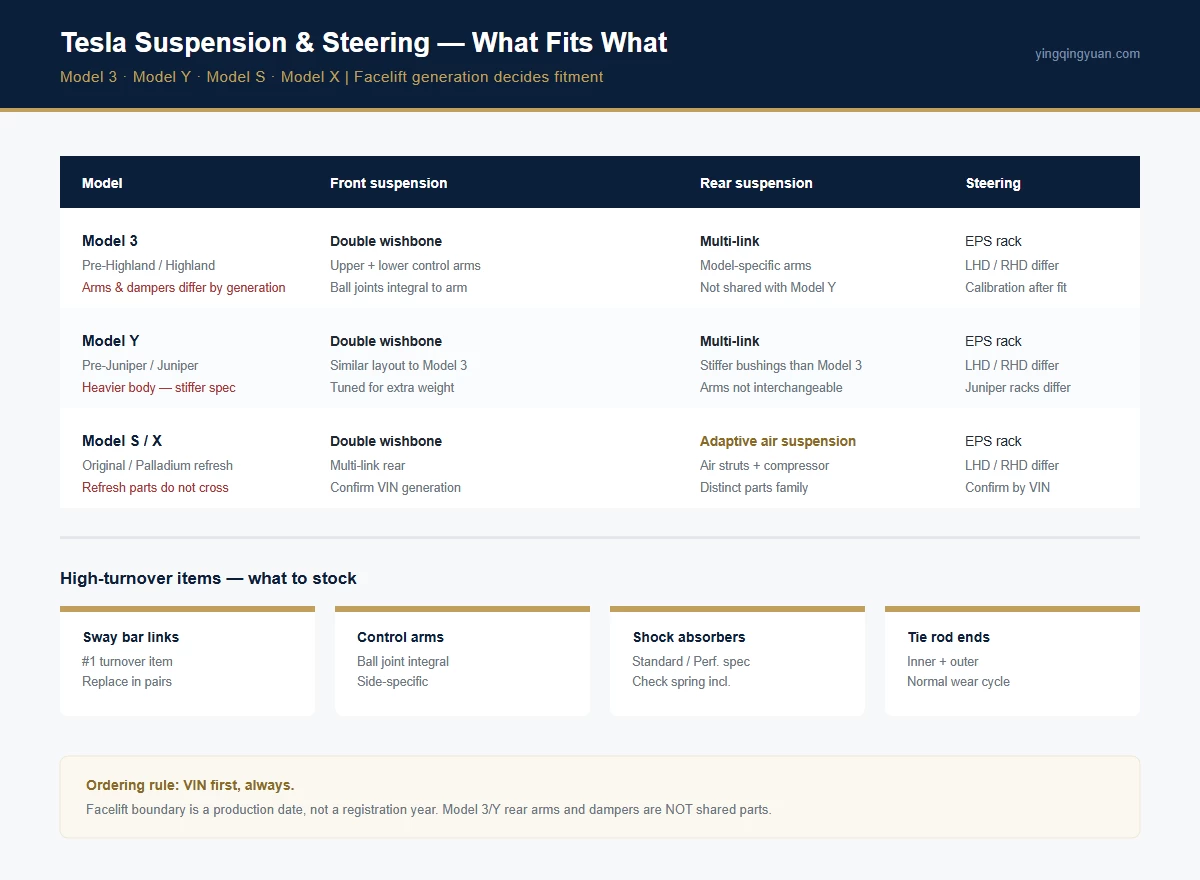
- Sway bar links (stabilizer bar links) — the highest-turnover suspension item. Knocking over small bumps is the classic symptom, and they are replaced in pairs.
- Control arm bushings and ball joints — on most Tesla applications the ball joint is integral to the arm, so the whole arm is replaced when the joint wears. Ordering "just the ball joint" is usually not an option.
- Shock absorbers and dampers — wear gradually; oil staining and body float are the usual indicators.
- Tie rod ends — normal steering wear; check inner and outer ends.
The Highland and Juniper Trap
The 2024 Model 3 facelift ("Highland") and the Model Y refresh ("Juniper") reworked suspension geometry and mounting points. Key consequences for buyers:
- Pre-facelift and facelift control arms are not interchangeable. Even when they look similar, bushing stiffness, ball joint spec and mounting geometry differ.
- Damper tuning differs across refresh years — a "Model 3 shock absorber" listing without a build-year range is incomplete.
- The facelift boundary is a production date, not a registration date. A 2024-registered car may be pre-Highland stock. Confirm by VIN, not by model year.
Front Suspension Layout by Model
| Model | Front layout | Rear layout | Sourcing notes |
|---|---|---|---|
| Model 3 | Double wishbone with upper and lower control arms, coilover damper | Multi-link with separate control arms | Upper/lower arms differ pre-Highland vs Highland; ball joints integral to arms |
| Model Y | Similar architecture to Model 3, tuned for the heavier body | Multi-link, stiffer bushings than Model 3 | Rear arms and dampers are not shared with Model 3 despite the shared platform |
| Model S / X | Double wishbone, multi-link rear | Adaptive air suspension on most builds | Air struts and compressors are a distinct parts family; coil conversions exist but change ride character |
The Model 3 / Model Y platform-sharing myth is the most common sourcing error in this category. The cars are related, but suspension components — rear control arms, dampers, sway bars — are Model-specific because of the Y's added weight and ride height. Never accept a listing that claims to fit "Model 3/Y" for these parts.
Steering: Racks, EPS and the RHD Detail
All current Tesla models use electric power steering (EPS) racks — no hydraulics, no pumps, no fluid. What buyers need to confirm:
- Steering racks differ between LHD and RHD builds. A rack for a North American Model Y will not fit a right-hand-drive vehicle. Specify drive side with every rack order.
- Rack part numbers changed at refresh boundaries. Highland and Juniper racks are not interchangeable with earlier units.
- EPS racks may require calibration after replacement — factor this into workshop labour quotes.
Tie rod ends and outer track rods are the steering consumables; they wear like any car's and are the first thing to check when a Tesla fails a steering inspection.
Model S and Model X: Air Suspension Adds a Parts Family
Most Model S and Model X builds ride on adaptive air suspension. For these cars the stocking list extends beyond arms and links:
- Air struts — front and rear, common failure at 8–12 years of service life
- Air suspension compressor — check the relay at the same time; a failed relay kills compressors
- Air line kits and valve blocks — for slow-leak diagnostics
Palladium-refresh S/X models (2021+) use updated components that differ from earlier cars — confirm by VIN before ordering.
OEM vs Aftermarket for Suspension Parts
| Route | Best for | Watch for |
|---|---|---|
| New OEM | Refresh-year vehicles, warranty-sensitive repairs, air suspension | Cost and lead time |
| Quality aftermarket | Wear items — links, arms, tie rods, dampers on out-of-warranty cars | Verify bushing durometer and ball joint spec match OEM; avoid unbranded arms |
| Used OEM | Heritage S/X air suspension cores | Air struts have finite life — used units are a stopgap, not a repair |
Suspension is a category where quality aftermarket is genuinely competitive for wear items — the geometry is standardised and the bar for materials is well understood. The exceptions are EPS steering racks and air suspension components, where verified OEM-grade supply is the safer route.
8 Things to Confirm Before Ordering
- VIN and build date — the production date determines Highland/Juniper compatibility, not the model year.
- Pre-facelift or facelift — for Model 3 (Highland) and Model Y (Juniper) suspension parts.
- Position — front/rear, upper/lower, left/right. Most arms are side-specific.
- Ball joint inclusion — on Tesla arms the joint is usually integral; confirm the arm includes it.
- Damper type — standard, comfort or Performance-spec; also whether the spring is included.
- Drive side — LHD or RHD for all steering racks.
- Complete kit or component — links, bolts and bushings are often sold separately from arms.
- Alignment hardware — camber bolts and eccentrics for the post-replacement alignment.
Frequently Asked Questions
Are Model 3 and Model Y suspension parts interchangeable?
No. The cars share a platform family, but Model Y control arms, dampers and sway bars are specific to the heavier vehicle. Only confirm cross-fitment against OEM part numbers, never against platform assumptions.
How do I know if a Model 3 is Highland or pre-Highland?
By the VIN and build date, not the registration year. The facelift began production in late 2023 for the 2024 model year, and early 2024-registered cars can still be pre-facelift stock. Send the VIN to your supplier and have them confirm before ordering.
Why do Tesla sway bar links fail so often?
Vehicle weight combined with firmer suspension tuning loads the links heavily. They are the first component to develop play, and typically the first suspension part a workshop replaces.
Can I replace just the ball joint on a Tesla control arm?
On most Tesla applications the ball joint is riveted or pressed into the arm as a sealed unit, so the arm is replaced as an assembly. Aftermarket service arms with replaceable joints exist for some applications, but the standard repair is arm replacement.
Do Tesla steering racks need programming after replacement?
EPS racks generally require a calibration or service-mode routine after installation. The rack itself is not "coded" the way some modules are, but the steering-angle calibration should be performed before the car is returned to the customer.
Stocking and Sourcing Tesla Suspension Parts
Suspension is the steady backbone of a Tesla parts catalogue — every Model 3 and Model Y on the road will need links, arms and dampers, and refresh-generation parts are a fast-growing demand. Getting the facelift boundary right is what separates a supplier who saves the shop time from one who costs it.
Browse our Tesla suspension and steering range by model:
- Tesla Model 3 suspension parts — control arms, links, dampers, Highland and pre-Highland
- Tesla Model Y suspension parts — including Juniper refresh components
- Tesla Model S suspension parts — arms, links and air suspension components
- Tesla Model X suspension parts — including air struts and compressors
Send us your VIN list and we will confirm facelift generation, position and drive side before you order. Suspension parts are side- and generation-specific — one verified shipment beats three corrections.