
Tesla Electrical Parts Guide: 12V Battery, Charge Port & Sensors (Model 3, Y, S & X)
Electrical parts are where Tesla sourcing gets genuinely technical. The high-voltage pack gets the attention, but most of the faults a workshop actually sees sit in the low-voltage system, the charge port and the sensor network — and those components changed more often than the pack did.
Three split points decide whether an electrical part fits: the low-voltage battery chemistry, the charging standard of the destination market, and the refresh generation of the car. This guide covers the components, the splits and what to confirm before ordering electrical parts for Model 3, Model Y, Model S and Model X.
The Low-Voltage Split: Lead-Acid vs Lithium
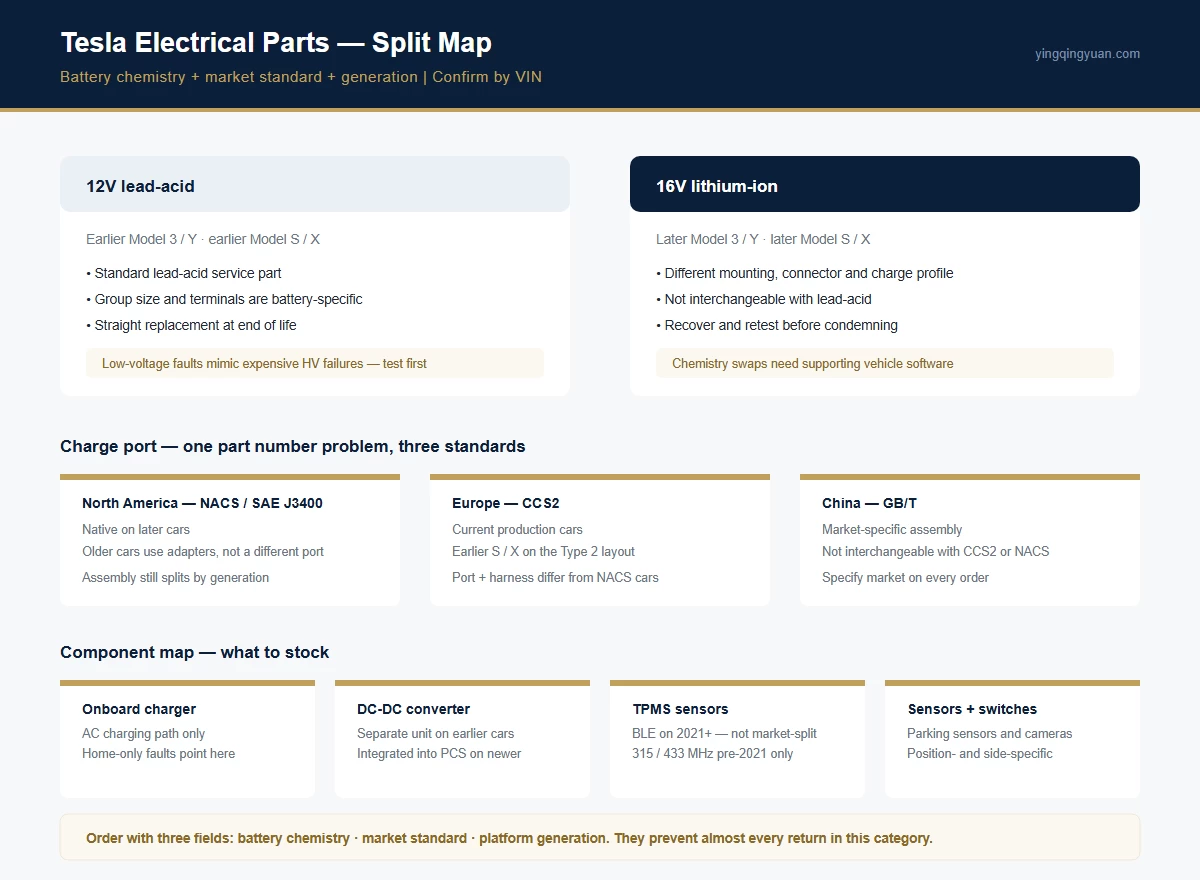
Tesla moved its low-voltage system from a conventional 12V lead-acid battery to a 16V lithium-ion unit during 2021–2022 production. The two are not interchangeable, and this single fact causes more returns in this category than anything else.
| Build period | Low-voltage battery | Sourcing notes |
|---|---|---|
| Earlier Model 3 / Model Y | 12V lead-acid (Clarios / Varta group sizes) | Group size and terminal layout are battery-specific; standard lead-acid service parts |
| Later Model 3 / Model Y (2021–2022 onward) | 16V lithium-ion (AtlasBX-type) | Different mounting, connector and charging profile; Tesla software 2023.32+ required when a car is switched between chemistries |
| Model S / Model X | Lead-acid on earlier cars, lithium on later builds | Confirm by VIN — the changeover does not track the model year cleanly |
Two practical points for buyers. First, a lithium low-voltage battery is not always a replacement item — Tesla's own service position is that a low unit should be recovered and retested before it is condemned, so workshops order fewer of these than they expect. Second, when a customer's car is converted between chemistries, the vehicle software has to support it. Supplying the right part number to a car running older firmware still produces a fault.
Because the low-voltage system powers the computers, the charge-port controller and the communication buses, a weak low-voltage battery mimics far more expensive failures. A workshop chasing a "won't charge" or "battery fault" complaint should verify low-voltage health before any high-voltage conclusion — which is also why low-voltage batteries are a steady, high-turnover line for a parts supplier.
Charge Port Assemblies: Three Standards, One Part Number Problem
The charge port is the most market-specific electrical part on the car. The physical connector differs by region, and the assembly differs again by generation.
- North America — the Tesla connector, now standardised as SAE J3400 and widely referred to as NACS. Later vehicles ship with this connector natively; older cars use adapters rather than a different port.
- Europe — CCS2 on current cars, with earlier Model S and Model X on the Type 2 layout.
- China — GB/T.
Within a single market, the port assembly still changes across refresh generations, and it splits into serviceable sub-parts: the door actuator, the latch mechanism, the pins and the port controller. That matters commercially, because a large share of charge-port complaints are not assembly failures — the fault is a stuck latch, debris or corrosion on the pins, or a low-voltage battery that never woke the car. Supply the assembly, but help the workshop diagnose first; the parts that come back are usually the ones sold without a symptom check.
Heat and discolouration at the pins is the one symptom that should always lead to replacement rather than cleaning. Worn pins raise resistance, which raises temperature, which degrades the connection further — and in some cases the equipment side is the real culprit. Ask for photographs of the pins on both the car side and the cable side.
Power Conversion: Onboard Charger, DC-DC and the PCS
AC charging and DC fast charging use different paths through the car, and the parts reflect that.
- Onboard charger — converts AC from a wall connector or mobile cable into DC for the pack. Home-only charging faults point here, or at the supply circuit, rather than at the pack.
- DC-DC converter — steps high-voltage DC down to run the low-voltage system. On earlier cars a separate unit; on later platforms it is integrated into the power conversion system.
- Power conversion system (PCS) — the combined assembly on newer platforms. If a car needs both an onboard charger and a DC-DC function, the service answer on these builds is one part, not two.
This is the clearest example of a generation trap in the electrical category: the same complaint on two different build years leads to completely different parts. Always confirm the platform generation alongside the fault description.
Sensors and Switches: TPMS, Parking and Cameras
- TPMS sensors — 2021-and-later Tesla vehicles use BLE (Bluetooth Low Energy) sensors that are not market-specific. Pre-2021 cars used 315 MHz or 433 MHz sensors depending on region. Mixing generations is the single most common TPMS ordering error.
- Ultrasonic parking sensors — position-specific and generation-specific; bumper-mounted sensors must match the harness and the fascia they sit in.
- Cameras and camera housings — the camera set changed with each refresh, and housings are handed and position-specific.
- Coolant pump and valve sensors — shared with the thermal system; a failed sensor produces temperature-related charge restrictions that are easily misread as pack degradation.
High-Voltage Cable, Contactors and Service Hardware
High-voltage side, the stocking list is shorter but the fitment bar is higher: HV cables, contactors and disconnect hardware are generation-specific and safety-critical. Alongside them sit the parts that every electrical repair consumes — single-use connectors, O-rings for HV connectors, terminal covers and the low-voltage battery tie-downs and clamps that are routinely discarded during a battery swap and then cannot be reused.
Selling those small parts alongside the main component is what separates a complete electrical order from one that generates a second shipment.
8 Things to Confirm Before Ordering Electrical Parts
- Low-voltage battery chemistry — lead-acid or lithium, confirmed by VIN, not by model year.
- Vehicle software level — required when a car is converted between low-voltage chemistries.
- Market standard — NACS / SAE J3400, CCS2 or GB/T for every charge port order.
- Charge port sub-part — door actuator, latch, pin set, controller or the complete assembly.
- Platform generation — separate onboard charger and DC-DC, or an integrated PCS.
- TPMS generation — BLE for 2021-and-later, frequency-specific for earlier cars.
- Sensor position and side — parking sensors and cameras are position-specific.
- Consumable hardware — connectors, O-rings, terminal covers and clamps that cannot be reused.
Frequently Asked Questions
Can I replace a Tesla 12V lead-acid battery with a lithium one?
Not as a straight swap. The lithium low-voltage battery uses different mounting, a different connector and a different charging profile, and the vehicle software must be at a level that supports the change. Confirm the car's build and software before ordering either type.
Do I need a different charge port for different countries?
Yes. The port assembly is market-specific: NACS / SAE J3400 in North America, CCS2 in Europe, GB/T in China. A port from one market will not serve a car delivered in another, and adapters do not change the port's own specification.
Do 2021 and later Teslas use the same TPMS sensors worldwide?
For 2021-and-later vehicles, yes — the BLE sensors are not frequency-split by market. The 315 MHz and 433 MHz split applies to pre-2021 cars only, which is why generation confirmation matters more than region for TPMS.
Why does the car not charge when the port looks fine?
Because the port is often not the fault. A weak low-voltage battery, a home circuit problem, the onboard charger or a communication fault can all produce the same symptom. Diagnose the low-voltage system and the equipment side before replacing the port.
Is a charge port with warm or discoloured pins still serviceable?
No. Heat at the pins indicates raised resistance, and cleaning does not restore the contact. Replace the affected component and check the cable and outlet side at the same time, since a worn supply side can create the same heat.
Sourcing Tesla Electrical Parts
Electrical parts reward precise questions. Generation, market standard and battery chemistry narrow the catalogue faster than any other three fields, and they are the three that cause almost every return in this category. For workshops, the value of a supplier here is not just availability — it is confirming the split before the order ships.
Browse our Tesla electrical range by model:
- Tesla Model 3 electrical parts — low-voltage batteries, charge ports, sensors and cables
- Tesla Model Y electrical parts — including Juniper refresh components
- Tesla Model S electrical parts — charge port, conversion and sensor assemblies
- Tesla Model X electrical parts — matching Model S electrical architecture
Related Tesla parts guides
- How to check Tesla aftermarket part fitment — the VIN and build-date checks that apply to every electrical order
- Tesla cooling and HVAC parts guide — thermal-system sensors and pumps that share the electrical fault chain
- Wholesale Tesla replacement parts: what buyers should confirm — for distributors building an electrical line
- Tesla parts packaging and international shipping — freight and documentation for cross-border electrical orders
Send us your VIN list, destination market and the fault description, and we will confirm battery chemistry, charge port standard and generation before you order. Electrical parts are the least forgiving category for guesswork — one confirmed order beats three replacements.