
Tesla Cooling & HVAC Parts Guide: AC Compressors, Radiators & Heat Pumps (Model 3, Y, S & X)
On a combustion car, heating is free — waste heat from the engine. On a Tesla, the cabin and the battery both depend on an active thermal system, which changes the HVAC parts business completely: every component is electrically driven, software-managed, and mission-critical for both comfort and range.
For parts buyers, this category has one dividing line that matters more than everything else combined: whether the vehicle has a heat pump or a resistive (PTC) heater. It changes the parts catalogue under the hood, and getting it wrong means the part will not fit. This guide covers the components, the split points and what to confirm when sourcing cooling and HVAC parts for Model 3, Model Y, Model S and Model X.
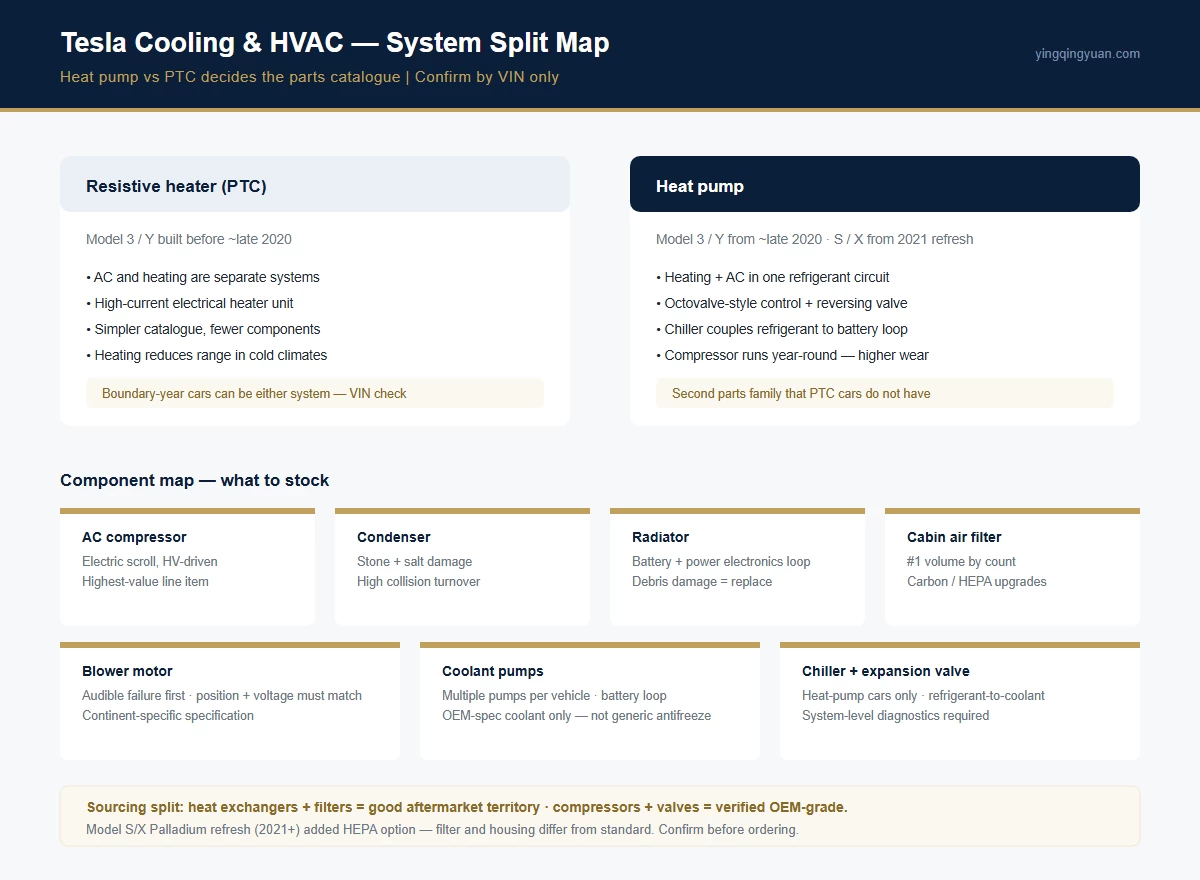
Heat Pump vs PTC — The First Question for Every Order
| System | Which cars | Parts implications |
|---|---|---|
| Resistive (PTC) heater | Model 3 and Model Y built before roughly late 2020 | Heater is a high-current electrical unit; AC and heating are separate systems; simpler catalogue |
| Heat pump | Model 3 and Model Y from late 2020 onward; Model S and X from the Palladium refresh (2021+) | Heating and AC are one integrated circuit with a reversing valve and octovalve-style control; many added components; system-level diagnostics required |
The production cut-off is approximate and build-dependent — a late-2020 Model Y can be either system depending on the plant and build week. The only safe method is VIN confirmation. A heat-pump car and a PTC car can look identical from the driver's seat.
The Component Map
- AC compressor — an electric scroll compressor, high-voltage driven. No belts, no clutch. On heat-pump cars the compressor is the heart of both heating and cooling, so it works year-round and fails accordingly.
- Condenser — front-of-vehicle heat exchanger; vulnerable to stone damage and road salt; often replaced after frontal collisions.
- Radiator — cools the battery and power electronics loop. Damage from debris is the common failure; check for the correct generation before ordering.
- Cabin air filter — the consumable. Activated-carbon and HEPA-grade options exist for several models; a reliable stocking item with genuine turnover.
- Blower motor — cabin ventilation fan; failure is audible first. Position (driver/passenger side) and voltage must match.
- Coolant pumps — electric circulation pumps on the battery and drive-unit loops; multiple pumps per vehicle.
- Chiller and expansion valve — heat-pump-specific components coupling the refrigerant and coolant circuits; effectively a second parts family that PTC cars do not have.
Coolant: Not a Generic Item
Tesla specifies its own coolant chemistry, and the cooling loop serves the battery — the most expensive component on the car. Key points for buyers:
- Use the OEM-specified coolant type only; mixing chemistries in a battery loop is a genuine risk, not a formality.
- Coolant pumps, hoses and seals are the service items; loops are software-monitored, and small leaks produce warnings long before overheating.
- After any cooling repair, the system expects an air-bleed/service procedure — include it in workshop labour quotes.
What Actually Fails, and Why
- Compressors — the highest-value line item in the category. High-voltage units; professional installation and correct refrigerant charge are prerequisites.
- Condensers and radiators — crash and debris damage, plus corrosion in salt-belt regions. High turnover in collision-adjacent markets.
- Blower motors — bearing wear; continent-specific voltage and blower position make correct specification essential.
- Cabin filters — the highest-volume item by count. HEPA and carbon variants command better margins than standard paper.
- Coolant pumps — long-service-life but certain failure; inexpensive parts that stop a car with a warning.
Model S and Model X: HEPA and Legacy Generations
Palladium-refresh S/X (2021+) added HEPA filtration capability and updated thermal architecture, while pre-refresh cars carry the older HVAC layout. The two generations' HVAC parts do not cross. Before ordering S/X components, confirm:
- Build date relative to the 2021 refresh boundary.
- Whether the vehicle has the HEPA option — the filter and housing differ from standard.
- Market spec, since regional homologation affects AC system configuration.
OEM vs Aftermarket for Cooling and HVAC
| Route | Best for | Watch for |
|---|---|---|
| New OEM | Compressors, heat-pump components, electronic valves | Cost and lead time — but thermal system reliability justifies it |
| Quality aftermarket | Cabin filters, blowers, condensers, radiators, pumps | Verify core dimensions, fin density and connector types; avoid unbranded heat exchangers |
| Used OEM | Heritage S/X service in low-supply markets | Compressors are wear items — used units carry real risk; heat exchangers must be leak-tested |
The practical split: heat exchangers and filters are good aftermarket territory; high-voltage compressors and refrigerant-to-coolant valves are where verified OEM-grade supply earns its premium.
8 Things to Confirm Before Ordering
- VIN — the only reliable way to establish heat pump vs PTC on boundary-year cars.
- Build date — refresh boundaries (late-2020 3/Y, 2021 S/X) change the catalogue.
- System type — heat pump cars have chiller, reversing valve and octovalve components that PTC cars do not.
- Market spec — regional homologation affects AC configuration and refrigerant type.
- Voltage and connector — for blowers, pumps and compressors; these are electric components, not just mechanical ones.
- Filter grade — standard, activated-carbon or HEPA.
- High-voltage safety — compressor and valve work requires qualified technicians; factor into who you supply.
- Service consumables — correct-spec coolant and refrigerant to complete the job in one shipment.
Frequently Asked Questions
How do I know if a Tesla has a heat pump?
Reliably, by the VIN. As a rule of thumb, Model 3 and Model Y from late 2020 onward and Palladium-refresh Model S/X (2021+) have heat pumps, but build weeks around the changeover can be either system. Ask your supplier to confirm before ordering thermal components.
How often should a Tesla cabin air filter be replaced?
Typically every two years, or annually in high-pollution or dusty regions. Carbon and HEPA-grade filters follow the same interval and are direct upgrades on applicable models — a consistent consumable revenue line for distributors.
Can an aftermarket AC compressor be used on a Tesla?
Quality aftermarket compressors exist for some applications, but the compressor is a high-voltage, software-integrated component central to the thermal management system. For this part specifically, verified OEM-grade supply is the safer commercial decision.
Why do Tesla radiators fail?
Mostly road debris and stone impact, plus corrosion in salt-treated climates. Because the radiator serves the battery cooling loop, even small leaks trigger warnings — so damage found at collision repair is usually replaced rather than repaired.
Is Tesla coolant the same as regular antifreeze?
No. Tesla specifies its own coolant chemistry for the battery and drive-unit loops. Mixing incompatible coolants in a battery thermal loop is a genuine safety and warranty risk — always match the OEM specification.
Stocking and Sourcing Tesla Cooling and HVAC Parts
Thermal management is what makes an EV work — the category touches comfort, range and battery health at once. For distributors, the winners are those who can answer the heat-pump question instantly from a VIN, and who ship the filter, pump and coolant in the same box as the compressor.
Browse our Tesla cooling and HVAC range by model:
- Tesla Model 3 cooling and HVAC parts — heat pump and PTC generations
- Tesla Model Y cooling and HVAC parts — including heat pump components
- Tesla Model S cooling and HVAC parts — pre-refresh and Palladium
- Tesla Model X cooling and HVAC parts — including HEPA-grade filtration
Send us your VIN list and we will confirm heat pump vs PTC, generation fitment and market spec before you order. One verified shipment beats three corrections.