
Wholesale Tesla Replacement Parts: What Buyers Should Confirm
Ordering Tesla replacement parts at wholesale volume is a different game from buying a single part for your own car. When you're stocking a repair shop, supplying a body shop chain, or distributing across a region, one wrong assumption — about part grade, fitment, or documentation — doesn't cost you one part. It costs you a shipment, a customer, and sometimes a contract.
Tesla vehicles are now among the most-serviced EVs on the road, and demand for replacement parts — bumpers, headlights, control arms, charge port doors, interior trim, battery-related components — keeps growing. But Tesla's unconventional production model makes wholesale sourcing trickier than traditional brands. This guide breaks down exactly what to confirm with your supplier before you place a wholesale order.
Why Tesla Wholesale Sourcing Is Different
Three things set Tesla parts sourcing apart from sourcing parts for Toyota or VW:
- Continuous production changes. Tesla changes parts mid-production without model-year announcements. Two Model Ys built three months apart can use different components. At wholesale volume, a fitment mistake multiplies across every unit in your order.
- Facelift splits. Model 3 splits into Pre-Facelift (2017–2023) and Highland (2024+). Model Y splits into Pre-Facelift (2020–2024) and Juniper (2025+). Bumpers, lights, hoods, and interior parts are largely incompatible across the split — and your customers will ask for both.
- EV-specific logistics. Some Tesla components — battery modules, certain electronics — fall under dangerous goods rules (UN 38.3, lithium battery shipping regulations) that ordinary parts exporters may not be equipped to handle.
None of this makes Tesla parts hard to source. It just means the confirmations below are non-negotiable.
1. Confirm the Part Grade You're Actually Buying
"Tesla parts" covers several very different product grades, and wholesale prices differ accordingly. Make sure you and your supplier are using the same vocabulary:
| Grade | What it means | Best for |
|---|---|---|
| Genuine OEM (Tesla-branded) | Original Tesla parts, sourced through official channels | Insurance work, warranty-sensitive repairs, premium customers |
| OEM-supplier parts | Made by the same factory that supplies Tesla, without Tesla branding | High volume body panels and trim where quality matters but branding doesn't |
| Certified aftermarket | Independent manufacture, built to match OEM part numbers and specs | Cost-sensitive volume orders, fast-moving consumables |
| Remanufactured / used | Rebuilt or salvaged components | Select electronics and drivetrain parts at reduced cost — confirm condition grading carefully |
Ask your supplier to state the grade in writing on the quotation and invoice. A price that looks too good is usually a different grade than you assumed.
2. Confirm Fitment — By VIN and Part Number, Not Just Model
"It fits Model 3" is not a specification. For wholesale orders, fitment confirmation should happen at the batch level:
- OEM part number matching. Tesla part numbers (format
1234567-00-X) are the gold standard. Ask the supplier which OEM numbers each wholesale SKU replaces, and verify those numbers against your market's vehicle population. - VIN-based verification. For mixed or uncertain orders, send your supplier sample VINs from your customer base. A professional Tesla parts exporter verifies compatibility against VIN daily and can flag mismatches in minutes.
- Revision awareness. Tesla's dash suffixes (
-00-X,-01-X,-02-X) mark part revisions. A newer revision typically supersedes an older one — but confirm with the supplier when suffixes differ significantly, especially for electrical parts.
Pro tip: Keep a fitment matrix (model × build period × part number) for your best-selling SKUs. It turns every future order into a copy-paste job instead of a research project.
3. Confirm the Supplier's Quality Control Process
At wholesale volume, a 2% defect rate is not a rounding error — it's a container full of claims. Before ordering, confirm:
- Inspection before packing. Are parts visually and functionally inspected before they leave the warehouse?
- Photo or video confirmation. Will the supplier send photos or video of the actual batch before shipment? Reputable exporters do this routinely for first orders.
- DOA and damage policy. What happens when a part arrives dead or damaged? Look for a clear, written replacement or credit procedure — and a realistic claims window.
- Batch consistency. If you reorder the same SKU in three months, will you get the same product? Ask how the supplier controls consistency across production batches.
4. Confirm Packaging and Export Documentation
Wholesale Tesla parts cross borders, and the paperwork is part of the product:
- Export-grade packaging. Body panels, bumpers, and headlights need reinforced crates and corner protection — not retail boxes. Confirm how fragile SKUs are packed for ocean freight.
- Correct labeling. Cartons should carry part numbers, quantities, and handling marks that match the packing list — so your warehouse can receive goods without opening every box.
- Documentation set. Commercial invoice, packing list, and correct HS codes, with descriptions that match the physical goods. Mismatched paperwork is one of the most common causes of customs delays.
- Dangerous goods handling. If your order includes battery-related or certain electronic components, confirm the supplier can provide UN 38.3 test summaries and ship under lithium battery regulations where applicable.
5. Confirm MOQ, Pricing Tiers, and Sample Orders
Wholesale pricing is a structure, not a number. Before committing:
- Ask for the tier table. Most exporters price by quantity band (e.g., 10 / 50 / 100 / 500 units). Get all tiers upfront so you can plan container consolidation.
- Start with a sample or trial order. A supplier confident in their quality welcomes a small first order — samples are cheap insurance on large commitments.
- Clarify payment terms and incoterms. Confirm whether quotes are FOB, CIF, or DDP, and agree on payment method (T/T, trade assurance platform, or letter of credit for large contracts) before you place the order, not after.
- Ask about mixed containers. Can you combine models and part categories in one shipment? Flexibility here dramatically improves your inventory economics.
6. Confirm Lead Time and Real Stock
"In stock" means different things to different suppliers. Confirm:
- Is the stock physically on hand, or is it production lead time? Some SKUs ship in days; production-ordered parts can take weeks. Both are fine — as long as you know which one you're buying.
- Restock frequency for your fastest-moving SKUs, so you can set reorder points that don't leave your customers waiting.
- Peak-season capacity. Around quarter-ends and Chinese New Year, ocean freight and production both tighten. A good supplier flags this proactively.
7. Confirm Warranty and After-Sales Support
Confirm in writing: what the warranty covers, for how long, and what the claim process looks like. Pay special attention to:
- Warranty scope — does it cover manufacturing defects only, or also shipping damage?
- Claim evidence — photos, video, or return of the part? Who pays return freight?
- Resolution options — replacement in next shipment, credit note, or refund?
- English-speaking support — claims move at the speed of communication. Confirm you have a named contact who responds in your working language.
The Wholesale Buyer's Pre-Order Checklist
Run through this before every first-time order (and periodically with existing suppliers):
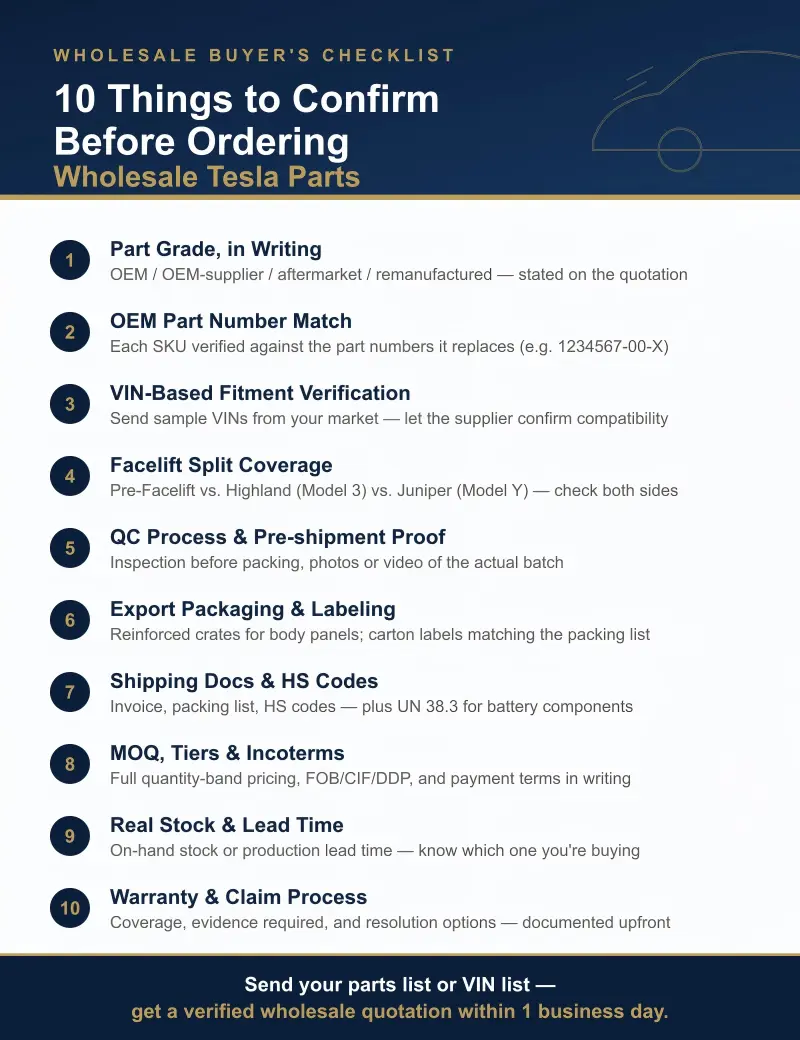
- ☐ Part grade stated in writing (OEM / OEM-supplier / aftermarket / remanufactured)
- ☐ OEM part numbers confirmed against your target vehicle population
- ☐ VIN-based fitment verification completed for uncertain SKUs
- ☐ Facelift split coverage checked (Pre-Facelift vs. Highland / Juniper)
- ☐ QC process confirmed, with pre-shipment photo or video proof
- ☐ Export packaging spec agreed for fragile parts
- ☐ Documentation set confirmed (invoice, packing list, HS codes)
- ☐ DG paperwork available if order includes battery-related components
- ☐ Pricing tiers, MOQ, incoterms, and payment terms locked in writing
- ☐ Warranty terms and claim process documented
Frequently Asked Questions
Can I mix different Tesla models and part types in one wholesale order?
Yes — most Tesla parts exporters support mixed orders and container consolidation. This is one of the biggest advantages of working with a full-line supplier: you fill a container with exactly the SKU mix your market needs instead of over-ordering a single part number.
Do wholesale suppliers accept small trial orders?
Established exporters do. A trial order (or sample order) lets you verify quality, packaging, and documentation before committing to volume. If a supplier refuses any small first order, treat that as a signal.
How do I verify the parts are genuine OEM?
Check Tesla part numbers and markings on the physical parts, request packaging photos, and start with a small verifiable order. Note that OEM-supplier and certified aftermarket parts are legitimate choices for many SKUs — the key is that the grade you're sold is the grade you receive.
What documents should a Tesla parts export shipment include?
At minimum: commercial invoice, packing list, and correct HS codes. Add UN 38.3 test summaries for lithium battery-related components, and any certificates of origin your market requires for duty purposes.
Do aftermarket Tesla parts affect insurance repairs?
It depends on the insurer and market. Many insurance jobs specify OEM or OEM-equivalent grades for structural and safety parts. Confirm the grade mix you stock against your customers' most common job types.
Get Your Wholesale Order Verified — Free
The fastest way to de-risk a wholesale Tesla parts order is to work with a supplier who verifies fitment for you. Send us your parts list (or just your customers' VINs) and the models you cover — our team will confirm compatibility, quote current wholesale tiers, and flag anything that needs a second look before you commit.
Message us with your parts list or VIN list, and get a verified wholesale quotation within one business day.