
Tesla Collision Repair Parts & ADAS Calibration Guide (Model 3, Y, S & X)
Tesla collision repair splits into two halves, and parts suppliers tend to be strong on one and blind to the other. The first half is physical: bumpers, fenders, glass, brackets. The second half is electronic: the cameras and sensors mounted to those parts, and the calibration that has to follow any repair that moved one of them.
Get the first half right and the second half wrong, and the customer gets a car that looks repaired and drives with its driver-assistance features unavailable. This guide covers both, and the components that decide which part number is correct.
Where the Sensors Actually Sit
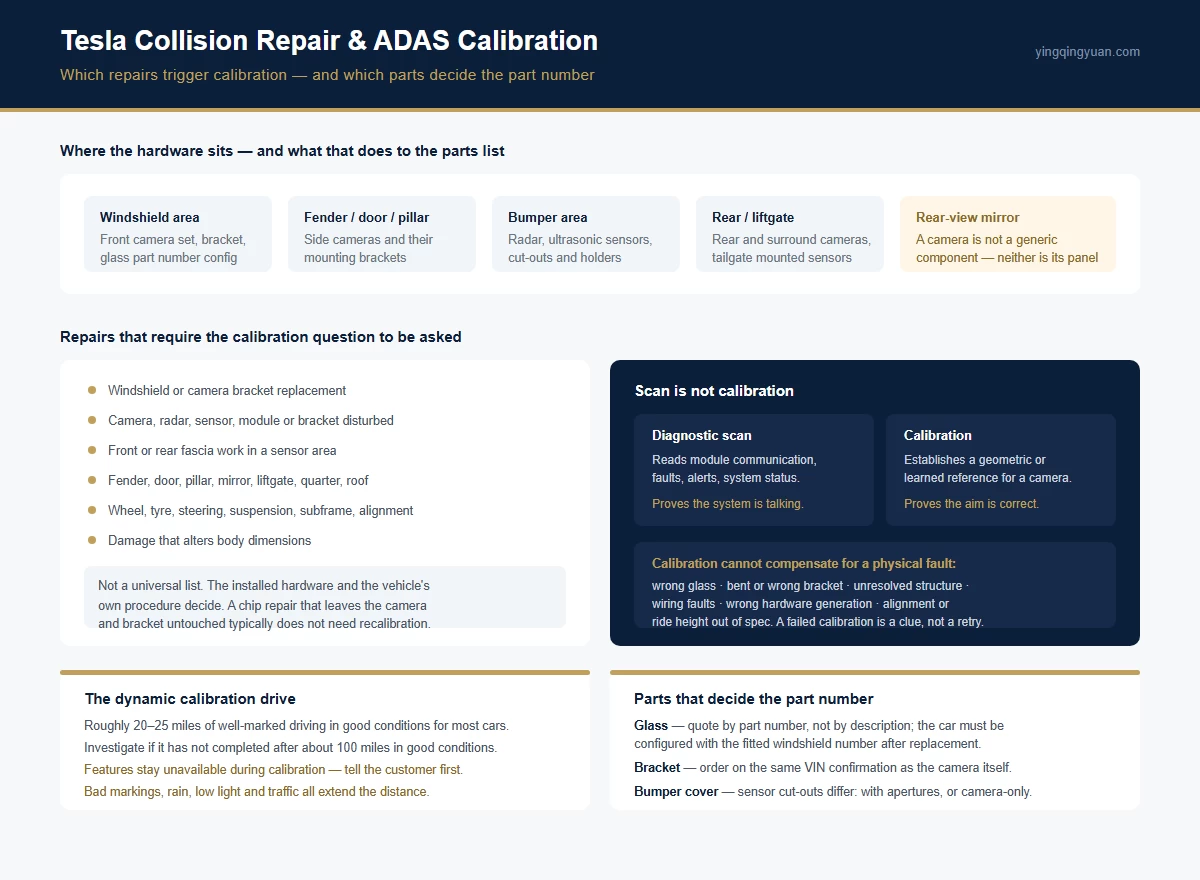
Tesla's driver-assistance hardware is distributed around the body, not concentrated in one module. On current cars the camera set is fitted around the windshield area, the fender sides, the B-pillars, the door and mirror area, and the rear of the vehicle depending on model and build. Older or specific configurations add radar and ultrasonic parking sensors.
The consequence for a parts order is straightforward: a camera is not a generic component, and the panel it mounts to is not a generic panel. A front fender, a door, a mirror assembly, a windshield and a bumper cover can each carry a camera, a sensor, a bracket, or nothing at all — depending on the build.
Three hardware generations are in circulation and they do not mix:
| Configuration | Approximate timing | What it means for parts |
|---|---|---|
| Ultrasonic parking sensors fitted | Earlier builds, up to around October 2022 | Bumper covers have sensor cut-outs; sensor holders, grommets and wiring are separate line items |
| Camera-only park assist | Around October 2022 onward | Bumper covers have no sensor apertures; ordering a sensor-cut bumper for these cars leaves visible holes |
| Autopilot computer generation change (HW3 to HW4) | From February 2024 (Shanghai) / around May 2024 (Berlin) | Camera sets and computer modules differ; the two generations are not interchangeable |
Which Repairs Trigger Calibration
Calibration is not decoration. Cameras and sensors are aimed to tolerances that a repair can quietly destroy, and a camera can keep reporting lane positions and distances confidently even when its reference no longer matches reality. The following categories of work require the calibration question to be asked:
| Repair | Why it matters |
|---|---|
| Windshield or camera bracket replacement | The camera comes off and goes back onto a new piece of glass — always requires clearing calibration |
| Camera, radar, ultrasonic sensor, module or bracket removal/replacement | Any disturbance of the mount changes the aim; some procedures add pitch verification |
| Front or rear fascia work in a sensor transmission or mounting area | Material thickness and paint build in front of a radar can affect its signal |
| Fender, door, pillar, mirror, liftgate, quarter panel, roof or structural work near a camera | Panel replacement moves the camera's mounting reference |
| Wheel, tyre, steering, suspension, subframe, ride-height or alignment work | The camera is aimed relative to the car's attitude; changing ride height changes the view |
| Damage that alters body dimensions | Structural repair changes the geometric reference the system depends on |
One important qualification: this is not a universal trigger list. The installed hardware and the vehicle's own service procedures decide. A small glass chip repair that leaves the camera and bracket untouched typically does not require recalibration. Work that moved the camera — or moved the car underneath it — should be treated as suspect until proven otherwise.
Calibration Is Not the Same as a Diagnostic Scan
This distinction is where repairers new to Tesla most often go wrong, and where parts get blamed for a procedure problem.
| Diagnostic scan | Calibration | |
|---|---|---|
| What it does | Reads module communication, faults, alerts and system status | Establishes a geometric or learned reference for a camera or sensor |
| What it proves | That the system is powered, talking and reporting | That the system's view of the world matches the car's actual geometry |
| Typical output | A fault or communication condition, or a clean bill of health | A completed or failed calibration, and restored feature availability |
A scan that comes back clean tells you the wiring and the module are fine. It tells you nothing about whether the camera is pointing where it should be. Supplying a replacement camera or bracket does not remove the need for the calibration step — no part can.
What Must Be Correct Before Calibration Can Succeed
Calibration cannot compensate for a physical problem. It will fail, or complete with an unreliable reference, if any of the following is unresolved:
- Structural or body repairs incomplete, or panel mounting measurements unverified
- A bent or incorrect camera or sensor bracket
- The wrong windshield or glass — this is the most common parts-side cause
- Damaged wiring, or power, ground, network or connector faults unresolved
- Incorrect parts fitted, including a camera of the wrong hardware generation
- Wheel alignment, tyre fitment or ride height outside specification
- Environmental prerequisites not met — level floor, target space, lighting or road conditions
A failed calibration is a diagnostic clue, not a reason to repeat the procedure. Repeating it without correcting the prerequisite wastes time and can hide the underlying fault.
The dynamic calibration drive
Most Tesla camera calibration completes dynamically, by driving. Tesla's guidance to owners is that calibration can complete after roughly 20 to 25 miles of driving on well-marked roads under good conditions, and that if it has not completed after around 100 miles in good conditions, service should be contacted. Faded lane markings, stop-and-go traffic, low light, rain, fog, low sun glare or a hazy windshield all reduce the usable information per mile and stretch the process out.
Driver-assistance features remain unavailable during calibration. That is normal, and it is worth telling customers before the car is handed back rather than after.
The Parts That Decide the Part Number
Windshield
Tesla windshields are not interchangeable by size alone. After replacement, the vehicle has to be told which windshield part number is fitted — Tesla's collision repair procedures direct the technician to Service Mode and the windshield configuration step to select the installed glass part number. Different windshields carry different camera-related characteristics, and the camera bracket mounting is part of that.
Practical consequence for suppliers: quote the windshield by VIN, and expect the customer to need the part number, not just "a Model 3 windshield". The same applies to any glass that carries a camera or its bracket, including rear glass on models where the rear camera is glass-mounted.
Camera brackets
A bracket looks like the cheapest part in the order and is one of the most consequential. A bracket that is bent, of the wrong revision, or from the wrong build generation puts the camera in the wrong place, and no amount of calibration will fix it. Order brackets on the same VIN confirmation as the camera itself.
Bumper covers, radar and parking sensors
Three separate traps sit in the bumper area:
- Sensor cut-outs. A camera-only car's bumper cover has no ultrasonic sensor apertures. Fitting a sensor-cut cover leaves visible holes.
- Radar transmission area. Where radar is present, repair of the fascia in the radar transmission path is restricted — plastic thickness, filler, staples and paint build-up can all affect the signal. A repaired-in-place bumper that looks perfect can degrade radar performance.
- Ultrasonic sensor holders. Sensors can be damaged by paint, aimed poorly, or connected to the wrong position. Function check and scan complement the physical inspection — they do not replace it.
Restraint components
Airbags and seatbelt pretensioners are build- and market-specific and must be ordered from the VIN. Restraint configuration is actually encoded in the VIN itself at position 6, which makes the confirmation straightforward — but only if the VIN is used. Fitting a pyrotechnic restraint component of the wrong specification is a safety issue, not a fitment issue.
Structural and body panels
Beyond the visible skin, collision repair consumes structural members, crash structures, reinforcement panels and mounting brackets. Aluminium-bodied models take longer to repair than steel equivalents because panel alignment is more labour-intensive, and Model X adds falcon wing door assemblies that include their own post-fit calibration step.
Indicative flat-rate ranges for common Model X collision operations, useful when a customer is sanity-checking a repair estimate:
| Operation | Typical range | Note |
|---|---|---|
| Front bumper cover remove and refit | 2.0–3.5 hours | Increases where radar or camera calibration is required |
| Rear bumper cover remove and refit | 1.5–2.5 hours | Sensor disconnection adds time |
| Front door skin replacement | 3.0–5.0 hours | Aluminium alignment is time-intensive |
| Falcon wing door assembly remove and refit | 4.0–6.0 hours | Includes post-fit calibration |
| Front crash structure replacement | 6.0–10.0 hours | Structural work with mandatory alignment check |
| Windscreen replacement | 2.0–3.0 hours | Camera recalibration required afterwards |
These are indicative only and vary between pre- and post-Palladium Model S/X variants. Always verify against the model-year-specific workshop schedule.
Pre-Order Confirmation Checklist
- VIN for every vehicle — restraint configuration is in the VIN, and so is the hardware generation.
- Sensor generation confirmed — ultrasonic-equipped or camera-only, before any bumper cover is quoted.
- Computer generation confirmed — camera sets and modules are not interchangeable across the HW3/HW4 boundary.
- Glass quoted by part number, not by description, and with the camera bracket identified separately.
- Brackets ordered on the same confirmation as the camera — never as an afterthought.
- Calibration stated as a separate line in the quote, so the customer understands it is a required step, not an upsell.
- Restraint parts quoted from the VIN — never from a model-year parts list.
- Repair sequence acknowledged — calibration after the structure, glass, alignment and ride height are correct, never before.
Frequently Asked Questions
Does a Tesla always need calibration after a collision repair?
No — it depends on what was disturbed. If the repair moved a camera or sensor, replaced the glass or its bracket, or changed wheel alignment, ride height or body geometry, calibration has to be considered. A cosmetic repair away from any sensor does not necessarily trigger it. The correct answer always comes from the vehicle's own service procedure for that specific VIN and repair.
How long does Tesla camera calibration take?
Tesla's owner-facing guidance is that dynamic calibration can complete after roughly 20 to 25 miles of driving with clear lane markings in good conditions, and that the process should be investigated if it has not completed after around 100 miles in good conditions. Poor markings, bad weather, low light and traffic all extend it.
Can I fit any Tesla windshield?
No. The windshield has to match the vehicle configuration, and the vehicle must be configured with the correct windshield part number after replacement. This is why windshields should be quoted from the VIN rather than from a size or description.
Why does my customer's car need a camera bracket as well as a camera?
Because the bracket is what positions the camera, and a damaged or incorrect bracket prevents calibration from succeeding. Replacing the camera without addressing the bracket produces a car that still cannot complete calibration. Order them together.
Are parking sensors and camera-only park assist parts swappable?
No. Bumper covers differ — sensor-equipped covers have apertures that camera-only covers do not. Fitting the wrong cover leaves visible holes or leaves sensors without a mount.
Is a diagnostic scan enough to confirm the repair is finished?
No. A scan confirms the system is communicating and reporting no faults. It does not confirm that the cameras are aimed correctly. Calibration is a separate operation with a separate outcome.
Continue Reading
- Tesla body parts buyer's guide — bumpers, fenders, hoods and doors
- Tesla headlight and tail light replacement guide — lighting assemblies and the sensor-related variants
- Tesla electrical parts guide — the low-voltage and sensor network behind these systems
- How to check Tesla aftermarket part fitment — the VIN confirmation workflow for every collision order
Send us the VIN list, the damaged-panel list and the repair scope, and we will confirm the sensor generation, the correct glass and bracket part numbers and the calibration-relevant items before you order. Collision parts are where a single wrong bracket turns into a comeback.