
Tesla Parts Packaging and International Shipping Questions
Wholesale Tesla parts aren't shipped the same way ordinary aftermarket parts are. They range from a 200-gram cabin filter to a 25-kilogram bumper reinforcement, from inert plastic trim to lithium-ion battery modules — and the buyer needs to know in advance how each category will be packed, what documents will travel with it, and what logistics rules apply. This guide answers the questions B2B buyers ask most often before placing an international order.
Why Tesla Parts Packaging Is a Category of Its Own
Three characteristics force Tesla parts packaging into a separate category from generic aftermarket parts:
- Wide weight and dimensional range. A Tesla parts catalog spans small fasteners and cabin filters (under 1 kg), mid-weight interior trim and lamps (2–10 kg), heavy bumper reinforcements and HV components (10–30 kg), and oversize body panels (often over 1.5 m long). A single shipment can mix all four — and each tier needs different packaging.
- Fragile electronics. Center screens, drive units, charge port assemblies, and various ECUs are sensitive to shock, vibration, and static. Generic foam-and-cardboard isn't enough; calibrated inserts and anti-static protection are required.
- Lithium battery regulations. Some Tesla components contain or are lithium batteries — and lithium cells fall under international dangerous goods rules (UN 3480, UN 3481, IATA DGR for air, IMDG for sea, ADR for road in Europe). These rules govern labeling, packing group, and the documents that must travel with the shipment.
The rest of this guide walks through the packaging tiers, the shipping methods, the documents, and the questions you'll want answered before you commit to an order.
Tesla Parts Packaging Tiers
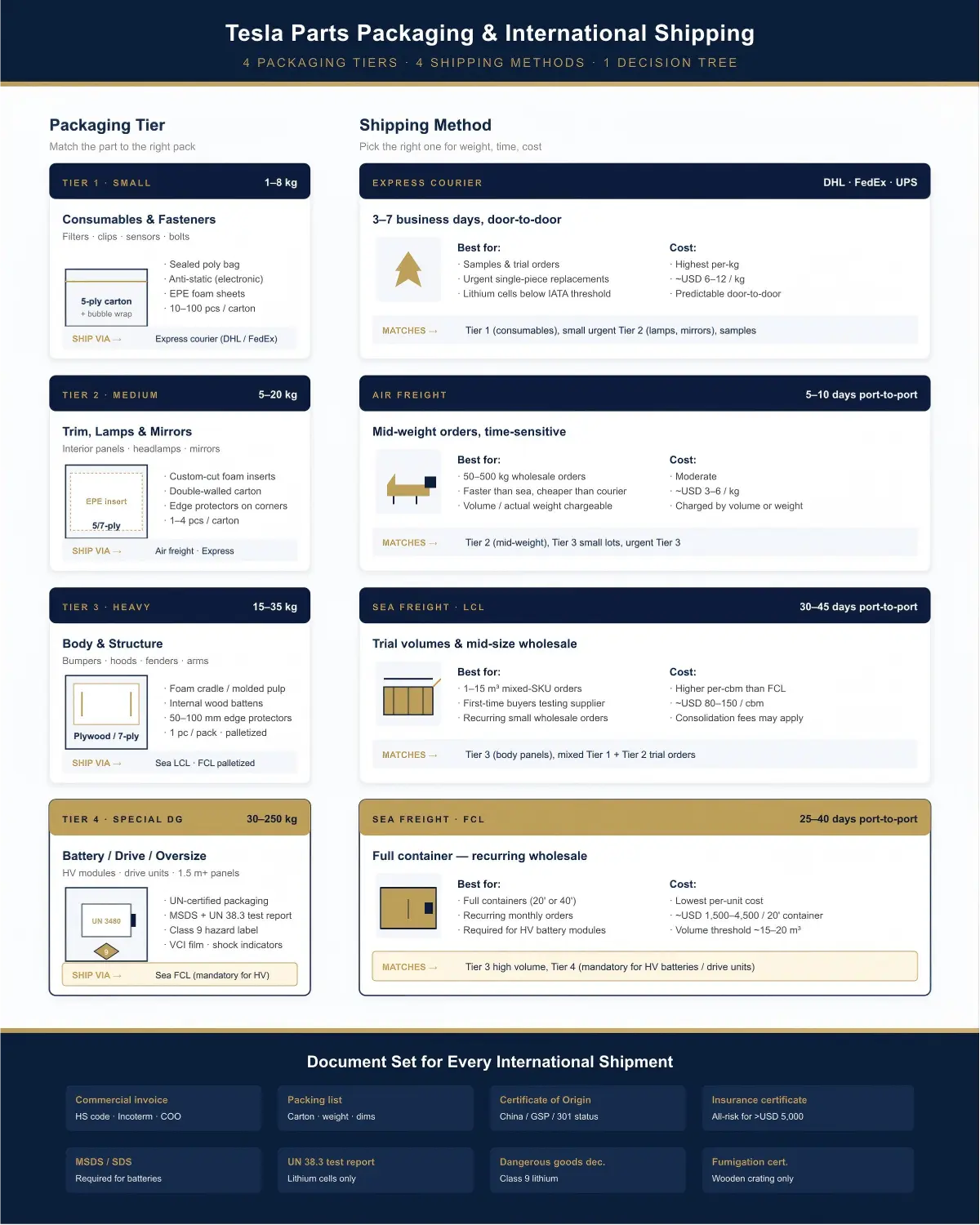
A serious Tesla parts exporter uses roughly four packaging tiers, matched to the part category. Asking your supplier which tier each SKU uses is a fair question — and the answer tells you a lot about whether they're set up for export-grade fulfillment.
Tier 1 — Small Consumables (filters, fasteners, clips, sensors)
- Inner packing: sealed poly bag or anti-static bag for electronics
- Outer carton: 5-ply corrugated export carton, typically 30 × 25 × 20 cm or similar small format
- Cushioning: bubble wrap or EPE foam sheets on all six faces
- Quantity per carton: 10 to 100 units, depending on part size
- Typical gross weight: 1–8 kg per carton
Tier 2 — Mid-Weight Trim and Lamps (interior panels, headlamps, taillights, mirrors)
- Inner packing: foam-lined carton with custom-cut EPE inserts matching the part shape
- Outer carton: 5-ply or 7-ply corrugated, double-walled for lamps and fragile items
- Cushioning: custom foam inserts on every contact face, edge protectors on carton corners
- Quantity per carton: typically 1 to 4 units (lamps rarely packed more than 2 per carton)
- Typical gross weight: 5–20 kg per carton
Tier 3 — Heavy Structural Parts (bumpers, hoods, fenders, suspension arms, HV cables)
- Inner packing: foam cradle or molded pulp insert; large bumpers and hoods often braced with internal wood battens
- Outer carton / crate: reinforced corrugated or plywood crate for items over 1.2 m
- Cushioning: 50–100 mm foam edge protectors, foam corner blocks, strapping
- Quantity per carton: usually 1 unit per pack
- Typical gross weight: 15–35 kg per pack
Tier 4 — Battery Modules, Drive Units, and Oversize Panels
- Battery modules: UN-certified packaging (UN 3480 / UN 3481), Class 9 hazard label, fiberboard or plywood drum-style container, terminal protectors, MSDS included
- Drive units: wooden crate with internal steel bracing, VCI anti-rust film, desiccant, shock indicators on the outside
- Oversize body panels (1.5 m+): plywood crate with internal foam cradles, often shipped on a pallet base
- Typical gross weight: 30–250 kg per pack
International Shipping Methods
Once the parts are packed, the next decision is how they move from the exporter's warehouse to your door. Tesla parts typically travel by one of four methods.
| Method | Best for | Typical transit | Cost signal |
|---|---|---|---|
| Express courier (DHL / FedEx / UPS) | Samples, small urgent orders, batteries below the IATA threshold | 3–7 business days door-to-door | Highest per-kg cost; predictable |
| Air freight | Mid-weight orders (50–500 kg), time-sensitive | 5–10 business days port-to-port, plus last-mile | Moderate; charged by volumetric or actual weight |
| Sea freight — FCL | Full container orders (typically 20' or 40' containers of mixed Tesla parts) | 25–40 days port-to-port | Lowest per-unit cost; requires higher MOQ |
| Sea freight — LCL | Smaller wholesale orders (1–15 m³) | 30–45 days port-to-port | Higher per-cbm than FCL; good for trial orders |
For first-time buyers, LCL sea freight is the most common starting point. For repeat buyers with established volume, FCL becomes economical once a single order exceeds roughly 15–20 m³.
Lithium Battery Shipping — The Special Case
Any Tesla part that contains a lithium cell — 12V lithium auxiliary batteries, high-voltage battery modules, key fobs, certain sensors — falls under international dangerous goods (DG) regulations. The exporter must handle the paperwork; the buyer should know what to expect.
Three regulations apply:
- UN 38.3 — the cell itself must have passed UN 38.3 testing (altitude simulation, thermal, vibration, shock, external short, impact, overcharge, forced discharge). A copy of the UN 38.3 test report travels with the shipment.
- IATA DGR — for any air shipment, the cells must be at or below the watt-hour threshold of the relevant section (Section II for small cells, Section I for larger ones), with the correct Class 9 label and a Shipper's Declaration for Dangerous Goods.
- IMDG Code (sea) — sea freight is generally more permissive for batteries but still requires packaging, labeling, and stowage compliance.
What this means for the buyer:
- Air freight is more expensive and slower for lithium items, and some couriers refuse certain battery categories entirely
- Sea freight is the standard route for battery modules — plan for 30–40 days transit, plus import clearance
- Documentation includes MSDS, UN 38.3 test summary, dangerous goods declaration, and in some markets a battery recycling / EPR certificate
Always confirm with your supplier before placing the order which dangerous goods categories their SKUs fall into. It changes your shipping cost, transit time, and import paperwork significantly.
Customs Documentation
International Tesla parts shipments need a specific document set. Most exporters provide these as part of the standard fulfillment package; verify in advance that they will.
- Commercial invoice — exporter and buyer details, HS code, country of origin, unit and total value, currency, Incoterm
- Packing list — carton count, gross / net weight, dimensions per carton
- Certificate of Origin (COO / CO) — China is typically the issuing country for Tesla parts exports; some markets (e.g. EU GSP, US Section 301) care about this
- HS code — common codes for Tesla parts include 8708 (vehicle body parts and accessories), 8517 (electronic parts), 8507 (batteries)
- MSDS / SDS — required for any chemical or battery component
- Dangerous goods declaration — required for lithium battery shipments (see above)
- Fumigation certificate — required by some markets when wooden crating is used
- Insurance certificate — optional but strongly recommended for orders above USD 5,000
Incoterms — What the Buyer and Exporter Each Handle
Incoterms define who pays for what between the exporter's warehouse and your door. Three are most common for Tesla parts:
- FOB (Free On Board) — exporter delivers the goods onto the vessel at the origin port; buyer takes over from there (ocean freight, insurance, customs, last-mile)
- CIF (Cost, Insurance, Freight) — exporter pays ocean freight and minimum insurance to the destination port; buyer handles customs clearance and last-mile
- DDP (Delivered Duty Paid) — exporter handles everything, including destination customs duties and last-mile to your warehouse; buyer just receives the goods
For B2B buyers new to sourcing from China, DDP removes most of the customs headache but typically costs more than FOB. FOB is best for buyers with their own freight forwarder and customs broker. CIF sits in the middle. There is no single right answer — ask your supplier for all three quotes and compare.
Damage Prevention and Claim Process
Even well-packed Tesla parts occasionally arrive damaged. The question isn't whether damage happens — it's what the process is when it does. Ask your supplier these four questions before you order:
- What's your damage rate? Reputable exporters report under 1% on body panels and under 0.5% on small parts. A supplier who can't answer this number is a red flag.
- What's the photo documentation process? Standard practice: photos of the damaged carton, the damaged part, and the inner packing within 48 hours of receipt, plus the carrier's inspection report.
- What's the resolution? Replacement part on the next shipment, refund, or credit note. Confirm in writing before the order.
- Is shipping insurance included? All-risk marine cargo insurance typically adds 0.3–0.5% of cargo value. For orders above USD 10,000, it's essentially mandatory.
Frequently Asked Questions
How are small Tesla parts (filters, clips, sensors) typically packed for export?
Small parts are usually packed in sealed poly bags (anti-static bags for electronics) inside 5-ply corrugated cartons, with bubble wrap or EPE foam on all six faces. A standard carton holds 10–100 units depending on size. Gross weight per carton is typically 1–8 kg. This is the simplest tier and matches standard e-commerce fulfillment practice.
How are bumpers, hoods, and large body panels packed?
Large body panels are packed individually in reinforced corrugated cartons or plywood crates with foam cradles matching the part shape. Bumpers typically get edge protectors on all corners and internal foam bracing. Gross weight per pack is usually 15–35 kg, and the pack dimensions often exceed 1.2 m on the longest side. These packs are palletized for ocean freight and shipped LCL or FCL.
Do you ship Tesla battery modules internationally?
Yes, but under dangerous goods regulations. Battery modules ship by sea (UN 3480 / UN 3481) with UN-certified packaging, MSDS, UN 38.3 test summary, and a Dangerous Goods Declaration. Air freight is possible for small lithium cells below the IATA watt-hour threshold but is more expensive and slower. Always confirm battery DG classification with your supplier before booking.
What's the difference between FOB, CIF, and DDP?
FOB (Free On Board): exporter delivers onto the vessel at origin port; buyer pays ocean freight, insurance, destination customs, and last-mile. CIF (Cost, Insurance, Freight): exporter pays ocean freight and minimum insurance to destination port; buyer handles customs and last-mile. DDP (Delivered Duty Paid): exporter handles everything, including destination duties and last-mile delivery. FOB is cheapest; DDP is most convenient. CIF is the most common middle ground.
How long does international Tesla parts shipping take?
Express courier: 3–7 business days door-to-door. Air freight: 5–10 business days port-to-port, plus customs and last-mile (typically 7–14 days total). Sea freight LCL: 30–45 days port-to-port, plus 5–10 days for customs and inland delivery. Sea freight FCL: similar transit but cheaper per unit at volume. Add 1–2 weeks of buffer for customs delays in peak season (Q4) or when importing into markets with strict inspection regimes.
What documents come with an international Tesla parts shipment?
Standard set: commercial invoice, packing list, certificate of origin, HS code on the invoice. Add MSDS for any chemical or battery item. Add UN 38.3 test summary and Dangerous Goods Declaration for lithium batteries. Add fumigation certificate when wooden crating is used. Add insurance certificate for high-value orders. Most exporters include these automatically; ask for samples before your first order so you can verify the format matches your import broker's requirements.
Can I mix different Tesla parts in one shipment?
Yes. Mixed-container (LCL) orders are common for trial volumes — typically 1–15 m³ of mixed SKUs in one consolidated pallet or crate. The packing list will itemize each SKU with its carton number and gross weight. Note that dangerous goods (batteries) cannot be mixed with regular cargo in some configurations and may need to ship separately.
How much does shipping cost?
It depends on weight, volume, route, and Incoterm. As a rough benchmark: express courier USD 6–12 per kg; air freight USD 3–6 per kg; LCL sea freight USD 80–150 per cubic meter; FCL sea freight USD 1,500–4,500 per 20' container. Always ask your supplier for a freight quote per order — they know the current rates for your destination and can quote against your exact carton dimensions.
Who handles customs clearance in my country?
Under FOB and CIF terms, you (the buyer) handle customs clearance — typically through your own broker. Under DDP terms, the exporter handles it through their destination agent. Many first-time buyers prefer DDP for the first order to learn the process, then switch to FOB or CIF once they have a broker in place.
What if my Tesla parts arrive damaged?
Document the damage immediately: photos of the carton (all sides), the inner packing, the damaged part, and any shock indicators on the outer pack. Notify your supplier within 48 hours. Most reputable exporters offer replacement on the next shipment, a credit note, or a refund, depending on the case. Shipping insurance (separate from the freight cost) covers damage in transit and is worth buying for orders above USD 5,000.
Can I use my own freight forwarder?
Yes, and for repeat wholesale buyers it's usually the smarter move. Under FOB terms, you book the ocean freight directly with your forwarder at the origin port and arrange everything from there. Under CIF and DDP, the exporter's logistics partner handles the origin leg and you take over at the destination. Either way, having your own forwarder gives you control over transit time, route, and cost.
Do you offer temperature-controlled shipping?
Standard Tesla parts (body, interior, electronics, mechanical) don't need temperature-controlled shipping. The exception is certain battery modules and high-voltage components, where extreme heat (above 60°C in transit) can damage cells. In those cases, the DG packaging already includes thermal protection. Confirm with your supplier if you're ordering sensitive HV components in summer.
Talk to Us About Your Shipment
If you have a Tesla parts order heading overseas — a sample shipment, a trial LCL, or a recurring container program — send us the part list, the destination country, and your target delivery window. We'll come back with packaging tier per SKU, a freight quote per Incoterm, and the document set your customs broker will need.
The right packaging and the right shipping method protect your margin. The wrong ones quietly erode it on every shipment.