
Tesla Chassis & Drivetrain Parts Guide: Drive Units, Axles & Mounts (Model 3, Y, S & X)
Chassis and drivetrain is the heaviest, slowest-moving and highest-value category in the Tesla parts business. A drive unit is not a single component — it is an assembly that combines the electric motor, the single-speed reduction gearbox and the inverter, with its own lubrication and cooling circuits. Ordering one against the wrong generation, drivetrain layout or fluid specification is an expensive mistake, and it is rarely discovered until the unit is on the bench.
This guide covers the parts, the failure patterns that create demand, the fluids and hardware that every job consumes, and what to confirm before ordering chassis and drivetrain parts for Model 3, Model Y, Model S and Model X.
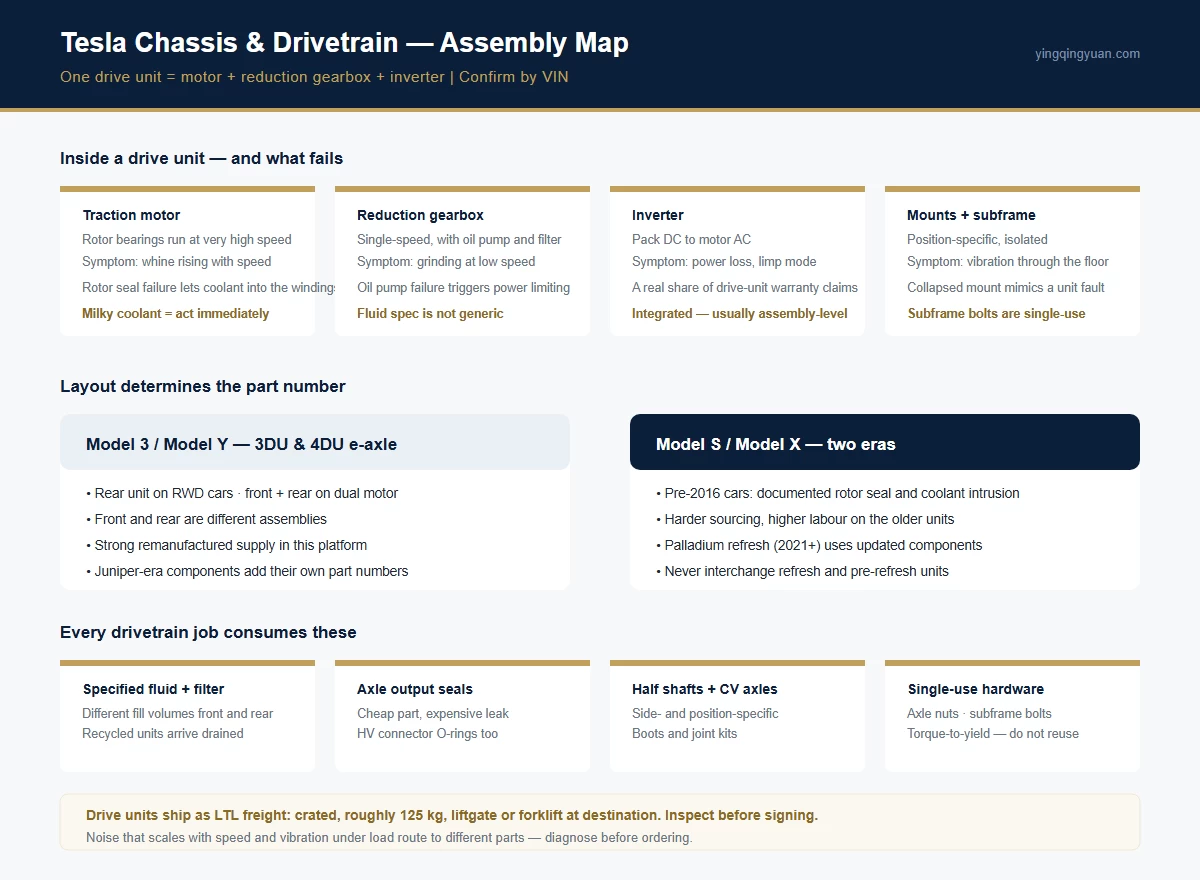
What a Drive Unit Actually Contains
Understanding the assembly is the prerequisite for sourcing it, because "drive unit failure" almost never means every internal part is scrap.
- Traction motor — the stator and rotor assembly, with bearings that support the rotor at very high rotational speed.
- Single-speed reduction gearbox and differential — Tesla's equivalent of a transmission, with its own lubricant and filter.
- Inverter and power electronics — converts pack DC into the AC the motor needs; a distinct failure point inside the same housing.
- Cooling and lubrication interfaces — the oil pump, rotor seal, coolant passages and manifold connections that keep the unit within operating temperature.
Model 3 and Model Y use the e-axle architecture widely referenced as 3DU and 4DU for the front and rear units on 2024–2026 cars. Front and rear units are different assemblies, and a dual-motor car has two of them — which matters both for sourcing and for how a fault is diagnosed.
What Fails, and What It Means for Parts Demand
| Failure | Typical symptom | Parts implication |
|---|---|---|
| Internal oil pump failure | Powertrain alert with power and speed limited; a specific drive-unit fault code is often stored | Sometimes a pump or internal repair; frequently escalates to a full unit on labour grounds |
| Bearing and gearbox wear | Whine that rises with speed, or grinding at low speed | Bearing-level repair is possible on some units; worn reduction gears usually mean assembly replacement |
| Rotor seal and coolant intrusion | Milky or discoloured coolant alongside drivetrain noise, coolant loss without an external leak | Once coolant reaches the windings, insulation damage follows — the practical answer is replacement |
| Inverter fault | Power loss, limp mode, isolation or inverter alerts | Inverter faults are a meaningful share of drive-unit warranty claims; on integrated units this means the assembly |
| Mount and subframe wear | Vibration through the floor or seat, clunks under load changes | Motor mounts, subframe bushings and the single-use bolts that hold them |
Two commercial observations follow. First, drive units are durable — the failures above cluster at high mileage or follow a period of ignored noise, and salvaged or remanufactured units have become a mainstream supply route for Model 3 and Model Y in particular. Second, the front-wheel-drive and dual-motor variants have distinct supply economics: more motors per car, more potential failure points, and higher labour.
Model S and Model X sit slightly apart. Earlier cars, particularly pre-2016 builds, had well-documented rotor seal and coolant intrusion issues, and parts for those older units are harder to source at higher labour cost. Palladium-refresh cars (2021 onward) use updated components that do not interchange with earlier ones.
Half Shafts, CV Axles and Output Seals
The half shaft or CV axle is the drivetrain's wearable link to the wheels, and it is the part most often ordered for drivetrain complaints that turn out not to be the drive unit at all.
- Half shafts and CV axles — front and rear, and side-specific. Length and joint specification differ between positions and between drivetrain layouts.
- Axle output seals — the seal where the shaft leaves the drive unit. A leaking output seal is a common, inexpensive repair that prevents a contaminated unit later.
- Axle nuts and shaft hardware — single-use; a drivetrain job that reuses them will not hold torque correctly.
- Boots and joint kits — the consumable that turns a shaft replacement into an overhaul.
The diagnostic detail worth passing to workshops: a whine that changes with vehicle speed but not engine load points at bearings, gears or a shaft; a vibration felt through the floor under acceleration points at mounts or rotor imbalance. Those two symptoms route to different parts, and supplying the wrong one is the most common drivetrain ordering error.
Mounts, Subframes and Single-Use Hardware
Chassis parts support the drivetrain, and on Tesla they are frequently single-use by design.
- Motor mounts — isolated and position-specific; a collapsed mount transfers vibration into the cabin and is often misdiagnosed as a drive-unit fault.
- Subframes and crossmembers — generation-specific assemblies. Any job that removes a subframe consumes its mounting bolts.
- Torque-to-yield bolts — suspension and subframe fasteners that must be replaced rather than reinstalled, including axle nuts.
- Hub and bearing assemblies — the drivetrain-to-wheel interface, covered in more detail in our wheels and hub bearings guide.
This is where a complete order matters most. A drive unit replacement that arrives without new output seals, O-rings and mounting hardware becomes a second shipment and a delayed car — the same principle that applies to trim clips in interior parts and retainers in body parts.
Fluids: The Specification That Destroys Units
Drive unit fluid is not generic. Tesla specifies specific gearbox lubricants for its e-axle units — formulations such as KAF1 and its successors, and Pentosin EDF-2 for certain applications — with different fill volumes for front and rear units. Coolant for the inverter and motor circuits is specified separately, using the designated Tesla coolant or an approved equivalent, mixed exactly as specified.
Two rules are worth printing on every order: recycled units are drained for transport, so the installer must refill with the correct fluid before the unit moves; and coolant formulations must never be mixed. A rebuilt or salvaged drive unit destroyed by the wrong lubricant in its first hundred miles is not a warranty conversation anyone wants.
Logistics: Why Drive Units Ship Differently
A drive unit weighs roughly 125 kg and arrives crated or palletised. It moves as LTL freight, not as a parcel, and the destination needs a forklift or a liftgate. For international orders, that changes landed cost and lead time, and it is worth stating plainly at quotation stage: inspect the crate before signing, check the aluminium casing for cracks and the connectors and pins for damage, and confirm the output shafts turn freely.
8 Things to Confirm Before Ordering Drivetrain Parts
- Model and generation — including Highland for Model 3 and Juniper for Model Y where drivetrain-adjacent chassis parts differ.
- Drivetrain layout — rear-wheel drive, front unit or dual motor; front and rear assemblies are not interchangeable.
- Front or rear unit — and for dual-motor cars, which of the two has failed.
- Symptom routing — noise that scales with speed versus vibration under load, which points to different parts.
- Fault codes — ask for stored codes; a drive-unit oil pump code and an inverter code lead to different outcomes.
- Fluid and coolant specification — and the correct fill volume for the unit and position.
- Single-use hardware — output seals, O-rings, axle nuts and subframe bolts.
- Freight class — confirm liftgate or forklift at destination, and crating standard for international moves.
Frequently Asked Questions
Is a Tesla drive unit one part or several?
It is an assembly containing the motor, the single-speed reduction gearbox and the inverter, with integrated lubrication and cooling. Some faults can be repaired at component level, but many end in a full assembly replacement.
How long is the drive unit covered by Tesla?
Coverage runs for 8 years with a mileage limit that varies by model — broadly 100,000 miles for Model 3 Rear-Wheel Drive, 120,000 miles for Model 3 Long Range and Performance and for Model Y, and 150,000 miles for Model S and Model X. Confirm against the specific vehicle before quoting a customer.
Can I reuse the axle nuts and subframe bolts?
No. These are designed as single-use, torque-to-yield fasteners. Reusing them risks incorrect clamping load on parts that carry the drive unit and suspension loads.
What noise means the drive unit is failing?
A whine or milling sound that rises with vehicle speed, or grinding at low speed, is the classic pattern. Vibration felt through the floor under acceleration points more often to a motor mount or rotor imbalance — a different repair.
Why does a used drive unit need fluid before installation?
Salvage units are drained for transport. Running a drained unit destroys the internal reduction bearings and the fluid pump within a very short distance, so the correct specified fluid and volume must be filled before the car moves.
Do Model S and Model X drive units interchange with Model 3 or Y units?
No. The assemblies, mounts and surrounding chassis differ between platforms, and within Model S and Model X the pre-2016 and Palladium-refresh units differ again. Confirm by VIN.
Sourcing Tesla Chassis and Drivetrain Parts
Drivetrain is a category where the supplier's value is measured in questions asked before the order, not in stock depth alone. Layout, position, generation, fluid specification and freight are the five fields that decide whether a unit arrives installable — and whether the workshop has to open the same car twice.
Browse our Tesla chassis and drivetrain range by model:
- Tesla Model 3 chassis and drivetrain parts — drive units, half shafts, mounts and subframes
- Tesla Model Y chassis and drivetrain parts — including Juniper-era components
- Tesla Model S chassis and drivetrain parts — including Palladium-refresh units
- Tesla Model X chassis and drivetrain parts — front and rear drive unit assemblies
Related Tesla parts guides
- Tesla suspension and steering parts guide — the chassis side of every drivetrain job
- Tesla wheels, tires and hub bearings guide — hub assemblies and axle-end hardware
- Tesla parts packaging and international shipping — LTL freight, crating and documentation for drive units
- Tesla Model 3 and Model Y parts fitment checklist — generation and layout confirmation by VIN
Send us your VIN list, the drivetrain layout and the fault description, and we will confirm unit position, generation and the fluids and hardware the job needs before you order. Drivetrain parts are the most expensive category to get wrong — one verified order beats three corrections.