
How to Vet a Tesla Parts Supplier: 12-Point Checklist for B2B Buyers
Most Tesla parts supply problems do not start in the workshop. They start in the sourcing decision — a supplier chosen on price and a catalogue PDF, with no test of whether that supplier can confirm a fitment, document a batch, or stand behind a claim six months later.
Tesla makes this harder than most brands. Generations split mid-model-year, some components need software pairing before they function, charging and lighting specifications change by market, and several fasteners are designed to be replaced rather than reused. A supplier who cannot work at that level of detail will cost you more than the margin they offered.
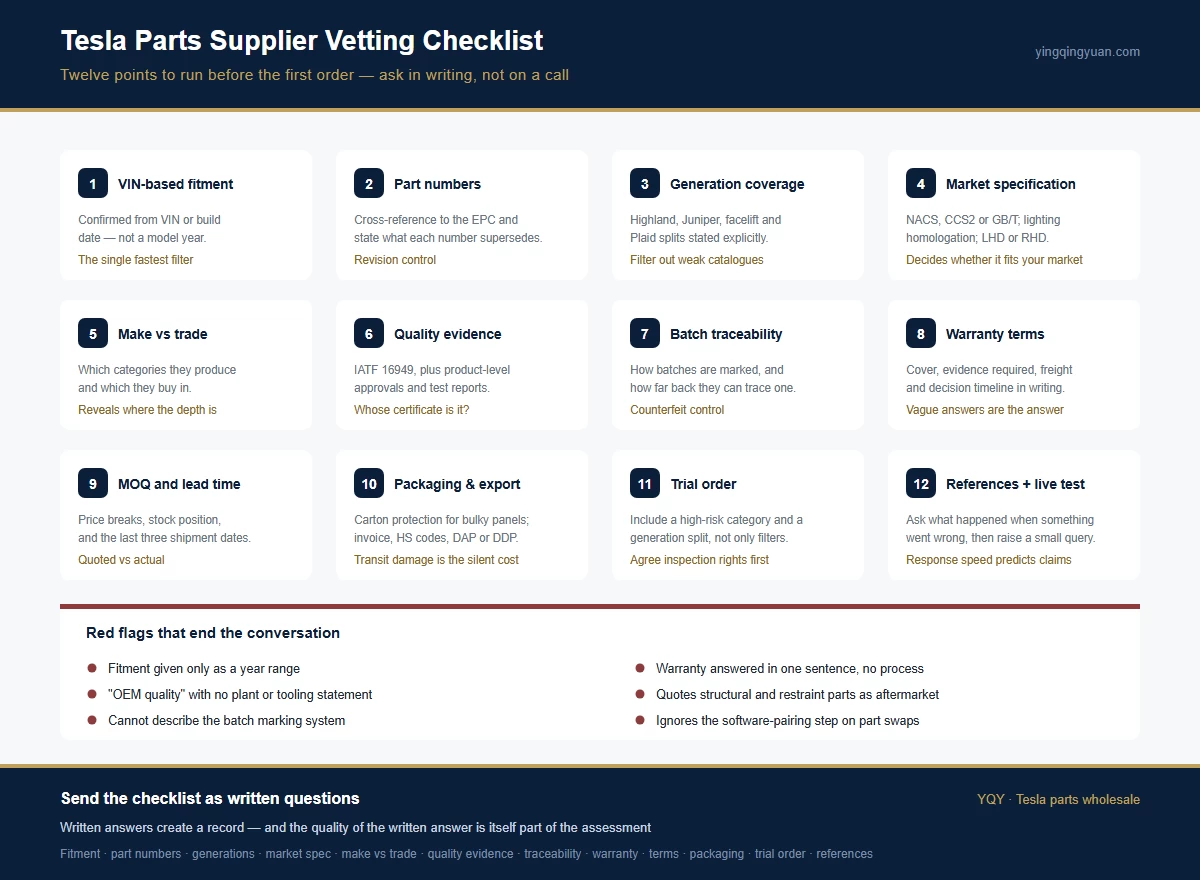
This is the checklist we would want a buyer to run on us. Twelve items, in the order they matter.
1. VIN-Based Fitment Confirmation
Ask the supplier how they confirm a fitment. The acceptable answer is that they work from the full VIN, or from the build date and exact configuration — not from a model year. "2018–2022 Model 3" is not a fitment statement; it is a range that spans a platform change.
A supplier who confirms by VIN will also tell you when the VIN is not enough and they need a photograph or a measurement. That is a good sign, not a bad one.
2. Part Number and Revision Control
Ask for the part number they are quoting, and whether it cross-references to the number in Tesla's electronic parts catalogue. Then ask about revisions. Tesla revises components within a generation, and a supplier who cannot describe how they track revisions will eventually ship you a superseded part.
The practical test: send them a part number and ask what it supersedes and what supersedes it.
3. Generation Coverage, Stated Clearly
| Model | Generations a supplier must distinguish |
|---|---|
| Model 3 | Pre-refresh (2017–2023) and Highland refresh (2023 onward) — different bumpers, lighting tooling and interior architecture |
| Model Y | Pre-refresh (2020–2025) and Juniper refresh (2025 onward), plus the long-wheelbase six-seat variant |
| Model S | Original (2012–2016), facelift (2016–2021) and Plaid refresh (2021–2026) |
| Model X | Original (2015–2021) and Plaid refresh (2021–2026) |
If a supplier's catalogue cannot express those splits, their fitment data is not usable for commercial buying. This is the fastest single filter on the whole list.
4. Market Specification
Tesla parts are not globally uniform. Before you accept a quote, confirm the supplier understands the differences that apply to your market:
- Charging standard — NACS in North America, CCS2 in Europe and many other markets, GB/T in China. Charge port assemblies and harnesses differ.
- Lighting homologation — headlights must meet the destination market's approval, not just fit the body.
- Left- or right-hand drive — steering, mirrors, wipers and interior trim.
- Tyre pressure monitoring — later cars use Bluetooth sensors that are not frequency-specific, while earlier cars split by market frequency.
- Auxiliary battery chemistry — lead-acid and lithium low-voltage systems are not interchangeable.
5. What They Manufacture vs What They Trade
Ask directly which categories the supplier produces and which they buy in. Both models are legitimate, but they carry different risk. A manufacturer controls tooling, batch records and lead time for their own categories and has less control everywhere else.
The answer also tells you where their technical depth actually sits. A supplier who manufactures suspension components will know material grades and torque-to-yield fasteners. That knowledge does not transfer automatically to lighting.
6. Quality System and Test Evidence
Certificates are the entry ticket, not the proof. Ask for both:
- System level — IATF 16949 for automotive production, with ISO 9001 as the minimum.
- Product level — Regulation 90 for brake friction, the relevant ECE or SAE standard for lighting, correct fluid specifications, and dimensional or material reports for structural-adjacent parts.
Then ask who the certificate belongs to. A trading company that forwards a factory certificate it does not control is telling you something important about how a claim will be handled.
7. Batch Traceability and Counterfeit Control
Ask how they mark production batches and how far back they can trace one. Then, on your first delivery, photograph the batch code and try to have it traced. Suppliers who can do this quickly are manufacturing or working directly with manufacturing. Suppliers who cannot are reselling.
Counterfeit risk in this market is real and concentrated in high-value, high-recognition parts. Blurred packaging print, rough castings, prices far below the market and part numbers that cross-reference to nothing are the usual tells.
8. Warranty Terms and the Claims Process
Get this in writing before the first order, and be specific:
- How long is the warranty, and from what date — production, shipment or fitment?
- Does it cover the part only, or labour and freight as well?
- Who pays return freight on a confirmed defect?
- What evidence is required — photographs, part number, batch code, installation notes?
- How long does a claim decision take?
A supplier with a defined claims process and a real defect record will answer these in a paragraph. A supplier with none will answer them vaguely, and that vagueness is the answer.
9. MOQ, Price Breaks and Lead Time
Map the commercial terms against how you actually sell:
- MOQ — per part or per order, and whether it is negotiable for trial quantities.
- Price breaks — where the real steps are, and whether they are stable or re-quoted every order.
- Lead time — quoted production time versus actual. Ask for the last three shipment dates on a comparable order.
- Stock position — whether fast-moving items ship from stock or are made to order. This decides your own lead time to your customers.
10. Packaging and Export Documentation
Bulky parts — bumpers, hoods, doors, suspension assemblies — fail in transit more often than they fail in service. Ask how the part is protected, whether cartons are drop-tested for the weight involved, and whether glass or lighting assemblies ship in rigid frames.
On documentation, confirm who handles commercial invoice, packing list, HS classification, certificate of origin where required, and whether the supplier can quote DAP or DDP terms. The full picture is covered in Tesla parts packaging and international shipping questions.
11. Trial Order and Pre-Shipment Inspection
Never open with a container. Run a trial order that includes:
- At least one high-risk category, not only filters and wipers
- At least one part where the generation split is easy to get wrong
- An agreed pre-shipment inspection right — photographs, carton weights and batch codes before dispatch
A supplier who resists a documented pre-shipment check on a first order is telling you how the relationship will run.
12. References, and a Live Test of the Claim Process
Ask for two references in your region or a comparable market, and ask them one question: what happened when something was wrong?
Then run your own live test. On the first order, raise a small, genuine query — a fitment question, a batch code request, a document correction. The speed and precision of that response predicts the response to a real claim far better than any reference.
Red Flags
| Red flag | Why it matters |
|---|---|
| Fitment stated only as a year range | The platform splits mid-range; returns follow |
| "OEM quality" with no tooling or plant statement | The phrase has no defined meaning and usually hides generic tooling |
| No part-number cross-reference | Revisions cannot be controlled |
| Cannot describe the batch marking system | No traceability means no real claims process |
| Warranty answer is a single sentence with no process | Claims will be argued, not resolved |
| Price far below the market across every category | Either the material grade or the testing is missing |
| Happy to quote structural and restraint parts as aftermarket | Shows no understanding of Tesla's own repair requirements |
| Ignores the software-pairing step | Parts arrive correct and features still do not work |
Put It in Writing
Send the checklist as questions rather than discussing it on a call. Written answers create a record, and the quality of the written response is itself part of the assessment. Six questions carry most of the weight:
- How do you confirm fitment — VIN, build date, or model year?
- Which of these categories do you manufacture, and which do you trade?
- What quality system certifications apply, and to which facility?
- How are production batches marked and traced?
- What are your warranty terms and the claims process, in full?
- What are the last three shipment dates on an order like ours?
Pair this with the technical side — how to check Tesla aftermarket part fitment and the Model 3 and Model Y fitment checklist — and with the commercial framework in wholesale Tesla replacement parts: what buyers should confirm.
Frequently Asked Questions
What is the single most important question to ask a Tesla parts supplier?
How they confirm fitment. If the answer does not involve the VIN, the build date or the exact configuration, nothing else in their catalogue can be relied on for commercial buying.
Should I buy from a manufacturer or a trading company?
Neither is automatically better. A manufacturer controls tooling, batches and lead time in their own categories; a good trading company can assemble a broader range and handle export. What matters is whether they are clear about which role they play, rather than claiming both.
How large should a first order be?
Small enough to lose without damage, broad enough to test a high-risk category and a generation-split part, with an agreed pre-shipment inspection and documented batch codes. A container on a first order tests nothing except your luck.
What warranty should I expect on aftermarket Tesla parts?
Terms vary, so the length matters less than the process. A shorter warranty with a defined claim route, stated evidence requirements and a decision timeline is worth more than a long warranty with no procedure attached.
How do I check a supplier's fitment data before ordering?
Send two or three part numbers with VINs that should and should not fit, and see whether their answers match reality. The mismatches are as informative as the matches.
Is a low price ever the right reason to switch supplier?
Only on categories where the part carries no safety, structural or software dependency. On those, the cost of one wrong container exceeds years of the margin you saved.
Related Tesla parts guides
- Tesla OEM vs aftermarket parts: a 2026 sourcing guide — which categories tolerate aftermarket supply and which do not
- How to submit a Tesla parts inquiry — what to send so the first quote is the right one
- Tesla parts packaging and international shipping questions — the export side of the same decision
- Tesla Model S & Model X parts guide after the 2026 production end — a good test case for any supplier's generation knowledge
Run the twelve points against us. Send your categories, destination markets and volumes, and we will answer each one in writing — including the parts we do not recommend buying aftermarket.