
Tesla Model S & Model X Parts Guide: Sourcing After the 2026 Production End
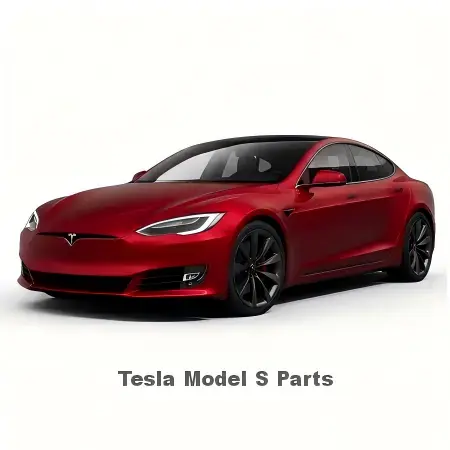
Tesla built its last Model S and Model X at Fremont in May 2026. The line that produced them is being rebuilt to build Optimus robots, and the two cars that started Tesla's move into the mass market are officially out of production. That does not mean they stop needing parts. It means the parts market for them changes shape — and for distributors, workshops and parts traders, that change is the opportunity.
This guide covers what the production end actually changes, which Model S and Model X components are shared with the Model 3 and Model Y, which are unique to the platform, and what to confirm before you place an S/X parts order in 2026.
What Actually Changed in 2026
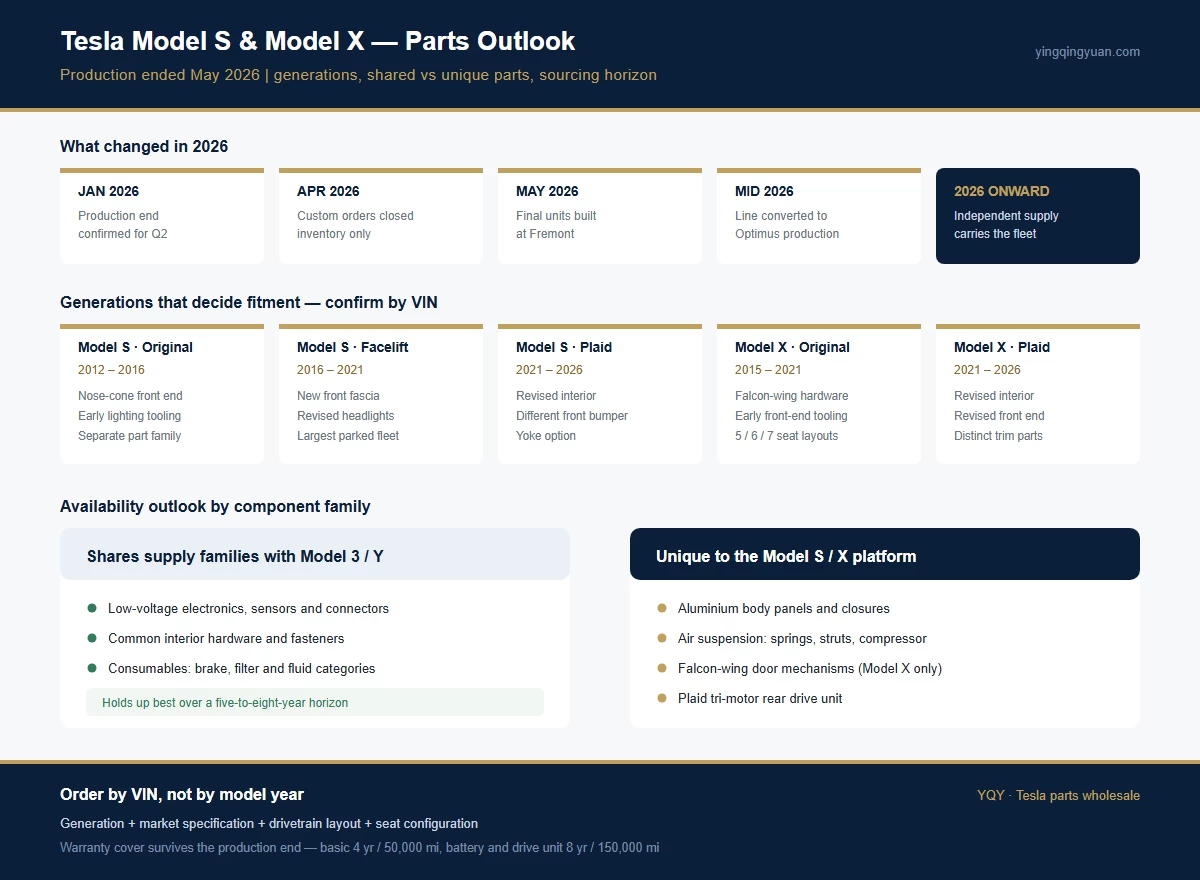
| Date | Milestone | What it means for parts buyers |
|---|---|---|
| January 2026 | Tesla confirms Model S and Model X will end production before the close of Q2 2026 | Order books start to close; last-build interest rises |
| 1 April 2026 | Custom orders stop worldwide — only existing inventory remains | New-car flow into a market ends; the parked fleet becomes the entire demand base |
| 9–10 May 2026 | Final Model S and Model X units roll off the line at Fremont | Production-date-split parts stop changing; the catalogue is now frozen |
| 21 May 2026 | Musk and Signature-series owners mark the final handover | Scarcity pricing on remaining inventory; collector interest in late cars |
| Mid 2026 onward | The S/X line is dismantled within roughly four months and converted to Optimus production | Tesla's own new-part supply for S/X narrows over time — which is where aftermarket supply steps in |
The practical point for anyone buying parts: the model is no longer a moving target. Every part number, every generation split and every revision is now fixed, which makes catalogue work far easier than it was while the cars were still being revised model year by model year.
Three Supply Streams, Not One
After a flagship model ends, parts do not come from a single source. They come from three, and the mix changes over the next five to eight years.
- Tesla's own service inventory. Tesla has said S/X owners will continue to receive software updates, service and parts support, and the battery and drive-unit warranty is a contractual obligation that survives the production end. Warranty work keeps a baseline of genuine parts moving through the network.
- Surplus genuine stock released to the aftermarket. Tesla has been clearing excess genuine S/X components — parts it judges it will not need for future service — through bulk liquidation channels. That stock reaches independent repairers and resellers at well below service-counter pricing, which is a genuine opportunity for anyone building an S/X line right now.
- Third-party and independent supply. Tesla has also indicated it intends to release design documentation and related technical material for the S/X platform. Whatever the timing, the direction is clear: the further the model recedes from production, the more the independent supply chain carries the fleet.
For a parts business, that means the S/X opportunity is not a spike — it is a long tail. Cars stay on the road far longer than they stay in production, and a discontinued premium platform with a few hundred thousand cars still in service is exactly the kind of fleet that needs a reliable aftermarket supply line.
The Generations That Decide Fitment
Model S and Model X never carried generation badges, but the platform changed substantially three times. Ordering against "Model S" or "Model X" alone is the fastest way to get a return.
| Model | Generation | Approx. build years | What changes for parts |
|---|---|---|---|
| Model S | Original | 2012 – 2016 | Nose-cone front end, early lighting and bumper tooling — a separate family |
| Model S | Facelift | 2016 – 2021 | New front fascia and headlights; the most common S generation in the parked fleet |
| Model S | Plaid / refresh | 2021 – 2026 | Revised interior, yoke option, different front bumper and wheel tooling |
| Model X | Original | 2015 – 2021 | Falcon-wing door hardware, early front-end tooling |
| Model X | Plaid / refresh | 2021 – 2026 | Revised interior and front end; a distinct set of body and trim parts |
Always confirm the build date from the VIN rather than trusting a model year. Cross-year changeover is normal on this platform, and the 2021 refresh does not follow the model-year boundary cleanly.
Shared With Model 3 / Y, or Unique to S / X
The single most useful thing to know about S/X sourcing is which parts you can treat as platform-common and which you cannot.
| Category | Availability outlook | Sourcing note |
|---|---|---|
| Electronics, sensors, connectors | Good — shared families | Many low-voltage components, sensors and connectors sit in the same supplier families as Model 3/Y; availability holds up |
| Interior hardware and trim | Mixed | Fasteners, switches and common hardware stay available; model-specific trim panels and seat parts are S/X-only |
| Suspension (including air suspension) | Watch closely | Air springs, struts and compressor assemblies are S/X-specific and already a top aftermarket category |
| Body panels and closures | Hardest long term | Aluminium panels are unique to the platform; the further out you go, the more this matters |
| Falcon-wing door mechanisms | Model X only | No shared equivalent anywhere in the range — a specialist category |
| Plaid tri-motor rear drive unit | Specialist | High-value, low-volume; treat as a made-to-order item |
High-Demand S/X Categories to Stock
These are the categories that keep a parked fleet running, and where buyers place the most repeat orders.
- Model S suspension & steering and Model X suspension & steering — air springs, control arms and bushings sit at the top of the list on older cars.
- Model S brake parts — pads and rotors are consumables with predictable demand and no software pairing step.
- Model X body parts and Model S body parts — bumpers, fenders and closures for repair work, where availability is the differentiator.
- Model S lighting — headlights are generation-specific, so the facelift and Plaid parts do not interchange.
- Model X cooling & HVAC — compressors, condensers and blower assemblies age out on a fleet this old.
- Model S electrical — low-voltage batteries, charge port assemblies and sensors.
- Model X interior and Model S chassis & drivetrain — the slow-moving but high-value end of the catalogue.
The Warranty and Legal Picture
Buyers ask whether parts support simply stops. It does not, but the rules differ by market:
- Warranty cover survives the production end. The S/X basic vehicle warranty runs 4 years / 50,000 miles, and the battery and drive unit warranty runs 8 years / 150,000 miles with a minimum 70% capacity retention guarantee. Tesla cannot cancel that obligation because the model stopped.
- United States. There is no single federal rule that fixes a parts-supply period for a discontinued model. In practice, manufacturers support a model for around a decade, and parts common to vehicles still in production stay available by default.
- China. The rules are explicit — manufacturers must keep compliant replacement parts available for at least five years after a model stops being sold.
- Europe. Competition rules require vehicle manufacturers to make spare parts available to independent repairers, which keeps the independent channel supplied.
Read those together and the takeaway for a parts business is straightforward: the legal floor protects the near term, and the aftermarket carries the long term. Nobody is going to be left without options, but the buyer who plans five years out will do considerably better than the one who plans one.
What to Confirm Before You Order S/X Parts
- Full VIN, not a model year. The 2016 and 2021 changeovers both cut across model years.
- Which generation. Original, facelift or Plaid — the front end, lighting and interior all differ.
- Left- or right-hand drive. Relevant for steering, mirrors, wipers and interior trim.
- Market specification. Charging standard and lighting homologation differ between North America, Europe, the Middle East and Asia.
- Air suspension or coil. Decides the entire front and rear suspension bill of materials on Model S.
- Trim level and seat configuration for interior parts — especially on the six- and seven-seat Model X.
- Whether the part needs software work. Some components are physically correct but need pairing before the feature works.
- One-time fasteners. Several suspension and structural fasteners are torque-to-yield and must be replaced, not reused — order them with the part.
If you are building an S/X line, start with the consumables that have no software dependency and a stable failure curve: brakes, suspension wear items, cooling components and low-voltage parts. Add body and lighting once you have the generation mapping nailed down. The full method is set out in our guide to checking Tesla aftermarket part fitment, and the wholesale side is covered in what buyers should confirm on wholesale Tesla replacement parts.
Frequently Asked Questions
Can I still buy new parts for a Model S or Model X?
Yes. Tesla continues to supply parts for both models, and the warranty on cars still in cover remains valid. Independent supply is also growing, and surplus genuine stock has been released into the aftermarket in bulk.
Will Model S and Model X parts become hard to find?
Gradually, and unevenly. Electronics and hardware that sit in shared supplier families hold up well. Aluminium body panels, air suspension components, falcon-wing door mechanisms and the Plaid rear drive unit are the parts to watch over a five-to-eight-year horizon.
Are Model 3 or Model Y parts interchangeable with the Model S or Model X?
Some are, and it is never safe to assume. Certain electronics, sensors, hardware and fasteners carry across, but almost nothing structural or body-related does. Confirm by part number and VIN before you commit.
Does using aftermarket parts affect the remaining Tesla warranty on an S or X?
Under US law, fitting an aftermarket part does not automatically void the warranty — the manufacturer has to show that the part caused the specific failure being claimed. Structural repair is the clear exception: Tesla's repair documentation requires new OEM parts and approved fasteners for bonded structural work.
Is it worth stocking Model S and Model X parts now that production has ended?
For a parts business, yes — with the right mix. A discontinued premium platform means a fixed, ageing fleet that needs consumables, suspension and cooling parts for years. Volume is lower than Model 3/Y, but so is competition, and the cars are worth repairing.
How do I confirm the exact part for a specific S or X?
Send the full VIN and a description or photo of the failed part. Generation, market specification and drivetrain layout all have to line up before a part number is reliable.
Related Tesla parts guides
- How to check Tesla aftermarket part fitment — the VIN and build-date method that applies to every S/X order
- Tesla Model 3 and Model Y parts fitment checklist — the same discipline for the volume models
- Tesla body parts buyer's guide — panels, bumpers and closures explained
- Tesla parts packaging and international shipping — freight and documentation for bulky body and suspension orders
Send us your VIN list, the generation and the failed component, and we will confirm the correct part number, market specification and the fasteners the job needs before you order. On a platform that just left production, an order confirmed once is worth three replacements.