
Tesla Headlight & Tail Light Replacement Guide: Model 3, Y, S & X
Lighting is the highest-value exterior part on a Tesla — and the one buyers most often mis-order. A single headlight assembly can cost more than a complete set of brake components, and the fitment variables are unforgiving: generation, side, spec region, connector type and software calibration all have to line up.
This guide is written for body shops, rebuilders, distributors and parts resellers sourcing Tesla lighting for Model 3, Model Y, Model S and Model X. It explains the three headlight technologies currently on the road, the SAE-versus-ECE specification split that causes the most failed export orders, the part numbers worth knowing, and what replacement actually involves.
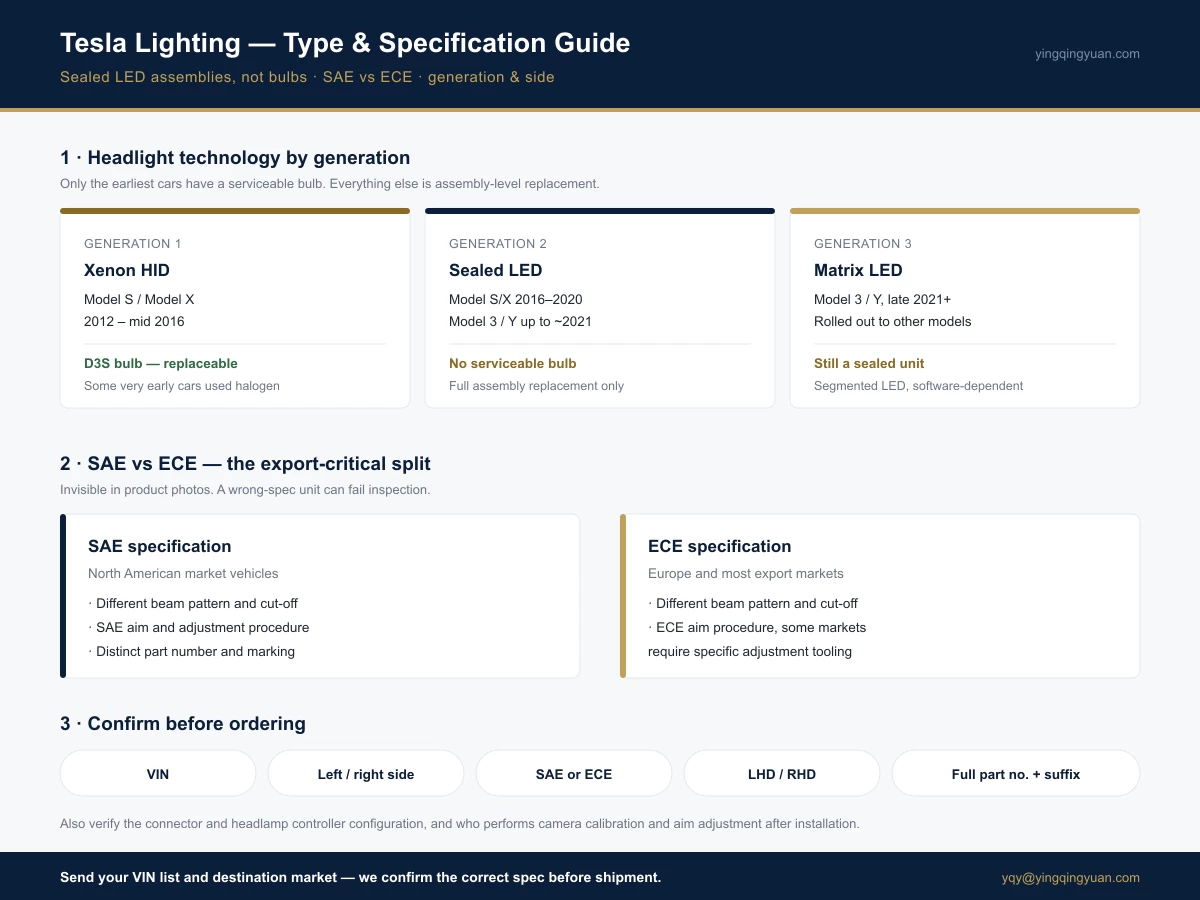
First: Does Your Tesla Actually Have a Bulb?
For the vast majority of Tesla owners and repairers, the answer is no. What looks like a failed bulb is almost always an assembly-level failure, and the repair involves replacing the entire headlight unit rather than a lamp inside it.
The only Teslas with a genuinely replaceable bulb are early Model S and Model X built roughly between 2012 and mid-2016, which used D3S xenon HID bulbs (some very early cars used halogen). Every Model 3, Model Y and Cybertruck, and every post-facelift Model S and Model X, uses a sealed LED or matrix LED assembly with no user-serviceable bulb.
Practical consequence: do not quote a "bulb replacement" for a modern Tesla. Quote an assembly. This single misunderstanding is responsible for a large share of inaccurate repair estimates.
The Three Headlight Technologies on Tesla Today
1. Early Xenon HID — Model S / Model X (2012 to mid-2016)
The only bulb-serviceable generation. US-spec cars used D3S xenon bulbs. Because the bulb itself is inexpensive but the diagnostic and labour path is not, owner-reported costs for what should be a simple swap range wildly. For buyers, this generation is a small, specialised parts market — bulb packs, ballasts and igniters rather than complete assemblies.
2. Sealed LED — Model 3 and Model Y (2021 and earlier), Model S/X (2016–2020)
A fully sealed unit. If the driver, projector or internal electronics fail, the whole assembly is replaced. No disassembly, no bulb. These units are still widely traded and are the most common used-OEM item in the lighting category.
3. Matrix LED — Model 3 and Model Y (roughly late 2021 onward)
Matrix hardware uses individually controlled LED segments — on the order of a hundred per headlight — enabling adaptive beam patterns. Important nuance for buyers: even with matrix hardware, a failure still means replacing the sealed assembly, not a bulb. Hardware and software capability have also rolled out at different times across markets, so two cars with visually identical headlights can behave differently depending on software level.
SAE vs ECE: The Specification Split That Breaks Export Orders
This is the single most important detail for anyone importing or exporting Tesla lighting, and it is invisible in product photos.
Tesla builds lighting to regional standards. North American vehicles use SAE specification headlights. European and most other export markets use ECE specification. The units differ in beam pattern, cut-off geometry, marking and sometimes connector or controller configuration. A SAE headlight fitted to a European car can fail inspection; an ECE unit fitted to a North American car may not meet local requirements either.
Compounding this, headlight aim and adjustment procedures are documented separately for SAE and ECE vehicles, and some markets add further requirements — for example, ECE-spec vehicles in certain regions require specific beam adjustment tooling and procedures.
Buyer rule: confirm the spec region before price. Ask for the part number and the specification marking, and state the destination market in your inquiry. If a supplier cannot tell you whether a unit is SAE or ECE, treat that as a red flag.
Left, Right — and When You Need a Pair
Tesla headlights are handed. Left-hand and right-hand units are different parts with different part numbers and must be ordered correctly. In practice, a single-side impact usually damages one assembly, but there are two situations where buyers should consider a pair:
- Cosmetic matching. Aged lenses yellow and haze at different rates. Replacing one headlight on a five-year-old car can leave a visible brightness and clarity mismatch.
- Software-linked routines. Some replacement procedures and calibration routines are documented for pairs, depending on model and market.
Also plan for the drive side: markets with left-hand traffic require right-hand-drive beam patterns, which is a separate specification again.
Part Numbers Worth Knowing
Tesla part numbers follow a base number plus a revision suffix, and the suffix matters. For Model 3 and Model Y LED headlight assemblies, the widely referenced base numbers include 1514952 for one side and 1514953 for the other, with revision suffixes such as -00-C and -00-D in circulation. Different suffixes can correspond to different production periods and internal revisions.
Never order from a base number alone. Always confirm the full part number, including suffix, against the vehicle's VIN. A supplier who quotes only the base number has not verified anything.
Tail Lights: Where Generation Differences Hit Hardest
Tesla has redesigned rear lighting more aggressively than front lighting across recent refreshes, which makes tail lights a high-error category:
| Model / Generation | Rear Lighting | Key Ordering Note |
|---|---|---|
| Model 3 pre-facelift (2017–2023) | Two-piece inner and outer lamps per side | Inner and outer are separate parts; both often needed after a rear impact |
| Model 3 Highland (2024+) | Redesigned rear lamp with new signature | Not interchangeable with pre-facelift lamps |
| Model Y pre-facelift (2020–2024) | Two-piece inner and outer lamps | Liftgate-mounted and body-side lamps are separate parts |
| Model Y Juniper (2025+) | Full-width rear lightbar treatment | Lightbar assembly and liftgate trim are generation-specific |
| Model S (2016–2020) / Model X (2016–2020) | Full assembly per side | Verify North American vs EU version |
| Model S / X Palladium (2021+) | Revised rear lamp design | Refresh units do not fit pre-refresh cars |
Note that "inner" and "outer" tail lamps are distinct parts on several models. Buyers ordering "a tail light" frequently need two components per side, plus the associated trim or access panel. Quoting the complete set avoids a second shipment.
What Replacement Actually Involves
Replacing a Tesla headlight assembly is not a bolt-off, bolt-on job. On current models the documented procedure typically requires:
- Opening the front fascia (bumper cover) to gain access
- Disconnecting the headlight connector — which uses a locking tab that must be released correctly, not forced
- Releasing the assembly from its alignment stud, clips, datum and mounting bolts
- Reinstalling with correct fastener torque and confirming clips and datums are fully engaged before tightening
- Clearing camera calibration and releasing the vehicle into service mode where required
- Adjusting headlight aim to the correct SAE or ECE procedure
Because the fascia has to come off, headlight replacement is usually combined with fascia or fender work — which is why lighting is a natural bundling opportunity for a supplier who also carries body panels.
Cost: OEM vs Aftermarket vs Used
| Route | Typical Cost | Best For |
|---|---|---|
| New OEM, installed at service centre | $1,200–$1,800 per unit | Insurance work, late-model cars, warranty documentation |
| New OEM, part only | Approx. $1,000–$1,250 | Shops performing their own labour |
| Aftermarket or verified used assembly, self-installed | $250–$400 | Cost-sensitive repairs, older vehicles, rebuilders |
| Xenon bulb replacement (early Model S/X only) | Wide range | 2012–mid-2016 cars only |
The gap between OEM and aftermarket pricing is the largest in the entire Tesla parts catalogue, which is exactly why lighting attracts low-quality supply. For visible, safety-critical, ADAS-adjacent parts, condition verification matters more than unit price.
8 Things to Confirm Before Ordering
- VIN. The authoritative fitment key.
- Generation. Pre-facelift, Highland, Juniper or Palladium.
- Side. Left or right — they are not interchangeable.
- Spec region. SAE (North America) or ECE (Europe and other markets), plus LHD or RHD beam pattern.
- Full part number including revision suffix. Not the base number alone.
- Connector and controller configuration. Some units include or require a separate headlamp controller.
- Inner and outer tail lamp components. Order the complete set, not just "a tail light".
- Calibration plan. Confirm who will perform camera calibration and aim adjustment after installation.
Frequently Asked Questions
Can I just replace the bulb in my Tesla headlight?
Only on early Model S and Model X built between 2012 and mid-2016, which use D3S xenon bulbs. Every Model 3, Model Y, Cybertruck and post-facelift Model S/X uses a sealed assembly and requires full replacement.
Are aftermarket Tesla headlights any good?
Quality varies significantly. For safety-critical, ADAS-adjacent lighting, insist on confirmed condition, correct spec region and intact mounting tabs. A unit with cracked tabs or internal moisture is a delay waiting to happen, regardless of price.
Will a Model Y headlight fit a Model 3?
No. Despite sharing a platform, Model 3 and Model Y use different headlight assemblies with different mounting geometry and part numbers.
Why do Tesla headlight prices vary so much?
Three main reasons: OEM versus aftermarket supply, generation (newer Highland and Juniper tooling is scarcer), and spec region (ECE units are less common in some markets). The gap between an OEM assembly priced in four figures and a verified used unit in the low hundreds is real, and reflects supply route rather than a like-for-like comparison.
Do Tesla tail lights need programming after replacement?
In most cases the lamp is a direct electrical replacement, but adjacent systems may need attention. If the repair involved fascia or camera-area work, camera calibration and a software routine are typically required. Confirm the full procedure for your specific model before quoting labour.
Sourcing Tesla Lighting for Your Business
Lighting is a high-value, high-error category. The way to protect margin is to verify fitment before the order ships, not after a comeback.
Browse our Tesla lighting range by model:
- Tesla Model 3 lighting parts — headlights, tail lamps, fog lights
- Tesla Model Y lighting parts — including Juniper-generation units
- Tesla Model S lighting parts — LED assemblies and refurbished options
- Tesla Model X lighting parts — front and rear assemblies
Send us your VIN list and destination market. We will confirm the correct side, generation and SAE/ECE specification for every unit before you commit — so the right light arrives the first time.