
Tesla Body Parts Buyer's Guide: Bumpers, Fenders, Hoods & Doors (Model 3, Y, S & X)
Body panels are the single largest category in Tesla collision repair — and the one where a wrong purchase costs the most. A fascia that arrives with the wrong sensor cutouts, a fender stamped in the wrong material, or a hood that fits a pre-facelift car but not a Highland build will stop a repair bay for days.
This guide breaks down what professional buyers — body shops, rebuilders, distributors and parts resellers — should confirm before ordering Tesla body parts for Model 3, Model Y, Model S and Model X. It covers the four main panel families, the generation splits that trip up most orders, material specifications, realistic cost ranges, and the supporting parts that are usually forgotten until reassembly.
The Four Body Panel Families You'll Source Most
1. Front and Rear Fascias (Bumper Covers)
The fascia is the outer cosmetic shell. On Tesla it is a large, single-piece moulding that also carries the parking sensor holes, camera apertures, tow hook cover and lower grille insert. It is almost always the first part damaged in a low-speed impact and the most frequently ordered body part.
The critical detail: a fascia is not just a shape. It is a trim-level and sensor-layout specific part. A base Model 3 fascia and a Performance fascia from the same model year can differ in lower valance profile, fog light apertures and sensor positions. Always confirm against the VIN, not the model year alone.
2. Fenders (Front Wings)
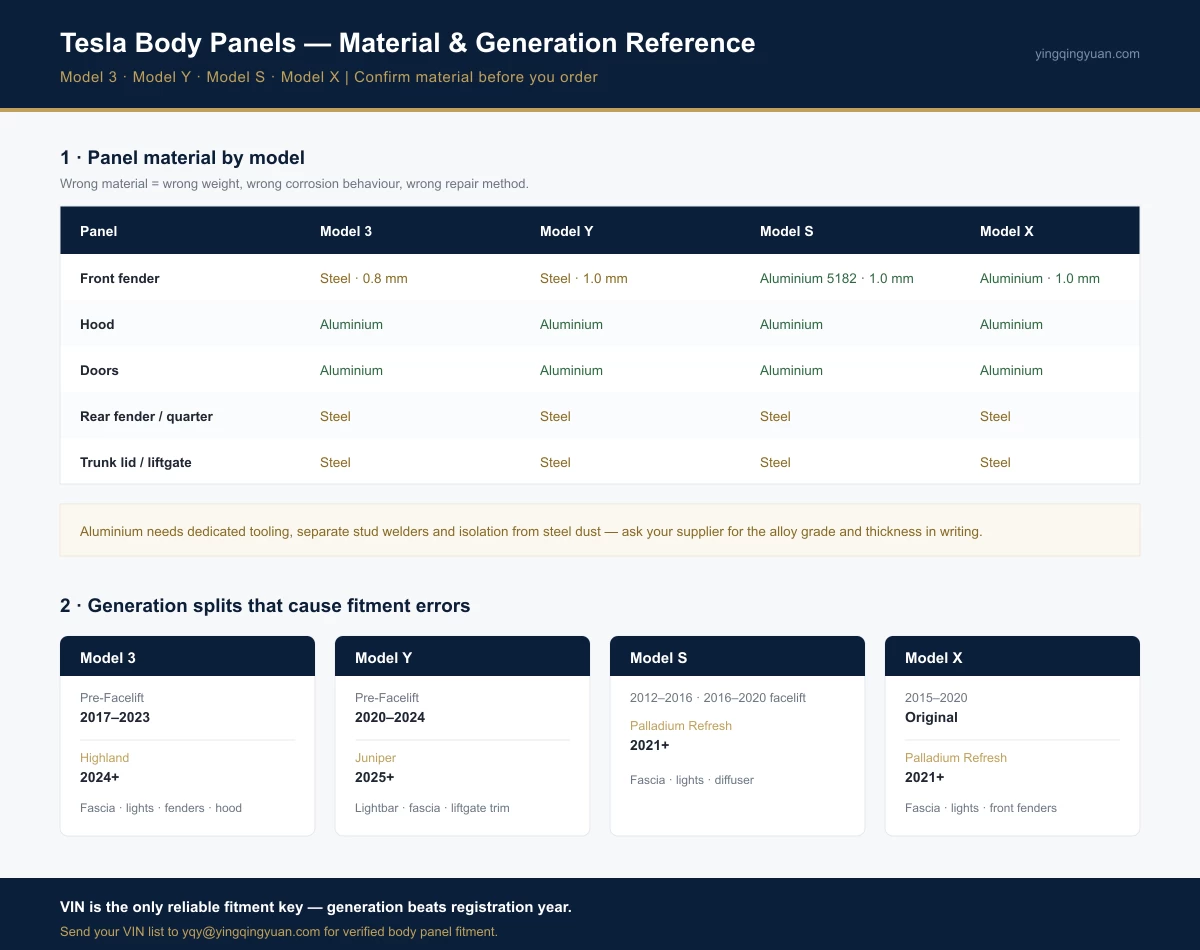
Tesla fenders are structural-adjacent cosmetic panels bolted to the body. They are a common repair item after side impacts, parking damage and rust in road-salt markets. Fender orders fail most often for two reasons: the buyer orders for "Model 3" without checking the generation, and the buyer assumes the material matches across models — it does not (see the material table below).
3. Hoods
The hood on all four Tesla models is a full aluminium stamping. This matters for repair economics: aluminium hoods cannot be repaired with conventional steel techniques, so a creased hood is usually a replacement rather than a repair. Dented but not creased units can sometimes be saved, but most collision work results in a new hood order.
4. Doors, Liftgates and Trunk Lids
Door shells, liftgate assemblies and trunk lids are high-value, high-freight items. Used OEM is genuinely competitive here — a verified, undamaged door shell can save a meaningful percentage over new OEM without sacrificing panel gap quality. The catch is verification: a panel with hidden creases, previously repaired tabs or prior paintwork creates extra body labour that erases the saving.
Don't Forget the Supporting Parts
This is where most orders fall short. A fascia alone rarely completes a repair. Buyers should source these together where possible:
- Bumper reinforcement bar and energy absorber
- Side brackets, retainer clips and push-pin clip kits
- Lower valance and lower grille insert
- Splash shields and wheel arch liners
- Tow hook cover
- Fender garnish and trim pieces
- Hood hinges and latch components
A missing bracket or a wrong lower grille insert can stall reassembly just as effectively as a wrong fascia. Bundling these parts at the quotation stage is one of the simplest ways to reduce comeback rates.
Why the Same Model Year Can Take Different Parts
Tesla updates its vehicles mid-cycle, without a clean model-year break. Three generation splits account for most body-part fitment errors:
| Model | Generation A | Generation B | What Changes |
|---|---|---|---|
| Model 3 | Pre-Facelift (2017–2023) | Highland (2024+) | Front fascia, headlights, fenders, hood profile, tail lights, rear fascia |
| Model Y | Pre-Facelift (2020–2024) | Juniper (2025+) | Front lightbar, fascia, fenders, rear lightbar, liftgate trim |
| Model S | 2012–2016 / 2016–2020 facelift | Palladium Refresh (2021+) | Fascia, headlights, fenders, rear diffuser, trim |
| Model X | 2015–2020 | Palladium Refresh (2021+) | Fascia, headlights, front fenders, rear trim |
Because changes are introduced mid-year, a 2023 registration can carry 2024-generation parts, and vice versa. Production date — read from the door jamb label — is more reliable than registration year, and the VIN is more reliable than both.
Material Matters More Than You Think
Tesla mixes steel and aluminium across the same model. Buying the wrong material is not a cosmetic issue — it changes weight, corrosion behaviour, paint preparation and whether a panel can be repaired at all.
| Panel | Model 3 | Model Y | Model S | Model X |
|---|---|---|---|---|
| Front fender | Steel, 0.8 mm | Steel, 1.0 mm | Aluminium 5182, 1.0 mm | Aluminium, 1.0 mm |
| Hood | Aluminium | Aluminium | Aluminium | Aluminium |
| Doors | Aluminium | Aluminium | Aluminium | Aluminium |
| Rear fender / quarter | Steel | Steel | Steel | Steel |
| Trunk lid / liftgate | Steel | Steel | Steel | Steel |
Why this matters in the shop: aluminium requires separate tooling, dedicated stud welders and isolation from steel dust to avoid galvanic corrosion. A supplier who cannot state the alloy grade and thickness for an aluminium panel is a supplier who has not controlled their own stamping process. Ask for the specification in writing.
New OEM vs Used OEM vs Aftermarket — Where Each Makes Sense
New OEM
The safest choice for anything visible, anything tied to ADAS, and anything with precise mounting requirements: fascias with sensor provisions, front carriers, energy absorbers, fenders, hoods, structural bolt-on components. On late-model Highland and Juniper repairs, where panel gap expectations are high and resale documentation matters, new OEM is often the deciding factor.
Used OEM
Strong value when condition is properly verified. Best suited to door shells, decklids, mirrors, wheel arch trim and rear bumper assemblies. The trade-off is verification risk — insist on grading, photos of mounting tabs, and confirmation of the OEM part number.
Aftermarket
Makes sense for non-visible support pieces, splash shields, clips, liners and some trim. It gets risky fast on highly visible exterior panels and on parts tied to sensors or precise mounting. The practical test: if a part looks like a bargain but needs modification to fit, it is not a bargain. Off clip-tab locations, inaccurate sensor cutouts and inconsistent edge alignment all convert a cheap panel into expensive labour.
What Body Panels Actually Cost
Reference ranges for planning purposes. Actual pricing depends on trim, generation, colour and supplier availability.
| Item | OEM (unpainted) | Aftermarket | Notes |
|---|---|---|---|
| Model 3 fascia (pre-Highland) | $380–$520 | $150–$320 | Painting required |
| Model 3 fascia (Highland) | $520–$680 | $180–$340 | Newer tooling, narrower supply |
| Model Y fascia (pre-Juniper) | $420–$580 | $160–$330 | Sensor cutouts vary by trim |
| Model Y fascia (Juniper) | $540–$720 | $200–$380 | Lightbar integration differs |
| Paint & clear coat | $400–$800 per panel | Metallic colours add $100–$200 | |
| Headlight assembly | $1,200–$1,800 installed | $250–$400 self-installed | Sealed LED — no bulb service |
Two planning notes. First, OEM fascias ship unpainted, so paint and clear coat must be budgeted separately — on metallic colours in high-labour markets, paint can approach the cost of the panel itself. Second, when paint is a fixed cost either way, a repaired OEM panel often makes more sense than an aftermarket replacement that then receives the same respray.
9 Things to Confirm Before You Order
- VIN. The only reliable fitment key. Ask for the full 17-character VIN, not just the model.
- Generation. Pre-facelift, Highland, Juniper, or Palladium refresh.
- OEM part number. The gold standard. Format is typically
1234567-00-X; the suffix letter matters. - Sensor provisions. Parking sensors, cameras, radar versus Vision-only builds — the fascia cutouts differ.
- Trim level. Standard, Long Range and Performance often use different lower valances and grille inserts.
- Supporting hardware. Brackets, clips, absorbers and reinforcement bars ordered together.
- Paint code. From the door jamb label — not from a photo.
- Spec region. North American (SAE) versus European (ECE) lighting and trim variants.
- Material specification. Steel versus aluminium, with thickness, for any panel you intend to repair or blend.
Frequently Asked Questions
Will an aftermarket Tesla bumper fit as well as OEM?
A well-tooled aftermarket fascia can fit acceptably, but quality varies widely. Check three things: OEM-equivalent clip tab locations, accurate sensor and fog light cutouts, and consistent edge alignment with the fender. If any of these require drilling or filing, the labour saving disappears.
Can I use a Model 3 fender on a Model Y?
No. Although the two models share a platform philosophy, the body panels differ in stamping, dimensions and mounting points. Model 3 and Model Y body panels are not interchangeable.
Is it worth repairing a Tesla bumper or should I replace it?
Repair when the damage is surface cracking or paint damage without structural deformation and all mounting tabs are intact. Replace when clip tabs have snapped off the fascia itself, the panel is split across a structural section, or the lower valance is torn beyond structural bonding.
Do I need to recalibrate sensors after replacing a Tesla bumper?
Yes, in most cases. Parking sensors and cameras mounted in or behind the fascia typically require calibration after replacement. Budget for calibration time and, where required, a software routine performed in Service Mode.
How long does it take to ship Tesla body parts internationally?
Lead time depends on the part and destination. Small trim and hardware ship by express courier in 3–7 days. Large panels travel by air freight in 5–10 days or by sea in 25–45 days. Fascias, fenders and hoods are usually consolidated into wooden crates or reinforced cartons because they cannot be folded or stacked.
Sourcing Tesla Body Parts for Your Business
If you are a body shop, rebuilder, distributor or parts reseller, the fastest way to get an accurate quotation is to send us your parts list with the matching VINs. We will verify each part number against your build specification — including generation, trim level, sensor layout and spec region — and come back with availability, pricing tiers and a shipping plan.
Browse our full body panel range by model:
- Tesla Model 3 body parts — fascias, fenders, hoods and doors
- Tesla Model Y body parts — including Juniper-generation panels
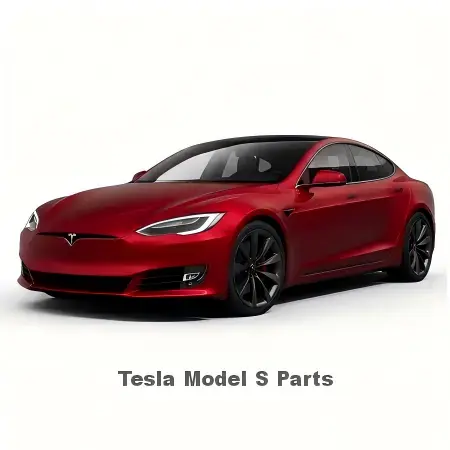
- Tesla Model S body parts — aluminium fenders and full panel range
- Tesla Model X body parts — front and rear collision components
Send your VIN list and we will confirm fitment before you commit to an order. No guesswork, no wrong panels, no stalled repair bays.