
How to Import Tesla Parts from China: HS Codes, Tariffs & Logistics (2026 Importer's Guide)
China remains the deepest and most competitive source of Tesla-compatible aftermarket parts. It is also, in 2026, the most expensive origin to import from if you are selling into the United States — not because the parts cost more, but because the duty stack on Chinese automotive parts is now the highest of any major sourcing corridor.
That combination changes what a good sourcing decision looks like. The question is no longer "what is the unit price", it is "what is the landed cost per part number, and does the part still make commercial sense at the destination". A distributor who prices a container on FOB value alone is now exposed to a tariff layer that can exceed the cost of the goods themselves on some part categories.
This guide sets out the 2026 duty structure by destination market, the HS codes that matter for Tesla parts, the compliance rules that decide whether a part can legally be fitted, and the logistics detail — batteries, magnets, packaging — that decides whether a shipment clears at all.
The 2026 duty picture, by destination
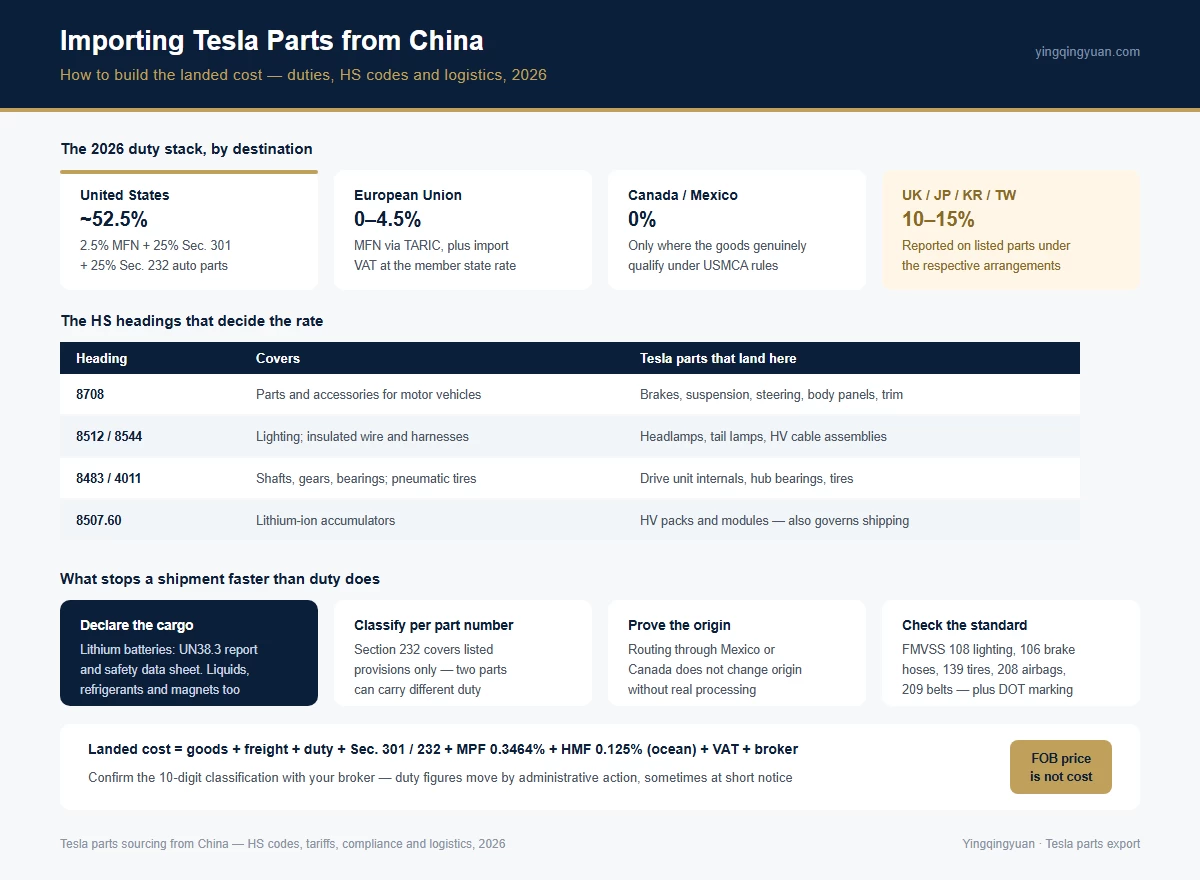
Duty rates on automotive parts changed materially in 2025 and 2026. The figures below reflect the position as generally reported for the 2026 tariff year, and every one of them should be confirmed against your own 10-digit classification with a customs broker before you commit to a purchase order. Tariff measures are amended by administrative action, sometimes with short notice.
| Destination | Indicative duty stack on Chinese auto parts | What drives the difference |
|---|---|---|
| United States | Roughly 52.5% all-in on many HTS 8708 lines: ~2.5% MFN + 25% Section 301 (List 3) + 25% Section 232 auto parts. Lines outside the Section 232 coverage — mufflers (8708.92) and EV traction motors, for example — sit nearer 37.5–40% | Section 232 automotive parts tariffs have applied to covered categories since 3 May 2025. They stack with Section 301 but not with Section 122 measures |
| Canada / Mexico | 0% on goods that genuinely qualify under USMCA regional value content rules | Origin qualification is the whole question — see the origin section below |
| European Union | MFN duty typically 0–4.5% on many automotive parts, plus import VAT at the member state rate | Classification runs through TARIC. Duty and VAT must be calculated separately — a zero duty line still carries VAT |
| UK / Japan / South Korea / Taiwan | Reported at around 10% (UK) and 15% on listed parts under the respective arrangements | Coverage depends on whether the specific part falls within the listed provisions |
| Other origins (India, Vietnam, Thailand) | MFN plus the 25% Section 232 layer on listed parts — around 27.5% versus ~52.5% from China | Origin diversification is now a standard part of US sourcing strategy |
Two details in that table deserve to be pulled out, because they are where most importer assumptions go wrong.
Section 232 does not apply to every product sold as an auto part. Coverage is defined by listed tariff provisions, so two parts that sit next to each other in a catalogue can carry materially different duty. That means the duty question must be answered per part number, not per shipment.
Section 301 exclusions do not remove the Section 232 layer. USTR has extended a set of Section 301 exclusions — reported at 178 exclusions extended to 10 November 2026 — but an exclusion applies only where the product matches the precise tariff provision and product description in the official notice, and it removes only the Section 301 duty. The Section 232 duty still applies. An exclusion is a valuation win, not a full exemption.
For batteries there is a separate stack. Lithium-ion cells under 8507.60 from China have carried an MFN rate around 3.4% plus a 25% Section 301 rate; propulsion batteries for passenger vehicles also fall within Section 232 coverage, which is why that category is reported near 53.4% all-in. High-voltage battery packs are not a casual import item, and the numbers explain why so much of the aftermarket focuses on the surrounding components instead.
The HS codes that matter for Tesla parts
A supplier's six-digit HS code is a starting point, not an answer. The binding classification is the destination country's full code — 10-digit HTSUS in the United States, TARIC in the EU — and it depends on what the part is made of, what it does, its level of assembly and whether it is new or used.
| HS heading | Covers | Tesla parts that land here |
|---|---|---|
| 8708 | Parts and accessories for motor vehicles | Bumpers and body panels, brake components, suspension arms, steering parts, interior structural trim |
| 8483 | Transmission shafts, gears, bearings | Drive unit internals, bearings, gear components |
| 8544 | Insulated wire and wiring harnesses | Wiring harnesses, sensor leads, HV cable assemblies |
| 8512 | Vehicle lighting and signalling equipment | Headlamps, tail lamps, indicators, light bars |
| 4011 | Pneumatic tires | Tires, including EV-specific fitments |
| 8507.60 | Lithium-ion accumulators | High-voltage packs and modules; also regulates how the goods may ship |
| 8708.30 / 8708.40 / 8708.80 / 8708.99 | Sub-headings for brakes, gearboxes, suspension and other parts | Where the duty rate on a specific Tesla part is often decided |
Misclassification is the most common compliance error in automotive imports, and it cuts both ways: too general a code can trigger a higher rate, while an aggressive code invites a penalty and retrospective duty if CBP or an EU customs authority disagrees. Get the classification in writing from your broker, per part number, before the first shipment — not after.
Origin is not the same as the shipping route
Routing Chinese-origin goods through Mexico, Canada or a third country does not change their origin. A different origin claim requires sufficient processing under the applicable rules of origin, supported by production records that survive audit. Trans-shipment through a USMCA territory does not qualify goods for USMCA treatment; the goods have to genuinely originate there, which for most Tesla components means real manufacturing content, not repacking.
This is the single most audited area in automotive import compliance, and it is not a place to accept a supplier's verbal assurance. If a quote looks too good because of an origin claim, the claim itself is the risk.
Compliance: what decides whether a part can be fitted at all
Duty is a cost problem. Compliance is a legality problem, and in some categories it is decisive.
- FMVSS in the United States. Safety-related components must meet the applicable Federal Motor Vehicle Safety Standard. The ones that come up most often in Tesla parts sourcing: FMVSS 108 for lighting, 106 for brake hoses, 139 for tires, 208 for airbags and 209 for seat belts. Non-compliant parts cannot legally be installed in a US-registered vehicle, and some require specific DOT markings.
- NHTSA oversight. Automotive safety systems fall under NHTSA's remit, and importing non-compliant safety equipment exposes both the importer and the reseller.
- EPA requirements for emissions-related components.
- EU type-approval and E-marking for lighting and other regulated components, on top of TARIC classification.
- Used parts are a separate regime. Several destinations restrict or prohibit used tires, engines, emissions components, safety devices and damaged parts. Used goods also need condition photographs, serial and part numbers, inspection reports and defensible transaction-value evidence. Cargo insurance may exclude pre-existing wear, corrosion and internal mechanical failure — so pre-shipment records are what separate an existing defect from transport damage.
- Branded goods. Tesla-branded packaging, logos and trademarks carry their own legal exposure in most markets. Aftermarket parts should be presented as aftermarket.
The practical takeaway for importers: safety-critical systems — airbags, belts, brake hoses, lighting, tires — should only be sourced where the supplier can document the standard the part is built to. That is a reasonable question to ask, and a supplier who cannot answer it is not a supplier for those categories.
Landed cost: how to build the number properly
Landed cost, not FOB price, is what decides whether a line is worth carrying. Build it from these components:
| Component | What to include |
|---|---|
| Goods value | Transaction value at the agreed Incoterm — and if the Incoterm is FOB or CIF, the freight and insurance you did not pay do not reduce the declared customs value in the way buyers often assume |
| Freight and insurance | Air or ocean, plus inland drayage at destination |
| Base duty | MFN rate for the classified line |
| Additional duties | Section 301, Section 232, anti-dumping and countervailing duties where applicable |
| Merchandise Processing Fee (US) | Reported at 0.3464% of value, with a minimum of $31.67 and a maximum of $614.35 per entry |
| Harbor Maintenance Fee (US) | 0.125%, applying to ocean freight only |
| Import VAT (EU and others) | Charged on the duty-inclusive value; often the largest single number in the calculation and frequently overlooked |
| Broker, terminal and clearance fees | Entry fees, examination, storage and delivery order charges |
| Warranty and returns provision | Fitment returns on generation-sensitive parts are a real cost — budget for them |
Run that calculation per part number before committing to a range. It is common for a category that looks excellent on FOB price to be unremarkable at landed cost, and for a category that looks expensive on FOB to be the better business because it is classified favourably.
Incoterms: where the risk actually sits
- EXW leaves the entire export and import chain with the buyer. Cheap on paper, and rarely the right answer for a first order.
- FOB port of loading is the most common structure for container freight, and the most transparent: the buyer controls the freight forwarder and therefore sees the true logistics cost.
- CIF is convenient but hides the freight cost inside the price, and the insurance cover is often the minimum required rather than the cover you would choose.
- DDP is attractive for a first trial order because the supplier handles clearance and duty — but it removes your visibility of the duty calculation and can create a customs liability if the declared value is wrong. Use it to learn the corridor, not to run it permanently.
Shipping: mode selection and the cargo declarations that stop shipments
| Mode | Best for | Watch out for |
|---|---|---|
| Express courier | Samples, small urgent orders, single parts | Duty thresholds and clearance handling vary by carrier; unit freight cost is high |
| Air freight | Time-critical, higher-value, moderate volume | Battery and magnet declarations; volumetric weight |
| LCL (less than container) | Mixed part ranges, mid volume | Consolidation delays, more handling, higher damage exposure |
| FCL (full container) | Volume ranges and body panels | Higher upfront commitment; container fill planning matters |
Certain cargo characteristics stop shipments far more often than duty does, and every one of them should be declared before collection rather than discovered at the airport:
- Lithium batteries. Require a battery report or UN38.3 test summary and a safety data sheet, plus carrier-specific approval. Never book a battery shipment without declaring it.
- Liquids, gases and refrigerants. Compressor oil, coolants and any pressurised or refrigerant-containing component trigger dangerous-goods handling.
- Magnets. Speakers, motors and magnetic components need magnetic-field declaration for air freight.
- Wood packaging. Must comply with ISPM 15 — heat-treated or fumigated with the correct mark — or the shipment can be refused entry.
- Glass and lamps. Bulky, fragile and easily damaged in a mixed LCL container; these are the parts to pack individually, not in bulk cartons.
Packaging is not a minor detail at this price level. A bumper or a lamp that arrives damaged turns a good margin into a claim, and a battery that was not declared turns a shipment into a seizure. Our parts packaging and international shipping guide covers how Tesla parts are packed for export in practice.
Supplier due diligence before the first order
Price discovery is easy. Verification is what protects the order. Before committing volume, a buyer should be able to answer all of the following:
- Is the supplier quoting a specific part number, or a generic description that could mean several different parts?
- Can they confirm fitment by VIN rather than by model name?
- Are they clear about which categories are genuine OEM, OEM-equivalent, or generic aftermarket — and about what the difference means for warranty?
- Can they document the standard a safety-critical part is built to?
- Will they provide a sample order and an inspection report before a container commitment?
- Do they declare battery, magnet, liquid or refrigerant content at the quotation stage, not the booking stage?
Our 12-point supplier vetting checklist turns those questions into a scoring sheet, and the OEM vs aftermarket sourcing guide explains how to split a parts range between genuine components and quality aftermarket equivalents so that warranty risk and margin land in the right places.
Origin-market specification is the last verification step and the one most often skipped. An aftermarket part built for a European car may physically bolt to a North American one and still be wrong — lighting colour and function, charge-port standard, mirror magnification and even battery chemistry differ by market. Our market specification guide covers the differences that matter, and our fitment checklist is the pre-order routine for confirming them.
Frequently asked questions
What is the import duty on Tesla parts from China in 2026?
For the United States, many automotive parts classified under HTS heading 8708 carry a combined stack of roughly 2.5% MFN duty, 25% Section 301 and, where the part falls within Section 232 automotive parts coverage, a further 25% — around 52.5% all-in. Parts outside Section 232 coverage sit nearer 37.5–40%. Other destinations are materially lower: USMCA-qualifying goods from Mexico and Canada can enter at 0%, and the EU applies MFN duty plus import VAT. These figures change by administrative action, so confirm the 10-digit classification with a broker before ordering.
What HS code do Tesla parts use?
Most Tesla structural, brake, suspension, steering and body components fall under HS heading 8708 (parts and accessories for motor vehicles), with sub-headings for brakes (8708.30), gearboxes (8708.40), suspension (8708.80) and other parts (8708.99). Lighting is generally 8512, wiring harnesses 8544, bearings and shafts 8483, tires 4011 and lithium batteries 8507.60. The six-digit code is only a reference — the destination country's full code is the binding one.
Can I avoid the tariffs by shipping through Mexico or Canada?
No. Routing does not change origin. Goods of Chinese origin remain Chinese-origin goods for duty purposes unless they undergo sufficient processing in the third country under the applicable rules of origin, supported by production records. Trans-shipment and repacking do not qualify.
Do Section 301 exclusions remove the duty?
Only partly. Exclusions are product-specific, must match the exact tariff provision and description, and remove only the Section 301 layer. The 25% Section 232 automotive parts duty still applies to covered categories. USTR's active exclusions have been extended in stages — reported as 178 exclusions extended to 10 November 2026 — so the list has to be checked against your specific code and rechecked before each shipment.
Can I import used Tesla parts from China?
It depends on the destination and the part. Several markets restrict or prohibit used tires, engines, emissions components, safety devices and damaged parts, and some treat certain categories as waste or scrap. Where used parts are permitted, expect to supply condition photographs, part and serial numbers, inspection reports and transaction-value evidence, and to accept that cargo insurance may exclude pre-existing wear and internal mechanical failure.
What documents should accompany a Tesla parts shipment?
Commercial invoice with the full part description and part numbers, packing list with weights and dimensions, the destination classification and duty calculation, bill of lading or airway bill, certificate of origin where a preferential rate is claimed, and — depending on the cargo — a safety data sheet, UN38.3 battery report, dangerous-goods declaration, magnetic-field declaration and ISPM 15-compliant wood packaging marks. Safety-related parts may also need conformity documentation for the applicable standard.
Is it cheaper to buy from China than from Mexico in 2026?
On goods cost, usually yes. On landed cost into the United States, often no. USMCA-qualifying Mexican parts can enter at 0% duty, while Chinese-origin parts in covered categories can face a stack of roughly 52.5%, plus antidumping and countervailing exposure on specific categories such as aluminium wheels and shock absorbers. The right answer is category by category: China tends to win on range, tooling and unit cost for complex assemblies, while near-shore supply can win on total delivered cost for simpler, higher-volume items.
Which collections should I browse?
- Tesla Model 3 brake parts and Tesla Model Y body parts
- Tesla Model 3 suspension and steering parts
- Tesla Model 3 electrical parts
Related sourcing guides
- How to vet a Tesla parts supplier: 12-point checklist
- Tesla OEM vs aftermarket parts: a 2026 sourcing guide
- Tesla parts by market: US vs EU vs China specification differences
- Tesla parts packaging and international shipping questions
- Wholesale Tesla replacement parts: what buyers should confirm
Send us your target part numbers, destination market and expected volume, and we will come back with the FOB price, the recommended classification for your broker, the packing data and the documentation each part needs to ship. Landed cost is the only price that matters — so we would rather build it with you before you commit.