
Tesla Brake Rotor Rust and Stuck Calipers: Diagnosis, Service and Parts (Model 3, Y, S & X)
A Tesla can arrive at a workshop with 80% of its pad material still intact and a repair quote for four rotors, four calipers and a set of pads. The owner has done nothing wrong. They have simply driven the car the way it was designed to be driven — letting regenerative braking do almost all of the stopping — and the friction brakes have spent three winters sitting still in salt and moisture.
This is the defining brake problem on electric vehicles, and it is not a Tesla defect. It is a maintenance pattern. Tesla's own service documentation lists annual caliper cleaning for vehicles driven where roads are salted, and the failure is explicitly excluded from warranty as wear and neglect. For owners, that means a cheap service can prevent a four-figure repair. For workshops and parts resellers, it means the brake category behaves very differently on a Tesla than on a combustion car: demand is driven by time and climate, not by mileage.
This guide covers why it happens, how to diagnose it in ten minutes, when to service versus replace, what the job costs, and which parts each repair actually consumes across Model 3, Model Y, Model S and Model X.
Why Tesla brakes corrode faster than they wear
On a conventional car, every stop scrubs the rotor face with pad material. That mechanical action does three things: it removes flash rust, it burns off moisture, and it keeps the caliper slide pins cycling through their travel. A Tesla removes most of that action from daily driving.
Regenerative braking slows the car by turning the motor into a generator. The friction brakes only join in during the final few miles per hour of a normal stop, during hard stops, when the battery is full or cold, and when the driver deliberately presses the pedal. In gentle urban driving, that can mean weeks between meaningful friction-brake applications.
- Bare cast iron plus moisture equals flash rust. Rotor faces are unprotected cast iron. A single damp night puts a brown film on them. On a combustion car it is gone by the end of the street; on a Tesla it stays.
- Rust under the pad becomes pitting. If the film is never scrubbed off, it grows into a textured, pitted surface. Pads then wear unevenly, and the pitting acts like a lap wheel on the friction material.
- Pad ears corrode into the abutment clips. The pad's steel ears sit in stainless clips on the caliper bracket. Salt bridges the gap, corrosion expands, and the pad can no longer slide freely.
- Slide pins lose their grease. Caliper slide pins are lubricated with high-temperature brake grease and sealed by rubber boots. Heat cycling, salt and time dry the grease out. A pin that will not slide holds the pad against the rotor permanently.
- Rear electric parking brakes are the worst case. Cars with an EPB apply the rear caliper by motor and leave it applied when parked. In winter, moisture in the mechanism freezes and the caliper can stick in the applied position — the classic "car will not roll on the first cold morning" complaint.
The result is a brake system that is mechanically healthy but functionally neglected: plenty of lining, no friction transfer layer, and hardware that has stopped moving.
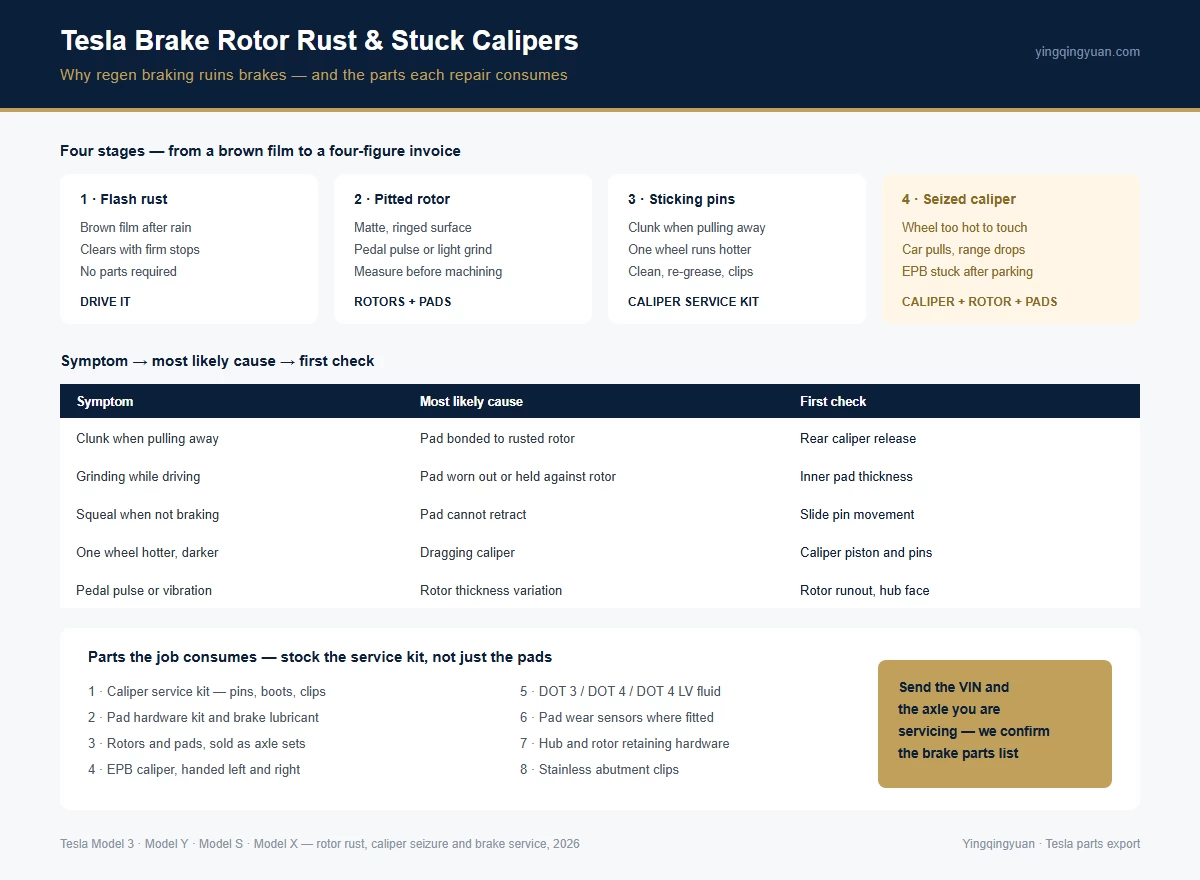
The four failure modes, and what each one needs
Most Tesla brake complaints map to one of four conditions. They escalate in cost, and the earlier ones are cheap to stop.
| Condition | What you see | Correct repair | Parts consumed |
|---|---|---|---|
| 1. Flash rust | Orange-brown film on the rotor face after rain or a wash; gone after a few firm stops; no noise | Drive it. Several deliberate 40–50 mph stops with the friction brakes clear the film. No parts. | None |
| 2. Pitted rotor face | Matte, textured or ringed surface visible through the spokes; light grinding at low speed; pedal may pulse | Measure rotor thickness and runout. Resurface only if above minimum thickness and the pitting is shallow; otherwise replace rotors and pads as an axle set. | Rotors, pads, hardware kit, brake fluid |
| 3. Sticking slide pins / corroded pad ears | Clunk when pulling away after parking; one wheel hotter than the others; uneven inner/outer pad wear; drag or reduced range | Disassemble, clean abutments and pins, replace corroded clips, re-grease with brake-specific lubricant. Replace pins or bracket if pitted. | Caliper service kit (pins, boots, clips), pad hardware kit, lubricant, often pads |
| 4. Seized caliper or EPB | Wheel too hot to touch, burning smell, car pulls under braking, rear wheel locked after parking, heavy uneven wear down to backing plate | Replace the caliper (rear EPB calipers include the motor/actuator on most builds). Replace the rotor and pads on that axle. Diagnose the EPB circuit before condemning the caliper. | Caliper assembly, EPB actuator where separately serviced, rotor, pads, fluid, hardware |
Note the pattern: the first condition costs nothing, the second costs a normal brake job, and the fourth costs several times that. Almost every expensive Tesla brake invoice started as condition one that nobody acted on.
Symptom-to-cause: a diagnostic table
Owners rarely describe the problem accurately, so the symptom is the best starting point. The table below is what a service writer should ask and what a technician should check first.
| Symptom | Most likely cause | First check |
|---|---|---|
| Loud clunk or crack as the car first moves after parking | Pad bonded to a rusted rotor, or EPB sticking | Rear caliper release; rotor face condition; parking brake function |
| Grinding or scraping that continues while driving | Pad worn to backing plate, or a pad held against the rotor by a stuck caliper | Pad thickness on both sides of each rotor — inner pads hide |
| High-pitched squeal when not braking | Worn pad wear indicator, or a pad that cannot retract | Slide pin movement; pad ear corrosion |
| Car pulls to one side under braking | One caliper not applying or not releasing evenly | Compare wheel temperatures after a short drive |
| One wheel visibly hotter and dirtier | Dragging caliper | Caliper piston and slide pins on that corner |
| Pedal pulsation or vibration when braking | Rotor thickness variation or runout, often from pitting | Rotor thickness at multiple points, runout with a dial gauge, hub face cleanliness |
| Range drop of a few percent with no other change | Dragging brakes creating constant rolling resistance | Coast test at walking pace; wheel temperature |
| Grinding only after a winter lay-up | Heavy rotor rust from storage | Rotor face and pad condition on all four corners |
The ten-minute check an owner can do
These checks do not confirm a diagnosis, but they tell an owner whether the car needs attention now or can wait. Flat ground, parking brake set, engine off.
- Look through the spokes in daylight. A healthy rotor is a smooth grey ring. A textured, matte or ringed face is pitting. Compare left and right — they should match.
- Compare brake dust across the four wheels. Tesla dust is naturally light. One noticeably darker wheel is doing more friction work than it should.
- Coast at walking pace and lift off. The car should roll freely. A soft scuff or drag from one corner is an early sticking caliper.
- Do one firm stop from 25 mph on an empty road. Even pedal, straight tracking, no grind. Anything else is a booking, not a wait-and-see.
- Touch-test after a normal drive — carefully. A wheel that is much hotter than its opposite number has a dragging brake. Do not touch a rotor; touch the wheel face briefly.
If the car grinds continuously, pulls hard, smells of hot friction material or will not roll after parking, stop driving. A seized rear caliper can overheat a wheel and damage a tire before it damages the brakes any further.
Service or replace? The decision rules
The most common mis-sell on a Tesla is a full pad-and-rotor job when the correct repair was cleaning and lubrication. The second most common is fitting new pads onto pitted rotors, which produces noise again within a few thousand miles. The rules below are the ones a workshop should apply.
| Component | Service is usually enough | Replacement is usually needed |
|---|---|---|
| Rotor | Surface rust only; thickness comfortably above minimum; no deep pitting; runout within spec | Below minimum thickness; deep pitting or a pronounced lip; excessive runout; heat cracks; scoring from a worn pad |
| Pads | Even wear, ample material, no cracking or separation | Worn near the backing plate; heavily uneven inner-to-outer; contaminated with grease or fluid; friction material separating |
| Slide pins | Light external corrosion, shaft intact, moves freely after cleaning | Pitted shaft; pin will not move freely after cleaning; boot torn and water has entered |
| Hardware | Clips and springs clean up and retain tension | Broken or missing clips, lost spring tension, corroded abutments — always replace, they are inexpensive |
| Caliper | Piston moves freely, boot intact, no leak | Piston seized or pitted, torn boot with fluid loss, cracked body, EPB actuator failed |
| Brake fluid | Moisture content within spec | Elevated moisture, dark fluid, or a two-year towing interval reached |
What the job actually costs
Prices vary widely by market and by how far the corrosion has gone, so treat these as ranges rather than quotes. They are useful because they show the gap between prevention and repair.
| Job | Typical independent workshop | Typical dealer / service centre |
|---|---|---|
| Caliper clean and lubricate, all four corners | Low labour cost; often bundled with a tire swap | Roughly $150–$250 in US reporting |
| Pads and rotors, one axle (aftermarket parts) | Parts commonly $300–$500 for a DIY-level job | Usually well over $1,000 with labour |
| Pads, rotors, fluid and caliper service, all four corners | Depends heavily on caliper condition | Owner reports around $1,000 and up; seized calipers push it toward $2,000 |
| One seized rear EPB caliper plus rotor and pads | Caliper is the dominant part cost | Highest single-corner invoice in the brake category |
The economics are the argument for annual caliper service in salt markets: it is a small fraction of the repair it prevents, and it can be done while the wheels are already off for a seasonal tire change.
The parts each job consumes
Brake parts are the least forgiving category in the Tesla aftermarket. Rotor dimensions, caliper brackets, pad shapes and EPB hardware differ by model, by trim and by build date, and a Performance car does not share brakes with a base car. Order by VIN, not by model name.
| Job | Parts to supply | Fitment notes |
|---|---|---|
| Annual caliper service | Caliper service kit (slide pins, boots, abutment clips), high-temperature brake lubricant, brake cleaner, new pad hardware | Model Y built after February 2025 uses a cleaning procedure without lubricant on the affected parts — confirm the procedure for the build date |
| Pad replacement, one axle | Pad set, pad hardware/anti-rattle kit, wear sensor where fitted, rotor retaining screws | Performance and non-Performance pad shapes differ; some cars use different pads front and rear |
| Rotor replacement, one axle | Rotors (pair), pads, hardware kit, hub bolts where torque-to-yield | Measure before ordering; do not assume a rotor from a same-model car fits a different trim |
| Caliper replacement | Caliper assembly, EPB actuator where separately listed, banjo washers, fluid, pads, rotor | Rear EPB calipers are handed left/right; some builds require software release of the parking brake before removal |
| Brake fluid service | DOT 3, DOT 4 or DOT 4 LV fluid, bleed nipples where corroded | Never DOT 5 silicone. Towing vehicles: replace every two years |
Model-specific catalogues are the fastest way to confirm the right parts:
- Tesla Model 3 brake parts
- Tesla Model Y brake parts
- Tesla Model S brake parts
- Tesla Model X brake parts
Rotor dimensions by model and trim are set out in our Tesla brake parts guide, and the wear-item calendar is in the maintenance schedule by mileage.
The salt-belt routine that prevents all of this
Tesla's schedule calls for caliper cleaning annually, or every 12,500 miles, in markets where roads are salted. In practice, the following routine keeps a Tesla out of the four-figure repair bracket:
- Once a year, with the winter wheel change. Remove the pads, clean the abutment flats, piston faces, retaining pins and pad contact areas, inspect the rotors and re-grease the correct points only. Never lubricate the back of a pad or let grease reach friction material, piston seals or rubber components.
- Every four to six weeks in winter. On a safe, empty road, make several firm stops from 40–50 mph to clear surface rust and exercise the calipers. Do not trigger ABS; the aim is heat and friction, not threshold braking.
- After every winter. Check rear EPB operation, pad ear corrosion and rotor face condition before the salt season ends, not after the noise starts.
- Before storage. Wash the underbody and brakes, dry the car, and leave it with the parking brake off where it is safe to do so. A car stored wet with the EPB applied is the ideal environment for a seized rear caliper.
- Test the fluid. Moisture content, not colour. Replace on the two-year towing interval or the four-year general interval, whichever the market documentation specifies.
The seasonal version of this routine, including tires, wipers and cabin filtration, is in our Tesla winter prep guide.
What this means for workshops and parts resellers
Tesla brake demand does not behave like combustion-car brake demand, and a stocking plan built on mileage will over-order pads and under-order hardware.
- Pads move slowly. A Tesla can pass 60,000 miles on its original pads. A shop that stocks pad sets by the dozen will sit on them.
- Hardware and service kits move fast. Clips, pins, boots, pad hardware kits and lubricant are the consumables of the annual service, and they are cheap enough to stock deeply.
- Rotors move in axle pairs, seasonally. Demand spikes after the first cold snap and again in spring, concentrated in salt-belt markets.
- Rear EPB calipers are the high-value tail. Low volume, high ticket, and almost always needed urgently because the car is immobile.
- Climate beats mileage. A coastal car with 20,000 gentle miles can need rotors before a dry-climate car with 80,000. Ask where the car lives, not just how far it has driven.
For sourcing decisions between original and aftermarket brake components, see our OEM vs aftermarket sourcing guide; for supplier qualification, the 12-point supplier checklist covers the questions that matter on safety-critical parts.
Frequently asked questions
Are rusted Tesla rotors a warranty item?
Generally no. Surface rust and seized calipers are classified as wear, corrosion and maintenance, not manufacturing defects, and Tesla's warranty excludes them. There is one important exception to rule out first: certain 2019–2021 Model 3 and 2020–2021 Model Y vehicles were recalled because caliper bolts could loosen and let a caliper contact the wheel rim. Check the VIN against the recall database before assuming corrosion is the cause of a scraping noise on those cars.
Can I just drive off the rust?
Yes, if it is only flash rust. Several firm stops from 40–50 mph will scrub the rotor face clean. If the surface is pitted, ringed or matte, driving will not fix it — the rotor needs measuring and probably replacing.
Why did my Tesla fail inspection with plenty of pad left?
Because the inspection is looking at the rotor face and the caliper, not only the pad. Pitting, scoring, a pronounced rust lip and a caliper that will not release are all failures even when the friction material is thick. Regenerative braking is exactly why this happens.
How often should calipers be serviced?
Tesla specifies annual cleaning and lubrication, or every 12,500 miles, for vehicles driven where roads are salted. In mild, dry climates the practical interval is longer — but any car parked outside in a humid or coastal environment should be inspected by year three.
Can I replace one caliper only?
Yes, if the opposite side is healthy. Replace pads and rotors as an axle set, and inspect the opposite caliper carefully — the conditions that seized one usually affect both.
What causes the clunk when I first drive after parking?
Almost always a pad that has bonded lightly to a rusted rotor, or a rear EPB caliper that is slow to release. It is the earliest audible warning of condition three and the cheapest moment to act.
Do Performance models have different brakes?
Yes. Performance variants use larger, differently cooled brakes, and pad and rotor part numbers differ from the base and Long Range cars. Never order brake parts by model name alone.
Which brake fluid should I use?
DOT 3, DOT 4 or DOT 4 LV, depending on the market and build. Never DOT 5 silicone — it is not compatible with the system. Towing vehicles should have the fluid replaced every two years regardless of test results.
How do I confirm the right parts before ordering?
Send the VIN. The VIN fixes the model, trim, build date and brake package, which is the only reliable way to avoid a return on a safety-critical part. Our VIN decoding and part number guide explains what to look for, and the fitment checklist covers the pre-order checks.
Send us your VIN, the axle you are servicing and the symptoms, and we will come back with the exact brake parts list — rotors, pads, caliper service kits, EPB calipers and hardware — with the fitment confirmed before you order. On a safety-critical category, one confirmed list is worth more than a fast shipment.