
Used vs New Tesla Parts: A Salvage and Remanufacturing Buyer's Guide for Shops and Resellers (2026)
Used Tesla parts sell for 50–80% less than dealer pricing on most categories, and the supply is growing every year as the first large wave of Model 3 and Model Y cars reaches collision yards. For an independent workshop or a reseller, that looks like an obvious margin opportunity.
It is also the category with the highest rate of expensive mistakes in the Tesla aftermarket, because a Tesla part is not only a physical object. It can be paired to a VIN, gated by software, dependent on a donor car's configuration, or regulated as dangerous goods when it contains a battery. A $3,000 drive unit that will not run in the buyer's car is not a bargain; it is scrap with a shipping invoice.
This guide sets out what used Tesla parts are genuinely worth buying, what to inspect, how to grade them, what the software and legal traps are, and when a new aftermarket part is the cheaper decision once the total cost is counted.
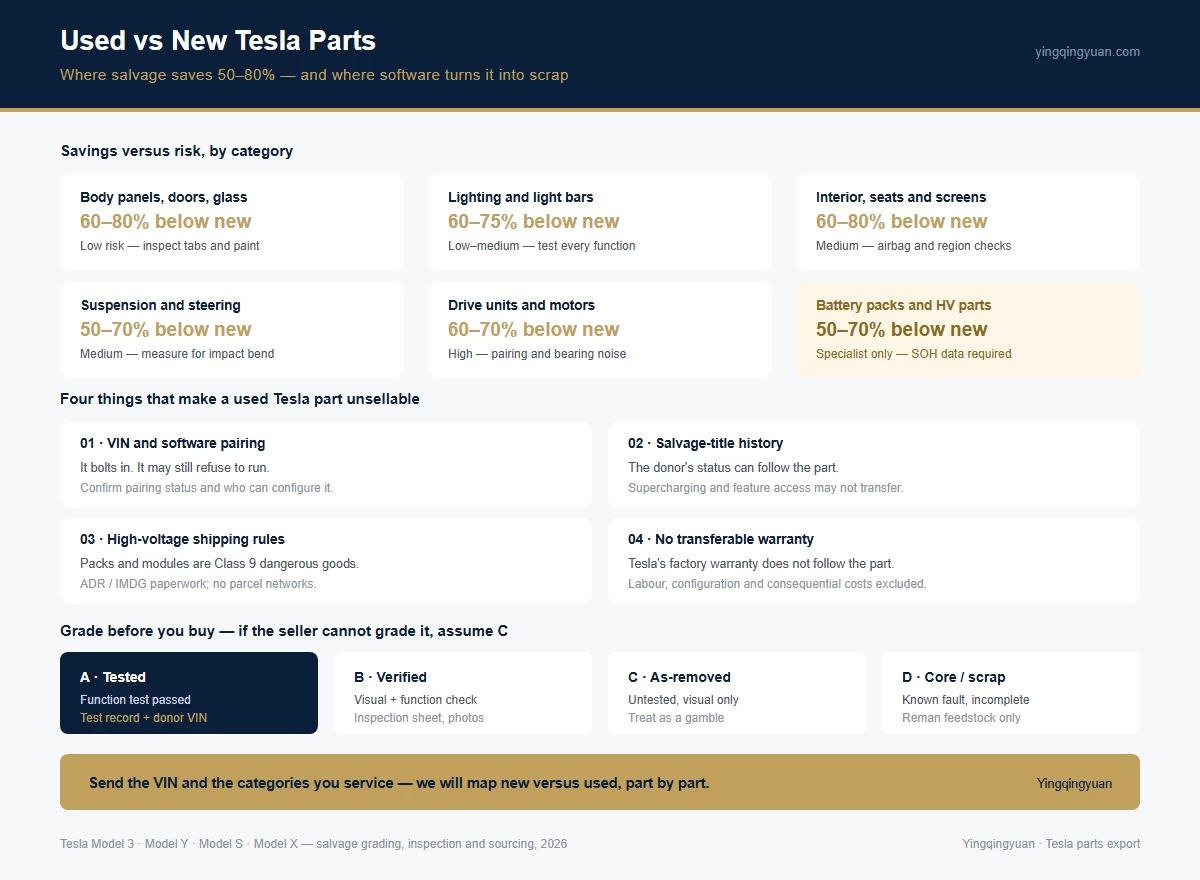
Where the savings actually are
Savings are not uniform across categories. They depend on how much of the part's value is mechanical versus electronic, and on how tightly Tesla controls the software around it.
| Category | Typical used saving | Risk | Verdict for a shop |
|---|---|---|---|
| Body panels, bumpers, fenders, hoods, doors, liftgates | High — often 60–80% below new | Paint match, hidden structural damage, mounting tab repair | Strong buy if inspected and colour-matched |
| Lighting: headlights, tail lights, light bars | High — 60–75% | LED driver faults, moisture ingress, broken mounting tabs, generation mismatch | Strong buy, test every function |
| Interior: seats, consoles, trim, screens | High — 60–80% | Airbag deployment history, screen delamination, software/region mismatch | Good buy; seats from a deployed car need scrutiny |
| Suspension and steering: control arms, knuckles, hubs, racks | Moderate — 50–70% | Bent components from impact, worn bushings, damaged ball joints | Conditional; measure before fitting |
| Brakes: calipers, EPB units, knuckles | Moderate — 50–70% | Corrosion, seized pistons, EPB actuator faults | Weak buy on salt-belt donors; new aftermarket usually better |
| Drive units and motors | Moderate — 60–70% | Software pairing, bearing noise, coolant ingress, unknown mileage | Only with test data and pairing confirmation |
| Battery packs and modules | 50–70% | State of health, VIN locking, thermal damage, Class 9 shipping | Specialist only |
| High-voltage cables, junction boxes, onboard chargers, DC-DC | 50–70% | HV safety, software configuration, hidden crash damage | Specialist only |
The pattern is simple: the further a part sits from software and high voltage, the safer the used purchase. Body, lighting and interior are the categories where salvage consistently beats new on total cost. Drive units, packs and HV electronics are where salvage most often goes wrong.
The four things that make a used Tesla part unsellable
1. VIN and software pairing
Tesla gates a growing number of components behind software configuration. A used battery pack, drive unit, onboard charger or body control module may physically bolt in and still refuse to function, or function only after a Tesla-level configuration step that an independent shop cannot perform. Some components carry the donor VIN in their configuration; others are matched to the car's security keys.
The practical rule: before paying for any electronic or high-voltage component, get a written answer to two questions — is this part VIN-locked or paired? and what reconfiguration will be required after installation, and who can perform it? If the seller cannot answer, the part is a gamble, not an inventory item.
2. Salvage-title and vehicle-status history
A donor car's status can follow its parts into the buyer's business. Tesla has historically disabled Supercharging on salvage-title vehicles, and features tied to the donor's software account may not transfer. That does not affect a door shell, but it matters enormously for anything the buyer expects to work as designed — charge ports, onboard chargers, infotainment hardware, and any component that requires a vehicle-level configuration change.
Ask for the donor VIN, the title status and photographs of the damage. A part from a theft-recovery or flood vehicle carries risks that a collision donor does not.
3. High-voltage safety and dangerous-goods shipping
Anything orange is high voltage. Battery packs, modules and some HV harnesses are Class 9 dangerous goods, must travel with ADR/IMDG-compliant documentation and packaging, and cannot be sent by ordinary parcel networks. Punctured or swollen modules can enter thermal runaway hours after damage. A used pack bought from an unqualified yard is a fire and liability risk before it is a parts risk.
4. No transferable warranty
Tesla's new-vehicle battery and drive-unit warranty does not transfer to a salvaged component. Whatever warranty exists comes from the seller, is usually limited to the unit itself, and typically excludes labour, software configuration, fluids and consequential damage. Under consumer-protection rules in most markets, labour and consequential costs fall outside a used-part warranty. Get the terms in writing before purchase, not after a failure.
A workable grading standard
“Grade A” means nothing without a definition. This is a grading scale a reseller can actually apply and defend to a trade buyer.
| Grade | Definition | Documentation | Typical use |
|---|---|---|---|
| A — Tested | Functional test passed, no structural damage, cosmetic wear consistent with low mileage | Test record, donor VIN, mileage, photographs | Retail to trade with confidence |
| B — Verified | Visually inspected, functions confirmed where possible, minor cosmetic damage | Inspection sheet and photographs | Repair work where appearance is secondary |
| C — As-removed | Pulled from a donor, not tested, condition unknown beyond visual | Donor VIN and damage photos only | Cheap cores, parts harvesting, non-critical use |
| D — Core / scrap | Known fault, damaged housing, or incomplete | Fault description | Remanufacturing feedstock only |
If a seller cannot tell you which grade a part is, assume C. If they cannot provide a donor VIN, assume D for anything electronic.
Inspection checklist by category
Body panels and structures
- Check mounting tabs, reinforcement points and panel gaps against a known-good car — repaired tabs are common and often hidden by paint.
- Look for filler, sanding scratches under the paint and inconsistent orange-peel texture, which indicate a repaint.
- For aluminium structures, inspect for cracks and previous welding; aluminium repair is not the same discipline as steel.
- Confirm the generation — a Highland Model 3 front fascia does not fit a pre-2024 car, and Juniper Model Y panels differ again.
Lighting
- Power every function: low beam, high beam, turn signal, DRL, position light and, where fitted, the light bar.
- Look for condensation inside the lens and for repaired mounting ears.
- Check connector shape and pin count against the buyer's harness — Tesla changed lighting architecture across generations.
Interior and screens
- Inspect the display for delamination, dead pixels, pressure marks and touch dead zones along the edges.
- Confirm region and software compatibility; a screen from a different market may not configure correctly.
- For seats, confirm airbag status — a seat from a deployed car must not be sold as a functional unit without disclosure.
- Trim colours and headliner materials change by model year; “Zen Grey” and white are not interchangeable sets.
Suspension, steering and brakes
- Measure control arms and knuckles for bend; impact damage often shows as a cracked bushing or a deformed mounting ear.
- Check ball joint play and boot integrity. A boot that has been split for months has already lost its grease.
- Reject brake calipers from salt-belt donors unless they have been stripped and inspected — corrosion inside the piston bore is not visible from outside.
Drive units
- Ask for a bench spin report or at least a noise description; bearing whine is the most common failure and is audible.
- Inspect coolant passages and connectors for residue, which indicates a leak or overheating history.
- Confirm part number and revision, and whether the unit requires pairing to the buyer's VIN.
- Record donor mileage. Mileage is the best available proxy for remaining life.
Battery packs and modules
- Demand state-of-health data measured recently, plus cell-group voltage spread and internal resistance where modules are sold separately.
- Inspect for swelling, electrolyte residue, burn marks, corrosion on terminals and evidence of coolant inside the enclosure.
- Check that the HVIL circuit is intact. A cut or bypassed interlock is a red flag, not a minor detail.
- Confirm the pack's part number matches the buyer's model and generation; capacity and chemistry vary across builds.
The total-cost comparison most buyers get wrong
Comparing a used part's sticker price with a new part's sticker price is the wrong calculation. The relevant comparison includes fitment risk, labour, configuration, warranty and downtime.
| Factor | Used OEM | New aftermarket | New OEM |
|---|---|---|---|
| Purchase price | Lowest | Moderate | Highest |
| Availability | Unpredictable, donor-dependent | Repeatable if the supplier stocks it | Restricted for some parts |
| Fitment certainty | Depends on generation and VIN match | High if the supplier confirms by VIN | Highest |
| Software/configuration risk | Real for electronic and HV parts | Low for mechanical parts | Lowest |
| Warranty | Seller-defined, limited | Supplier-defined, often 12 months | Factory terms |
| Lead time | Immediate if in stock, otherwise indefinite | Days to weeks depending on route | Variable |
| Best for | Body, lighting, interior, discontinued parts | Wear items, service parts, high-volume collision parts | Warranty repairs, software-sensitive components |
For a workshop, the decision usually comes down to two questions: can I get this part new, repeatably, at a price that still leaves margin? and if the used part fails, what does that cost me in labour and reputation? On brake calipers, filters, suspension arms and body panels for current models, new aftermarket usually wins. On a discontinued Model S interior trim piece or a rare colour-matched door, salvage may be the only option.
Building a hybrid inventory that works
Shops and resellers that handle Tesla parts well tend to follow the same structure: new aftermarket for anything that wears, corrodes or is consumed in a service; used OEM for structural, cosmetic and discontinued items; and no inventory at all in software-locked electronics unless they have a specialist partner who can configure it.
- New aftermarket for the service line. Brake pads, rotors, caliper service kits, filters, suspension arms, bushings, cooling components, 12V batteries. Predictable demand, repeatable supply, warranty support.
- Used OEM for collision and cosmetic. Doors, fenders, bumpers, lights, seats, trim. Buy by grade, photograph everything, disclose the donor VIN.
- Specialist partner for HV and electronics. Battery packs, drive units, onboard chargers. Buy only with test data and a named person who will perform configuration.
- No blind pre-purchase of electronic modules. If you cannot test it and cannot configure it, you cannot warrant it.
The sourcing discipline that applies to new parts applies to used ones as well: a supplier who cannot answer fitment questions is a liability in either category. Our 12-point supplier checklist is written for new-parts suppliers but maps almost one-to-one onto salvage yards.
Cross-border realities
Used automotive parts generally attract lower duty than new parts in many markets, but the classification still depends on the part and the country, and used parts are often subject to additional inspection or restriction. Batteries and HV components add dangerous-goods requirements on top of customs.
- Classify correctly. Most Tesla parts fall under HS 8708, but batteries, electronics and lighting can sit in different headings. Misclassification is the most common cause of a held shipment.
- Expect inspection. Used parts are more likely to be examined for cleanliness, safety and origin than new ones.
- Document the donor. VIN, title status and damage photographs protect both buyer and seller if a part's history is questioned.
- Do not mix HV and general cargo documentation. A pack shipped on a general pallet without Class 9 paperwork will be stopped, and the cost of that stop usually exceeds the saving on the pack.
For the new-parts version of this calculation — duty stacks, Incoterms, HS codes and landed cost — see our import guide for Tesla parts from China. Market-specific specification differences are covered in the US vs EU vs China spec comparison.
Where used parts fit by category
- Tesla Model 3 body parts and Tesla Model Y body parts — the strongest salvage category
- Tesla Model 3 lighting and Tesla Model Y lighting — good used supply, but test every function
- Tesla Model 3 interior parts and Tesla Model Y interior parts — colour and generation matching is the main risk
- Tesla Model 3 chassis and drivetrain parts — buy new for wear items, used only with test data
Frequently asked questions
Are used Tesla parts worth buying?
For body, lighting, interior and some suspension components, yes — savings of 50–80% are real and the risk is manageable with inspection. For battery packs, drive units, onboard chargers and other software-sensitive electronics, only with test data and a confirmed configuration path. The category matters more than the price.
Can a used Tesla battery pack be installed in another car?
Sometimes, but not reliably. Tesla uses software handshakes between components, and a pack may need configuration that only a Tesla-level tool can perform. A pack that is locked to another VIN is effectively a core. Confirm compatibility in writing before buying.
Do used Tesla parts come with a warranty?
Only the seller's warranty, if any. Tesla's new-vehicle warranty does not transfer to a salvaged component. Typical used-part warranties cover the unit itself and exclude labour, software configuration, fluids and consequential damage — confirm the terms in writing.
Is it safe to buy a used Tesla drive unit?
It can be, if you have a bench spin or noise report, donor mileage, part number and revision, and confirmation of whether pairing is required. Without those four items, you are buying an unknown quantity that costs more to ship back than to inspect properly.
What does “salvage title” mean for the parts?
The donor vehicle was declared a total loss by an insurer. The parts themselves may be fine, but the vehicle's status can affect software features and, historically, Supercharging access on the donor car. For body and interior parts this rarely matters; for electronics it can.
How are used Tesla parts shipped?
Body and interior parts ship as ordinary freight. Battery packs and modules are Class 9 dangerous goods and require compliant packaging, documentation and carriers. Drive units usually ship palletised. Never accept a pack shipped as general cargo.
Should a repair shop stock used or new Tesla parts?
Both, in different categories. New aftermarket for wear and service items gives repeatable supply and warranty support; used OEM for collision, cosmetic and discontinued parts gives access and margin. Keep software-locked electronics out of stock unless you have a configuration partner.
How do I confirm a used part fits?
Match the donor VIN to the buyer's VIN, compare part numbers and revisions, and check the generation. Model names are not enough — Highland and pre-Highland Model 3, and Juniper and pre-Juniper Model Y, share very few exterior parts. Our Highland and Juniper compatibility guide sets out what changed.
Tell us the model, year, VIN and the categories you service, and we will map which parts are better bought new — with fitment confirmed before shipment — and which are worth sourcing used. A hybrid plan beats a single-source policy on both margin and downtime.