

RHD vs LHD Tesla Parts: What Actually Differs, and What Does Not (2026 Guide)
Every week, a workshop in the UK, Ireland, Australia, New Zealand, Japan or Hong Kong orders a part that was catalogued for a left-hand-drive Tesla and discovers at fitting that it does not work. The panel gap is wrong, the connector is mirrored, the headlamp pattern points at oncoming traffic, or the steering component mounts in the wrong orientation. The part is genuine. The listing was simply written for the wrong market.
Right-hand-drive Teslas share their platform, powertrain and most service parts with left-hand-drive cars, which is exactly why the mistakes happen: the majority of parts really do interchange, so buyers stop checking. The differences cluster in a predictable set of systems — lighting, steering, pedals, dashboard and wiring, wipers and some body trim — and they are expensive when missed because the return freight usually exceeds the part's margin.
This guide sets out what differs between RHD and LHD Teslas, what is safe to source across markets, how to identify a car's market before ordering, and what an exporter or importer should put in writing on every quote.
Which markets are right-hand drive
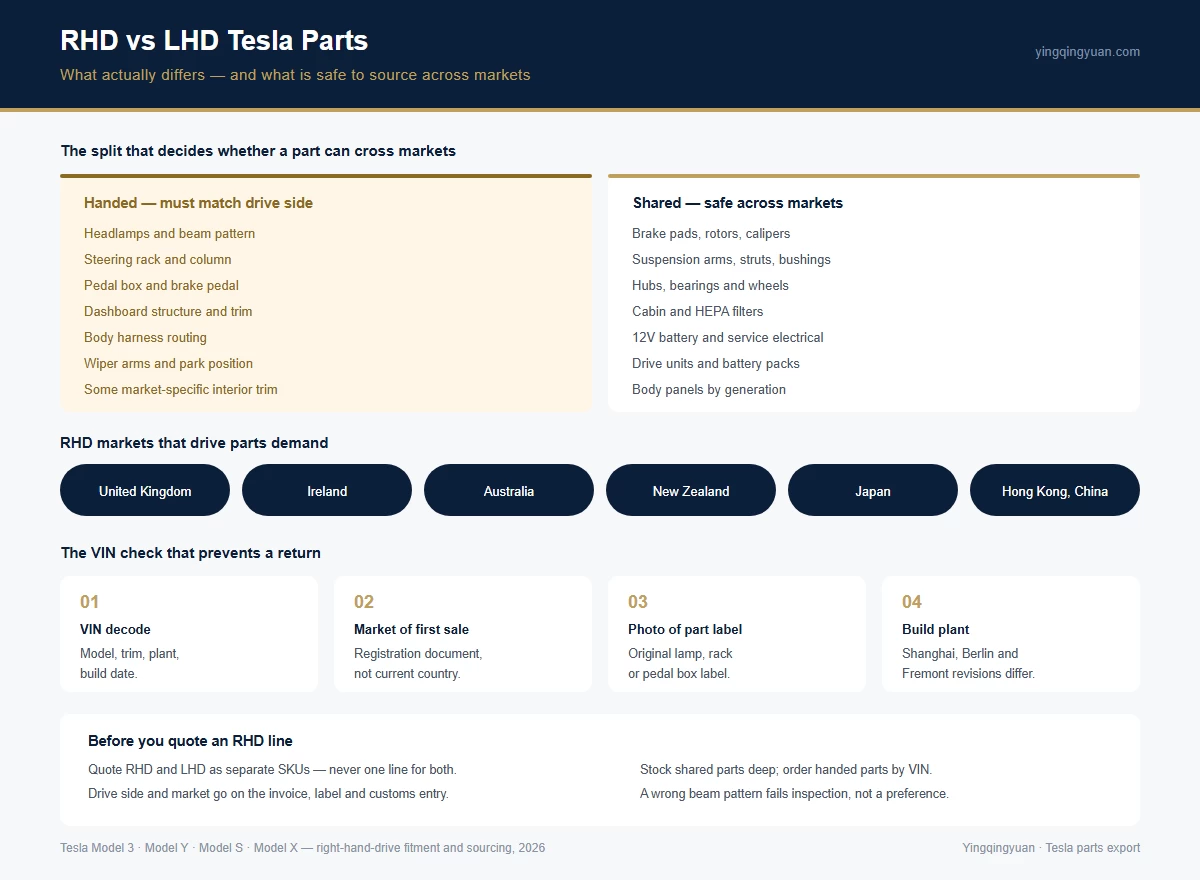
Tesla sells the same Model 3, Model Y, Model S and Model X in both configurations. The right-hand-drive markets that matter most for parts volume are:
- United Kingdom — Model 3 and Model Y, largely Shanghai and Berlin builds depending on period and variant
- Ireland — same specification family as the UK
- Australia and New Zealand — Shanghai-built Model 3 and Model Y
- Japan — Shanghai-built cars, with their own homologation and lighting requirements
- Hong Kong, China — right-hand-drive market with its own registration and inspection rules
- South Africa, Singapore, Malaysia, Thailand, Indonesia and India — smaller but growing RHD populations
Two consequences follow. First, RHD parts demand is spread across many small markets rather than concentrated in one, so no single distributor carries deep stock. Second, the build plant matters as much as the drive side: a Shanghai-built RHD car and a Berlin-built LHD car can differ in lighting supplier and connector detail even before the steering side is considered.
The systems that genuinely differ
The table below separates the parts that are handed from the parts that are not. Treat it as a screening tool, not a substitute for a VIN check.
| System | RHD vs LHD | Why it matters |
|---|---|---|
| Headlamps and fog lamps | Different | Asymmetric low-beam pattern is cut for the side of the road driven on. An LHD lamp fitted to an RHD car throws light into oncoming traffic and fails inspection |
| Tail lamps and light bar | Usually shared | Function is not handed, but connector and revision can still differ by plant and generation |
| Steering rack and column | Different part numbers | Input shaft orientation, column stalks and clockspring differ; a rack is not a bolt-in swap across drive sides |
| Pedal box and brake pedal | Different | Pedal position and linkage are mirrored; the assembly is handed |
| Dashboard structure and trim | Different | The dash is moulded around the driver's side; glovebox, knee bolster and under-dash trim are handed |
| Wiring harness and fuse access | Different routing | Harness lengths and connector exits follow the steering side; a LHD body harness will not route cleanly |
| Wiper arms and blades | Often different | Park position and arm geometry mirror with the steering side; confirm by part number rather than length |
| Mirrors | Usually shared, glass may differ | Housing is handed left/right on every car; the mirror glass curvature can vary by market regulation |
| Front and rear bumpers, fenders, doors | Usually shared | Body aperture is the same; sensor and camera content varies by trim and market, not by drive side |
| Brakes, suspension, hubs, wheels | Shared | No handing by drive side; differences come from model, trim and generation instead |
| HV battery, drive units, onboard charger | Shared architecture | Drive side does not change the powertrain; market and software configuration do |
| Cabin filters, wipers, 12V battery | Shared | Service items carry over across drive sides, subject to model and generation |
Lighting: the most common and most consequential error
Headlamps are where RHD and LHD parts diverge most visibly, and where a wrong part is not merely inconvenient but illegal. The low-beam cutoff on an asymmetric lamp is shaped to illuminate the near side of the road without dazzling oncoming traffic. Drive on the other side of the road and the pattern is reversed: the raised section of the beam now points at the traffic you are meeting.
Three practical rules follow:
- Order lamps by VIN and market, never by model year. A 2022 Model 3 built for the UK and a 2022 Model 3 built for Germany can share a body and a battery but not a headlamp part number.
- Do not “fix” an LHD lamp with a beam deflector and sell it as RHD. Deflectors are a temporary travel measure. They are not a compliant permanent repair and will fail a roadworthiness inspection.
- Replace headlamps in pairs where the revision differs. Even within the correct drive side, Tesla has used multiple lamp revisions with different colour temperature. Mixing revisions produces a visible mismatch that customers reject.
For the removal and fitment procedure itself, see our headlight and tail light replacement guide. Model-specific catalogues are here: Model 3 lighting parts and Model Y lighting parts.
Steering, pedals and dashboard: the structural differences
Moving the driver from one side to the other is not a mirror-image exercise in a modern car. It changes the steering column, the pedal assembly, the dashboard casting, the HVAC ducting behind the dash, and the routing of the body harness.
- Steering rack. The rack's mounting points may be shared, but the input shaft, pinion orientation and column interface are not. A rack from an LHD car will not connect correctly to an RHD column without the matching parts.
- Steering column and stalks. Indicator and wiper stalks are on opposite sides, and the clockspring and steering-angle sensor are configured for the column they are fitted to. This matters for ADAS calibration after a repair.
- Pedal box. Brake and accelerator pedals are positioned for the driver's side, and the bracket is handed. Do not quote a single pedal part number across markets.
- Dashboard and HVAC case. The dash structure, knee bolster, glovebox and some ducting differ. A dashboard from an LHD car can be made to fit only with the matching RHD components, which defeats the purpose.
- Body harness. Harness length and connector exits follow the steering side. This is the single most expensive mistake in a RHD conversion or repair, because the harness is buried behind the dash and routed through the cabin.
Dashboard and console parts are catalogued under Model 3 interior parts and Model Y interior parts; the steering and suspension side is covered in the suspension and steering guide.
What is safe to source across markets
Most of the car is not handed, which is why cross-market sourcing works at all. The following categories can be quoted from a single catalogue, provided the model, trim, generation and build plant are confirmed:
| Category | Cross-market status | What still needs checking |
|---|---|---|
| Brake pads, rotors, calipers | Safe | Model, trim (Performance vs standard) and generation |
| Suspension arms, struts, bushings | Safe | Model, drive type and generation; Juniper and Highland splits |
| Wheel bearings, hubs, wheels | Safe | Bolt pattern, offset, TPMS generation |
| Cabin and HEPA filters | Safe | Heat-pump vs non-heat-pump, HEPA-equipped or not |
| 12V battery and service electrical | Safe | Lead-acid vs 16V lithium, terminal hardware |
| Body panels and glass | Mostly safe | Generation and plant; camera and sensor content by trim |
| Drive units, battery packs, chargers | Architecture shared | Market software configuration and pairing, not drive side |
| Headlamps, steering, pedals, dash, harness | Not safe | Must match drive side and market specification |
How to identify an RHD car before quoting
The VIN is the only reliable starting point, but it does not spell out “RHD” in plain text. Build a five-point check into every quote:
- VIN decode. Confirm model, trim, plant and approximate build date. Our VIN decoding guide explains how to read it.
- Market or region code. Ask for the registration document or the market the car was sold in. A car can be exported and re-registered, so the current country is not proof of original specification.
- Photograph the part. A photo of the original headlamp label, steering rack label or pedal box settles more arguments than a catalogue screenshot.
- Check the part number against the car, not the listing. Tesla supersedes part numbers frequently; the revision suffix matters as much as the base number.
- Confirm the build plant. Shanghai, Berlin and Fremont cars have different supplier and revision histories, even within the same model year.
What this means for exporters and importers
The commercial risk in RHD parts is not the part cost; it is the cost of being wrong. Air freight both ways, customs clearance, labour and a lost trade customer usually exceed the margin on a single order by a wide margin.
- Quote RHD and LHD as separate lines. A mixed-model price list invites the wrong part being picked. Separate SKUs, separate photos, separate labels.
- Put the drive side on the invoice and the carton label. “Model 3 2022 headlamp — RHD, UK spec” is a specification; “Model 3 headlamp” is a guess.
- Stock the fast-moving shared parts deeply and the handed parts narrowly. Brakes, filters and suspension carry across markets; RHD lamps and steering components should be ordered against a VIN, not held speculatively.
- Expect inspection differences. The UK, Ireland, Australia, Japan and Hong Kong all test lighting as part of roadworthiness. A non-compliant beam pattern is a failure, not a customer preference.
- Document the market on the customs paperwork. For used or mixed consignments, a clear description reduces the chance of a held shipment. Our packaging and international shipping guide covers the documentation side.
Duty and import treatment for new versus used parts is covered in the import guide; regional specification differences beyond the drive side are in the US vs EU vs China comparison.
Frequently asked questions
Are Tesla parts the same for right-hand-drive and left-hand-drive cars?
Most mechanical and service parts are, including brakes, suspension, wheel hubs, filters, 12V batteries, drive units and battery packs. Lighting, steering racks and columns, pedal boxes, dashboard structures, body harnesses, wiper arms and some trim are handed and must match the drive side and market.
Can I fit a left-hand-drive headlight to a right-hand-drive Tesla?
It will usually bolt in, but the beam pattern will be wrong for the road and will fail an inspection in the UK, Ireland, Australia, Japan, Hong Kong and other RHD markets. Beam deflectors are a temporary travel measure, not a compliant repair.
Is the steering rack different on an RHD Tesla?
Yes. The rack's input shaft and pinion orientation, and the column interface, differ by drive side. The mounting points may look similar, but the assembly is not interchangeable without the matching column and related components.
Do RHD Teslas use different brake or suspension parts?
No. Brakes, suspension, hubs and wheels are not handed by drive side. Differences in those categories come from model, trim (particularly Performance), generation (Highland, Juniper) and build date.
How do I know if a Tesla was built for an RHD market?
Decode the VIN, check the original market from the registration document, and confirm the build plant. The current country of registration is not proof, because cars are exported and re-registered. For handed parts, ask for a photo of the original part label.
Are RHD Teslas built in Shanghai?
Many are — Australia, New Zealand, Japan and several Asian markets receive Shanghai-built cars, and the UK has received Shanghai and Berlin builds depending on model and period. Build plant affects supplier and revision details, so confirm it alongside the drive side.
Can an RHD car be converted to LHD or the reverse?
Technically possible and almost never economic. It requires a steering rack and column, pedal box, dashboard structure, HVAC case, body harness, lighting and interior trim, plus recoding and calibration. For a production repair, buying the correct car or the correct parts is cheaper.
Which parts should an RHD-market distributor stock?
Deep stock of shared service items — brakes, filters, suspension arms, hub bearings, 12V batteries — and narrow, VIN-ordered stock of headlamps, steering components, pedals and dashboard trim. The shared items generate repeat business; the handed items should not sit on a shelf.
Send us the VIN, the market the car was sold in and a photo of the original part label, and we will confirm whether the part is shared or handed before you order. On RHD parts, one VIN check is cheaper than one return.