
Tesla's 16-Inch Screen and V2L: 2026 Model 3 and Model Y Parts Compatibility Update
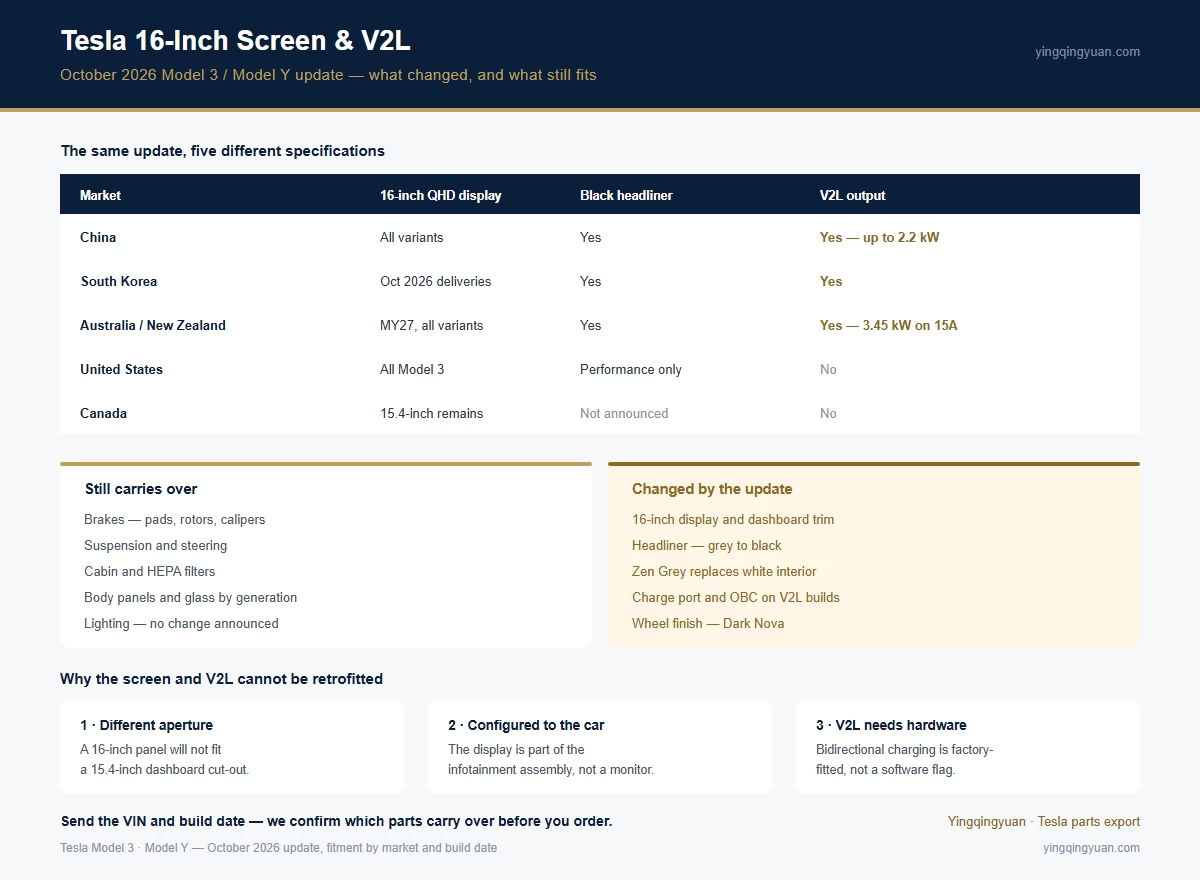
Tesla changed the Model 3 twice in the space of a month — once in Asia-Pacific and once in North America — and the two updates are not the same. Cars built in Shanghai for China, South Korea, Australia and New Zealand received a 16-inch QHD display, a black headliner, a new Zen Grey interior, Dark Nova wheels and vehicle-to-load (V2L) power output. Cars built in Fremont for the United States received the larger display on every trim, a black headliner only on Performance, and no V2L at all. Canada, at the time of writing, still lists the 15.4-inch screen.
For anyone buying, selling or fitting Tesla parts, this is the most important development of the fourth quarter: it creates a new part-number split inside a single model year, it makes several popular accessories obsolete for new cars, and it produces a wave of owners asking whether the bigger screen can be retrofitted. The short answer is no — and understanding why tells you exactly which parts do and do not carry over.
This guide sets out what changed by market, what the hardware differences mean for fitment, and how to identify a car before quoting parts.
What changed, market by market
The table below reflects Tesla's announcements of 1–2 October 2026 and the specifications published in each market. Tesla rolls changes onto the line as component inventory runs out rather than on a single changeover date, so a car delivered in the same week can be either specification. Always confirm by VIN and build date.
| Market | 16-inch display | Black headliner | Zen Grey interior | V2L | 19-inch Dark Nova |
|---|---|---|---|---|---|
| China | All variants | Yes | Yes (light grey) | Yes — up to 2.2 kW | Yes, replaces silver Nova |
| South Korea | From October 2026 deliveries | Yes | Yes | Yes | Yes on Premium Long Range |
| Australia / New Zealand | MY27, all variants | Yes | Yes on Premium and Performance | Yes — up to 3.45 kW from a 15A outlet, 2.3 kW from 10A | Yes |
| United States | All Model 3 variants, announced 2 October 2026 | Performance only | Not announced | No | Varies by trim |
| Canada | No — 15.4-inch remains at time of writing | Not announced | Not announced | No | Not announced |
| Europe / other | Not confirmed at time of writing | — | — | — | — |
Two details are easy to miss. First, the US update also brought a range and power increase for the Model 3 Performance — 316 miles of EPA range and 528 hp — which means Performance brake and cooling hardware should be confirmed separately rather than assumed unchanged. Second, the 2026 Model Y already moved to a 16-inch 2K display in January 2026, with a later April update adding blacked-out badges, 20-inch Spiral Storm wheels and a light grey interior option in some markets. The Model Y is therefore ahead of the Model 3 on the display, but behind it on V2L outside the markets where the Model Y L introduced it.
The 16-inch display: what it is, and why it cannot be retrofitted
The new panel is not simply a larger version of the old one. Reporting from the launch markets describes a QHD unit at 2560×1440, against 1920×1200 on the outgoing 15.4-inch screen — roughly 80% more pixels. The physical difference is half an inch diagonally; the meaningful difference is pixel density, which affects map legibility and text rendering more than it affects video.
Tesla has stated that earlier cars cannot be retrofitted, and the reason is structural rather than commercial:
- Mounting and bezel geometry differ. The display sits in a different aperture in the dashboard assembly, with its own bracket and trim surround. A 16-inch panel does not drop into a 15.4-inch aperture.
- The display is part of the infotainment assembly, not a standalone monitor. It is driven by the car's compute unit and configured to the vehicle, so swapping the panel alone does not produce a working system.
- Software configuration is vehicle-level. Even where the hardware physically fits, the car must be configured to recognise it — a step outside the scope of an independent workshop and not offered by Tesla as a retrofit.
What this means in practice:
- Screen protectors, films and mounts sized for 15.4 inches do not fit MY27 cars. This is the fastest-moving accessory mismatch of the quarter, and the easiest to avoid by asking for the build date.
- Dashboard trim, centre-console surrounds and display bezels split by build. A trim piece from a 2025 car may not seat around a 2026 display.
- Used 15.4-inch screens retain their market. Every pre-update Model 3 and Model Y still needs them, and collision demand does not disappear because a new panel exists.
- Do not promise a retrofit. The aftermarket will eventually offer adapters; until a proven solution exists with software support, selling one is selling a future complaint.
V2L: a hardware feature, not a software unlock
Vehicle-to-load lets the car supply AC power through its charge port using a Tesla outlet adapter. In China the output is quoted at up to 2.2 kW; in Australia the same system supports up to 3.45 kW from a 15A outlet and 2.3 kW from a standard 10A outlet. The adapter is sold separately — around ¥599 in China and A$145 in Australia — and is not included with the car.
The critical point for parts: V2L requires bidirectional power electronics in the onboard charger, installed at the factory. It is not a software flag that can be enabled over the air, and Tesla has confirmed that earlier cars cannot be retrofitted. That produces three practical consequences:
- The onboard charger and charge-port assembly differ on V2L-capable builds. Treat them as separate part numbers, not as interchangeable units.
- The adapter is a genuine accessory line, but market-specific. A Chinese adapter, an Australian adapter and a European adapter have different sockets and different rated outputs. Selling across markets without matching the plug type creates returns.
- Third-party bidirectional adapters carry warranty risk. Tesla's warranty does not cover damage caused by non-Tesla bidirectional adapters or chargers. For a reseller, that is a disclosure obligation, not a footnote.
V2L availability also varies within the Model Y range: the six-seat Model Y L introduced it in several markets and Tesla has extended it to MY27 Model Y vehicles, while other configurations still lack it. Confirm by VIN and market, not by model name.
Interior changes: colour is a fitment issue
The white interior that has been a Model 3 staple for years is discontinued in the updated markets and replaced by Zen Grey — marketed as light grey in China. The headliner moves from grey to black across the updated range, and in the US only on Performance.
Interior trim is where resellers lose the most money on returns, because colour and material changes are invisible in a part number search:
| Component | What changed | Fitment consequence |
|---|---|---|
| Headliner and pillar trim | Grey to black on updated cars | Colour mismatch is immediately visible; clips and roof-rail trim should be confirmed by build |
| Seat covers and cushions | White replaced by Zen Grey / light grey | Not interchangeable as a set; foam and heating elements should be matched to the seat generation |
| Door cards and armrests | Material and colour change with the interior option | Order by interior code, not by model year |
| Floor mats and liners | Footwell geometry unchanged | Carry over — but colour matching to Zen Grey is a customer expectation, not a fitment rule |
| Centre console trim | Surrounds the larger display | Confirm display size before supplying console or dash trim |
Wheels: new finish, same fitment — with one caveat
The 19-inch Dark Nova wheel replaces the silver Nova on several updated builds. Dimensionally it is the same wheel in a dark finish, so brake clearance, tyre size and lug hardware carry over. The caveats are practical rather than structural:
- TPMS generation still governs the sensor. 2021 and later Tesla vehicles use Bluetooth (BLE) sensors worldwide; pre-2021 cars use 315 MHz or 433 MHz radio-frequency sensors depending on market. A wheel set built for a 2019 car will not read correctly on a 2026 car.
- Finish matching matters on a partial replacement. A single silver Nova alongside three Dark Nova wheels is a visible mismatch, and refinishing to match is rarely economical.
- 20-inch Spiral Storm on Model Y is a separate option with its own tyre specification; do not assume a 19-inch tyre carries over.
Bolt patterns, torque figures and hub specifications by model are set out in our wheels, tyres and hub bearings guide.
What still carries over
The update is a cabin and charging change, not a platform change. Most of the car is untouched, which is good news for anyone holding service inventory.
| System | Status on updated cars | Notes |
|---|---|---|
| Brakes — pads, rotors, calipers | Carry over | Confirm Performance hardware separately where power and range changed |
| Suspension and steering | Carry over | Same platform and mounting points |
| Cabin and HEPA filters | Carry over | Service interval unchanged |
| Body panels and glass | Carry over from Highland / Juniper | Generation-specific, but not changed by the October update |
| Lighting | Carry over | No change announced in this update |
| Display and dashboard trim | Changed | 16-inch aperture and surround |
| Headliner and interior trim | Changed | Black headliner, Zen Grey option |
| Charge port and onboard charger | Changed on V2L builds | Bidirectional hardware; market-specific adapter |
| Wheels | Finish change only | Dark Nova; TPMS generation unchanged |
How to identify the car before quoting parts
Model year is no longer a reliable identifier. Tesla introduces changes as inventory turns over, so two cars delivered in the same month can differ. Use this sequence:
- VIN decode. Confirm model, trim, plant and approximate build date. Our VIN decoding guide explains how to read it.
- Build date from the door jamb or the car's software screen. This is more reliable than the sales invoice.
- Visual confirmation. Measure the display diagonally, check headliner colour, and look for the charge-port adapter compatibility entry in the Tesla app or shop listing.
- Part number and revision check. For interior and electrical parts, compare the revision suffix — a superseded number is often the difference between a fit and a return.
- Market confirmation. A US car has no V2L regardless of build date; a Chinese car may have it. Market determines the harness and the adapter, not just the plug.
What this means for resellers and workshops
- Split your catalogue by build, not by model year. The October 2026 cars need their own line for display, dash trim, headliner and charge-port components.
- Accessory demand is about to fragment. Screen protectors, sunshades, console organisers and dash mounts sized for 15.4 inches will not fit the new aperture. This is a short-term returns problem and a medium-term opportunity.
- V2L adapters are a market-specific SKU. Stock the plug type your customers can actually use, and disclose the warranty position on third-party adapters.
- Service parts remain stable. Brakes, suspension, filters, cooling and most body parts are unaffected — the update does not invalidate a service inventory.
- Used 15.4-inch displays still have a market. The installed base is enormous and will be for years.
The generation logic behind these splits — Highland versus pre-Highland, Juniper versus pre-Juniper — is covered in our Highland and Juniper compatibility guide. Interior fitment by generation is covered in the interior parts guide.
Frequently asked questions
Can I retrofit the 16-inch screen to my older Model 3?
No. Tesla has stated that earlier cars cannot be retrofitted. The display sits in a different dashboard aperture with different mounting and trim, and the system requires vehicle-level configuration. There is no approved retrofit path at the time of writing.
Does every 2026 Model 3 have the 16-inch screen?
In the United States, Tesla announced the 16-inch screen for all Model 3 variants on 2 October 2026. In China, South Korea, Australia and New Zealand it is standard across the updated range. Canada still lists 15.4 inches, and other markets had not been confirmed at the time of writing. Because Tesla changes the line as inventory runs out, confirm by VIN and build date.
Why does my US Model 3 not have V2L?
V2L requires bidirectional power electronics in the onboard charger, fitted at the factory. The US Model 3 update did not include V2L, and it cannot be added by software. Only the markets that received the full update — China, South Korea, Australia and New Zealand — list V2L for the Model 3.
Is the V2L adapter included with the car?
No. It is sold separately — around ¥599 in China and A$145 in Australia — and it is market-specific. Third-party bidirectional adapters are not covered by Tesla's warranty if they cause damage.
Will my 2025 floor mats fit a 2026 Model 3?
Footwell geometry did not change with the October update, so mats and liners carry over. The caveat is colour: if the car has the Zen Grey interior, a white or black mat set will fit but may not match. Fitment and appearance are two different questions.
Do the new Dark Nova wheels fit older Model 3 cars?
The wheel is dimensionally the same 19-inch fitment, so brake clearance and tyre size carry over. The TPMS sensor does not: 2021 and later cars use Bluetooth sensors, pre-2021 cars use 315 or 433 MHz sensors by market. Build the wheel set for the car's TPMS generation.
Are brake and suspension parts affected by the update?
No. The October 2026 changes are cabin, display, wheel finish and charging hardware. Brakes, suspension, steering, filters and most body parts carry over from the equivalent Highland or Juniper build. The US Performance model did gain power and range, so confirm its hardware separately.
How do I know which specification a car is?
Decode the VIN, check the build date on the door jamb or software screen, measure the display, and confirm the headliner colour. For V2L, check the market and the adapter compatibility listing in the Tesla app. Do not rely on the model year alone.
Send us the VIN and build date and we will confirm which parts of a 2026 Model 3 or Model Y carry over — display and dash trim, headliner, interior, wheels, charge-port hardware and the service parts that did not change. On a model year that splits mid-quarter, the VIN is the only reliable order reference.