

Tesla Parts for Hot Climates: UAE, Saudi Arabia, Australia and the Gulf Heat Guide
A Tesla in Dubai does not fail the way a Tesla in Norway fails. The cold-climate problems — seized calipers, frozen charge ports, heat pumps struggling below freezing — are replaced by a different set: condensers packed with fine desert sand, cabin filters that clog in a few thousand kilometres, compressors running at maximum for months, batteries derating during fast charging, and interior trim that bakes under UV.
The common thread is that the thermal management system is doing two jobs at once. In 45°C ambient heat it must cool the cabin and protect the battery simultaneously, often while fast charging. There is very little thermal headroom left, so any restriction — a dirty condenser, a blocked filter, a low refrigerant charge — turns into a performance problem rather than a comfort complaint.
This guide covers what actually wears out in hot markets, the warning signs that appear before a failure, a pre-summer inspection that prevents most of it, and the parts a distributor or workshop in the Gulf, Australia or the US Sun Belt should keep moving.
Why heat is a parts problem, not just a comfort problem
Tesla's thermal system is integrated: the same refrigerant circuit and coolant loops condition the cabin, the battery, the drive units and the onboard charger. Heat affects all four at once.
- Battery capacity and charging speed. Cells are happiest around 20–40°C. Above that, the car protects itself by limiting fast-charge power and, in extreme cases, by reducing available power. Owners experience this as “the car charges slowly in summer” — a thermal problem, not a charger problem.
- Compressor duty cycle. The electric compressor runs almost continuously in peak summer. Continuous operation at high pressure accelerates wear on bearings and valves, and any refrigerant loss becomes visible first as weak cooling at idle.
- Condenser airflow. The condenser sits at the front of the car and rejects heat to the air. Fine dust and sand block the fins, which is equivalent to fitting insulation around the radiator. Airflow falls, pressures rise, and the compressor works harder for less cooling.
- Cabin filtration. Dust and sand loading shorten cabin and HEPA filter life dramatically compared with temperate markets. A restricted filter reduces airflow and forces the blower to work harder.
- Materials and fluids. UV degrades trim, seals and tyres; heat accelerates brake fluid moisture absorption and shortens 12V battery life; rubber bushings harden faster.
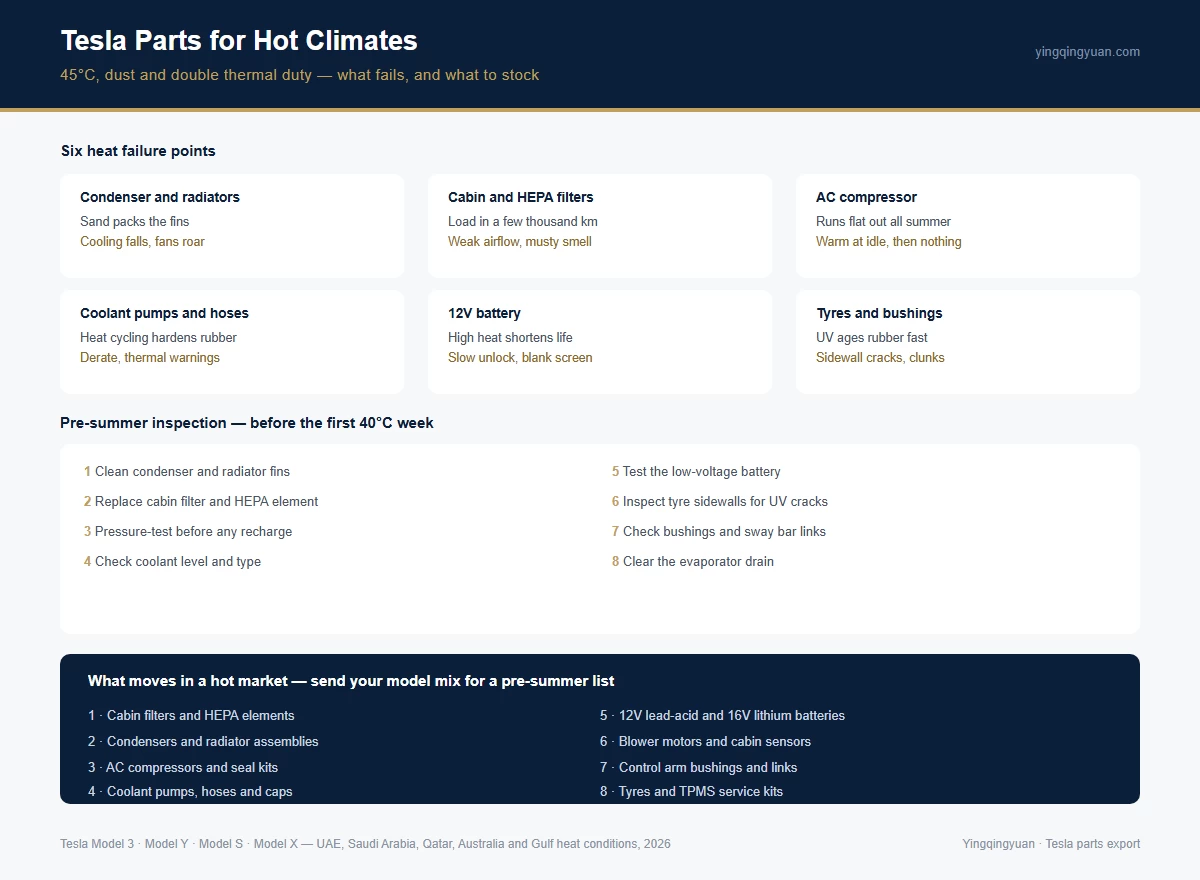
The six heat failure points
| Component | What heat does | Symptom the owner reports | Parts consumed |
|---|---|---|---|
| Condenser and radiators | Fine sand and dust pack the fins; airflow drops and heat rejection falls | Weak cooling in traffic, fans running at maximum, “climate control reduced” alert | Condenser where fins are corroded or crushed; cleaning labour and clips |
| Cabin and HEPA filters | Dust loading blocks the element in a fraction of the temperate-market interval | Weak airflow, musty smell, fogging, blower noise | Cabin filter pair; HEPA element and pre-filter where fitted |
| AC compressor | Continuous high-pressure operation; refrigerant loss raises discharge temperature | Warm air at idle, intermittent cooling, whining or squealing, no cooling at all | Compressor, O-rings and seals, receiver-drier, refrigerant |
| Coolant circuit and pumps | Heat cycling hardens hoses and stresses pump seals; low coolant reduces heat transfer | Cooling system warning, reduced power, heater or battery temperature faults | Coolant pump, hoses, reservoir cap, correct-spec coolant |
| 12V / low-voltage battery | High under-bonnet and cabin temperatures shorten service life | Slow unlocking, blank screen, car fails to wake, repeated jump starts | 12V lead-acid or 16V lithium battery, terminal hardware |
| Tyres, bushings, brake fluid | UV and heat age rubber; hygroscopic brake fluid absorbs moisture faster | Early tyre cracking, clunks over speed bumps, softer pedal | Tyres, control arm bushings, sway bar links, brake fluid |
Warning signs that appear before the failure
Hot-climate failures rarely arrive without warning. The car reports most of them, but the messages are easy to dismiss as normal summer behaviour.
| What the owner notices | What it usually means | First check |
|---|---|---|
| “Cabin climate control reduced” or cooling weakens in traffic | Condenser airflow restricted or refrigerant charge low | Condenser face for sand and bent fins; system pressures |
| Fans roar at maximum after parking | The car is trying to reject heat it cannot shed | Condenser and radiator condition; coolant level |
| Fast charging tapers early in hot weather | Battery thermal management at its limit | Coolant level and pump operation; condenser cleanliness |
| Warm air at idle, cold again at speed | Airflow-dependent cooling — typically a partially blocked condenser | Condenser cleaning before any parts replacement |
| Musty or dusty smell on start-up | Filter loaded and evaporator damp | Cabin filter replacement and evaporator clean |
| Whine or squeal from the front while parked with AC on | Compressor under stress or failing | Stop using maximum cooling; diagnose before it contaminates the circuit |
| Screen blank or doors slow to unlock after a hot day | Low-voltage battery at end of life | Battery health test and terminal inspection |
The most important line in that table is the fourth: warm at idle, cold at speed is the classic signature of a blocked condenser, and cleaning it is far cheaper than replacing a compressor that was never at fault.
The pre-summer inspection
In hot markets, the service calendar matters less than the season. A inspection before the first 40°C week prevents most summer breakdowns and takes under an hour with the car on a lift.
- Clean the condenser and radiator face. Low-pressure water or air, straight through the fins, never a high-pressure jet at an angle. Check for bent fins, sand packing and debris behind the bumper. Do not use a pressure washer close enough to deform the fins.
- Replace the cabin filter before summer, not when it smells. In dusty markets the practical interval is annual or every 10,000–15,000 km; workshops in the Gulf report filters loading far sooner. HEPA-equipped cars also have a pre-filter that is often forgotten.
- Check refrigerant charge and pressures. A slow leak of 15–25% over a couple of years is enough to weaken cooling without a complete failure. Find the leak before recharging.
- Inspect coolant level and condition. Use the specified coolant only; mixing types can gel and block the circuit. Check hoses for hardening and seepage at clamps.
- Test the low-voltage battery. Heat kills batteries quietly. A four-year-old unit in a hot climate is a candidate for replacement before it strands the car.
- Check tyre age, not just tread. UV cracking on sidewalls is common in Gulf markets even when tread remains legal.
- Inspect suspension bushings and sway bar links. Heat-hardened rubber produces clunks that owners attribute to the road surface.
- Test brake fluid moisture. Hot, humid coastal climates accelerate absorption. Replace on the two-year interval for towing vehicles.
- Clean the evaporator drain. A blocked drain produces water in the footwell and a musty cabin — a common coastal complaint.
- Check the charge-port and HV connectors for dust ingress. Do not open HV components; inspect seals and report damage.
Parts to stock for a hot-climate market
Demand in hot markets is skewed toward cooling and air quality, with a secondary tail of electrical and suspension wear. A stocking plan built for a European winter will be wrong here.
| Priority | Part | Why it moves |
|---|---|---|
| 1 | Cabin filter pairs and HEPA elements | Highest-turnover item in dusty markets; annual replacement is normal |
| 2 | Condensers and radiator assemblies | Fin corrosion and impact damage; replacement follows repeated cleaning |
| 3 | AC compressors and seal kits | Continuous summer duty; the highest-value cooling part |
| 4 | Coolant pumps, hoses, reservoir caps | Heat cycling and seal ageing |
| 5 | 12V lead-acid and 16V lithium batteries | Shortened life in high ambient temperatures |
| 6 | Blower motors and cabin temperature sensors | Dust ingress and continuous operation |
| 7 | Control arm bushings, sway bar links | Rubber hardening; clunk complaints |
| 8 | Tyres, TPMS service kits | UV ageing and heat cycling; BLE sensors on 2021+ cars |
Model-specific cooling catalogues: Model 3 cooling and HVAC, Model Y cooling and HVAC, Model S cooling and HVAC, Model X cooling and HVAC. For the system overview, see the cooling and HVAC parts guide.
Fitment notes that matter more in the heat
- Refrigerant specification is not universal. Most current Tesla models use R1234yf, but confirm the system and the label before charging. Using the wrong refrigerant or an incorrect charge weight reduces cooling and can damage the compressor.
- Condenser part numbers vary by model, generation and market. A condenser that fits a pre-Highland Model 3 may not fit a Highland car, and Model Y Juniper parts differ again.
- Cabin filters differ by HVAC configuration. Cars with the under-bonnet HEPA system use a HEPA element plus a pre-filter in addition to the cabin pair. Quoting only the pair leaves the job incomplete.
- Coolant must match the specified type. Tesla uses specific low-conductivity coolant formulations; mixing incompatible types can cause gelling and blocked passages.
- Compressor replacement requires system flushing. If a compressor has failed mechanically, debris can contaminate the circuit. Fitting a new compressor without flushing and replacing the receiver-drier will destroy the replacement.
- Batteries and thermal parts are generation-specific. Confirm by VIN, especially across the 2021 heat-pump changeover and the Highland/Juniper refreshes.
What does not change in a hot climate
Not every part behaves differently. Brake pads and rotors still last a long time because regenerative braking does most of the work; the difference is that corrosion is less of a problem than in salted-road markets, while fluid moisture and rubber ageing are more of one. Drive units and batteries are not “hot-climate parts” in a fitment sense — the same hardware is used — but their cooling support systems are worked harder.
The practical rule for a distributor is to keep the standard service range and add depth in cooling, filtration and low-voltage electrical. That combination covers most of the incremental demand without duplicating the entire catalogue.
Frequently asked questions
Why does my Tesla air conditioning feel weak in Dubai summer?
Usually one of three things: a condenser blocked by sand and dust, a cabin filter loaded to the point of restricting airflow, or a low refrigerant charge from a slow leak. Cooling that improves once the car is moving points to airflow; cooling that is weak at all speeds points to charge or compressor. Diagnose before replacing parts.
How often should a Tesla cabin filter be changed in a dusty climate?
Annually, or every 10,000–15,000 km, is the practical interval in Gulf markets — considerably shorter than the two-year interval quoted for temperate markets. Cars with a HEPA system also have a separate HEPA element and pre-filter that need checking.
Can I clean the condenser myself?
You can remove loose sand with low-pressure air or water directed straight through the fins, with the car off. Do not use a high-pressure washer close to the fins — it bends them and reduces airflow permanently. If the fins are corroded, crushed or the condenser is leaking, replacement is the answer.
Why is my Tesla charging slowly in hot weather?
Battery thermal management is limiting charge power to protect the cells. Common contributors are a dirty condenser, low coolant, a failing coolant pump or simply a very hot battery after a long drive. If the derating is consistent and severe, have the cooling system checked rather than changing chargers.
Does heat damage a Tesla battery?
High ambient heat accelerates ageing over time, which is why parking in shade and avoiding prolonged storage at very high state of charge both help. The car protects itself during use by derating charging and power, but the long-term effect of repeated extreme heat is real.
Are Tesla parts different for the Middle East?
Fitment is largely the same as other markets for the same model and generation; the differences are in specification (such as lighting and market equipment) and in which parts wear faster. Cooling, filtration and low-voltage parts move far faster in Gulf conditions.
How often should brake fluid be changed in a hot, humid climate?
Tesla's general guidance is a health check at two or four years depending on market documentation, with replacement if the fluid fails. In hot and humid coastal climates, moisture absorption is faster, and many workshops replace on a two-year calendar — especially on towing vehicles.
What should a workshop stock before summer?
Cabin filters and HEPA elements, condensers, compressor seal kits, coolant and caps, 12V batteries, blower motors and cabin temperature sensors. Those eight lines cover the majority of hot-weather failures; brakes and suspension can follow the normal service pattern.
Tell us your market, model mix and the cooling complaints you see most, and we will build a pre-summer parts list with fitment confirmed by VIN — condensers, filters, compressors, coolant parts and low-voltage batteries. In a 45°C market, the cheapest repair is the one done before the first heatwave.