
How to Submit a Tesla Parts Inquiry (and Get an Accurate Quote Fast)
If you've ever emailed a Tesla parts supplier and waited days for a vague reply — or worse, received a quote for the wrong part — the problem is almost always the inquiry, not the supplier. A clear, complete inquiry gets you a usable quote in hours. A vague one gets you a guessing game that costs you a sale.
This guide walks you through exactly what to include in a Tesla parts inquiry — whether you're a body shop ordering ten bumpers, a distributor stocking fifty headlights, or a repair shop sourcing a single charge port door. The same checklist applies to retail buyers, but at wholesale volume, getting it right the first time directly protects your margin.
Why Your Inquiry Format Matters
Tesla parts fitment is unusually sensitive. Three things make a Tesla inquiry different from a Toyota inquiry:
- Mid-cycle production changes. Tesla changes parts without model-year announcements. Two units of the same trim built months apart may use different revisions of the same component.
- Facelift splits. Model 3 splits into Pre-Facelift (2017–2023) and Highland (2024+). Model Y splits into Pre-Facelift (2020–2024) and Juniper (2025+). Parts across the split are mostly incompatible — and your customer often doesn't know which version they own.
- OEM part numbers are unforgiving. Tesla part numbers look like
1234567-00-X. The last two characters (revision suffix) often matter. Guessing them wastes everyone's time.
A good inquiry doesn't just request a price — it gives your supplier enough information to verify fitment, suggest the right revision, and quote a realistic lead time. That's the difference between an inquiry that turns into a shipment and one that turns into a back-and-forth.
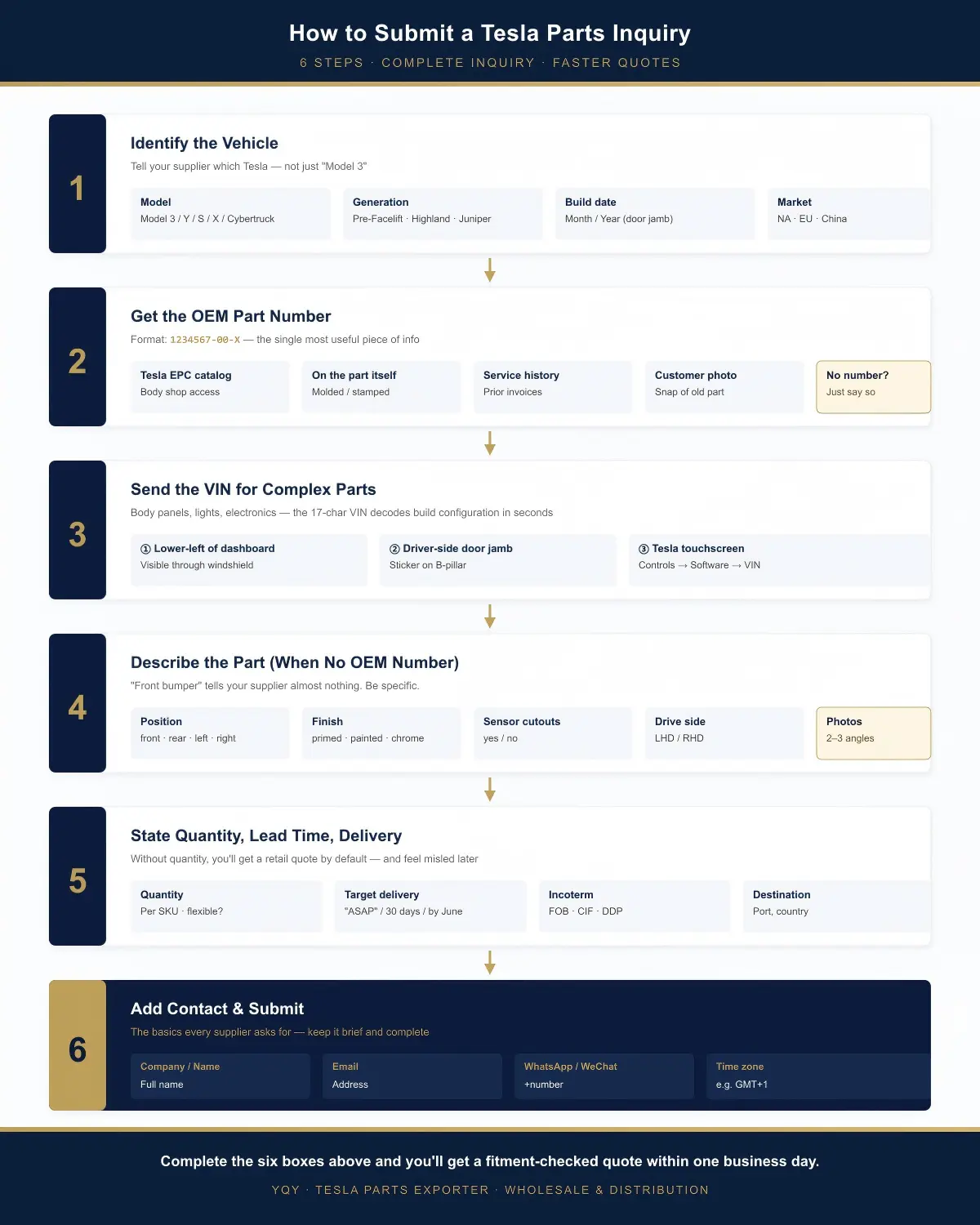
Step 1 — Identify the Vehicle (Model + Generation + Build Date)
Before anything else, your supplier needs to know which Tesla the part goes on. "Model 3" alone is not enough. At minimum, include:
- Model — Model 3, Model Y, Model S, Model X, or Cybertruck
- Generation / facelift — Pre-Facelift vs. Highland for Model 3; Pre-Facelift vs. Juniper for Model Y; pre-2021 vs. 2021+ refresh for Model S/X
- Build date (month/year) — found on the driver-side door jamb label. Critical for Highland / Juniper transition windows and mid-cycle changes
- Market — North American, European, or China-spec. Some exterior and interior parts differ between regions
Why the build date matters: Model 3 Highland launched around late 2023 in North America; Model Y Juniper launched around early 2025. Vehicles built six months before or after those dates are commonly misidentified by customers as the "other" generation. Build date eliminates the guess.
Step 2 — Get the OEM Part Number (If You Have It)
The OEM part number is the single most useful piece of information in any Tesla inquiry. It removes ambiguity and tells your supplier exactly which SKU to quote.
Where to find it:
- Tesla parts catalog — if you have access (EPC for body shops, third-party catalog tools)
- The old part itself — most Tesla parts have the number molded or stamped on the back or underside
- The vehicle's service history — prior repair invoices usually list OEM numbers
- Ask the customer to photograph the part — even a blurry photo of the part in place is better than no number at all
If you don't have an OEM number, don't fake one. Just say so in the inquiry. A professional supplier will help you identify it.
Step 3 — Send the VIN (For Complex or High-Value Orders)
For any part where fitment is uncertain — body panels, lights, interior trim, anything structural or electronic — send the vehicle's VIN along with your inquiry. The 17-character VIN is decoded for free in seconds and reveals the exact build configuration.
Three places to find the VIN:
- Lower-left corner of the dashboard (visible through the windshield)
- Driver-side door jamb sticker
- Tesla touchscreen → Controls → Software → Vehicle Identification Number
Privacy note: VINs are not secret. They appear on every insurance card, registration, and repair order. Still, if you're sending multiple VINs from your customer base, redact the last 5–6 characters in your email and send the full VIN only via your supplier's secure portal — common practice for body shops.
Step 4 — Describe the Part (When You Don't Have the OEM Number)
If the customer can only describe the part in plain language, that's fine — but be specific. "Front bumper" tells your supplier almost nothing. "Front bumper, Model 3 Highland, North American spec, with parking sensor holes, no front camera cutout, primed" tells them almost everything.
Helpful details to include:
- Position — front, rear, left, right, upper, lower, inner, outer
- Material / finish — primed, painted (color code), chrome, matte, gloss
- Sensor / camera cutouts — present or absent (this affects SKU drastically)
- Drive side — left-hand drive or right-hand drive (LHD / RHD) for Model S, Model X, and right-hand-drive Model 3/Y markets
- Photos — attach 2–3 clear photos from different angles
Step 5 — State Quantity, Lead Time, and Delivery Terms
If your inquiry is for wholesale volume, your supplier needs to know the size of the order before they can quote a realistic price or lead time. At minimum, include:
- Quantity per SKU — and whether quantities are flexible (e.g. "10 firm, +5 if the price works")
- Target delivery window — "ASAP", "within 30 days", "for a June opening order"
- Destination country / port — for shipping cost and Incoterms (FOB, CIF, DDP)
- Incoterm preference — FOB Shanghai, CIF destination port, or DDP your warehouse
- Repeat-order potential — if this is the first of monthly recurring orders, say so; suppliers prioritize stable buyers
Step 6 — Include the Basics Every Supplier Asks For
Regardless of the part, your inquiry should always include:
- Company name (or full name for individual buyers)
- Country / city of delivery
- Contact method — email plus WhatsApp / WeChat / phone
- Preferred reply channel — and your time zone if you're not in Asia
- Tax / import documents needed — commercial invoice, packing list, COO, MSDS for batteries, etc.
Inquiry Checklist (Copy and Paste Into Your Email)
Use this template as a starting point. Replace the bracketed items with your details.
Subject: Tesla Parts Inquiry — [Model] [Generation] — [Part Name] Hello [Supplier Name], We are [Company Name], a [body shop / distributor / repair shop] based in [City, Country]. We would like a quotation for the following Tesla parts: 1. Vehicle details - Model: [Model 3 / Y / S / X / Cybertruck] - Generation: [Pre-Facelift / Highland / Juniper / etc.] - Build date: [Month / Year] (from door jamb label) - Market: [North America / EU / China / Other] - VIN (if available): [17 characters] 2. Part details - Part name: [e.g. front bumper] - OEM part number (if known): [1234567-00-X] - Photos attached: [Yes / No] - Position / side: [front / rear / left / right] - Color / finish: [primed / painted — code / chrome] - Sensor or camera cutouts: [yes / no] 3. Order details - Quantity: [e.g. 10 units, may increase to 15] - Target delivery: [within 30 days / by June] - Incoterm: [FOB Shanghai / CIF / DDP] - Destination port / city: [Port, Country] 4. Contact - Company: [Name] - Contact: [Your name] - Email: [address] - WhatsApp / phone: [+number] - Time zone: [e.g. GMT+1] Please confirm availability, price tiers at different quantities, lead time, and shipping cost. Photos of the part are attached. Thank you, [Your Name]
Common Mistakes That Slow Down Quotes
After handling thousands of Tesla parts inquiries, the same handful of mistakes account for most delays. Avoid these and your quote will arrive faster:
- "It fits Model 3" with no generation. Pre-Facelift and Highland share almost no exterior panels. Always specify.
- No OEM number and no photos. Without one or the other, your supplier has to guess — and they will quote the most common SKU, which may not be yours.
- Sending a stock photo of the part, not the customer's actual part. Tesla makes multiple versions of nearly every body panel (sensor vs. no sensor, with vs. without camera cutout, painted vs. primed). A stock photo is not enough.
- Forgetting the build date. Especially for Model 3 Highland / Model Y Juniper transition vehicles. Two months of build date can change the part number.
- Not stating quantity upfront. Wholesale pricing differs from retail by 30–60%. Without quantity, you'll get a retail quote by default — and feel misled when the bulk price comes later.
- Sending one inquiry with twenty different parts. This is fine — just say so. Most suppliers prefer a single structured list over twenty separate emails.
- No reply channel beyond email. Email alone crosses time zones poorly. Adding WhatsApp or WeChat speeds replies from Asia by hours.
What Happens After You Submit
A professional Tesla parts supplier will typically respond within one business day with:
- Confirmation of fitment — which generation and build date your part fits, plus the OEM number it replaces
- Grade recommendation — OEM, OEM-supplier, or aftermarket, depending on your stated use case
- Quantity-based pricing — unit prices at each quantity tier, plus MOQ if any
- Lead time — in-stock vs. made-to-order, plus production window for made-to-order
- Shipping options — FOB / CIF / DDP quotes with realistic transit times to your destination
- Sample policy — whether samples are available and at what cost (typically refundable against bulk order)
If your supplier doesn't reply within 24–48 hours, or if the reply doesn't address the six points above, that's a signal to look elsewhere. Tesla parts sourcing is competitive — a serious exporter will treat your inquiry like a sales call, not an inbox to clear.
Frequently Asked Questions
Do I need a VIN for every inquiry?
No. For simple consumables (filters, wiper blades, cabin air items) where fitment is generation-agnostic, model + generation is enough. For body panels, lights, interior trim, electronics, and any part where fitment changed mid-cycle, send the VIN. It eliminates the most common error in Tesla parts orders.
What if my customer can't find their VIN?
Direct them to the Tesla touchscreen: Controls → Software → Vehicle Identification Number. It's listed there even if the physical VIN plate is unreadable. If the screen is dead, the door jamb label is the second-best option. If neither is accessible, build date + market is usually enough for body panels.
Can I send inquiries in languages other than English?
Most Chinese Tesla parts exporters (including us) work fluently in English, Spanish, and Chinese. German, French, Portuguese, Arabic, and Russian are also commonly handled. Sending your inquiry in your own language is usually fine — the supplier will translate. Sending in English with clear photos is faster, though.
Should I send photos of the damaged part or photos of the new part I want?
Both, if you have them. A photo of the damaged part on the vehicle shows fitment context (sensor holes, mounting points, color). A photo of the part you want (or its packaging) confirms the SKU you're after. The most useful single photo is a clear shot of the OEM number sticker on the original part.
How many parts can I put in one inquiry?
There is no hard limit. A single inquiry with 20–30 SKUs in a structured list is more efficient than 20 separate emails. Use a table or bullet list with one row per part. For orders over 100 SKUs, ask your supplier for an Excel template — it speeds up both quotation and re-ordering.
What if I need a part that's not in the supplier's catalog?
Send the OEM number anyway. Most Tesla parts are obtainable through the OEM-supplier network even if they're not listed publicly. The supplier will tell you whether they can source it, what the minimum order is, and how long it takes. A "no" is more useful than silence — it tells you to keep looking.
Is it OK to share my customer list (multiple VINs)?
For quoting purposes, yes — most suppliers only need VINs to verify fitment. For ongoing orders, ask the supplier to sign an NDA. As a baseline precaution, share the first 12 characters of the VIN (which encodes model and factory) and provide the last 5–6 characters only when the order is confirmed.
How do I know if a supplier is legitimate before I send my first inquiry?
Three quick signals: (1) they reply with specific Tesla fitment knowledge, not generic "we can source any car part" copy; (2) they ask for your VIN or OEM number, not just "send your model"; (3) they offer written terms — invoice, warranty, lead time — before payment. Anyone who accepts payment before confirming these is a risk.
Send Us Your Inquiry
If you've read this far, you already know what makes a Tesla parts inquiry work. Send us the details above — vehicle, OEM number (if you have it), photos, quantity, destination — and you'll get a fitment-checked quotation within one business day.
We work with body shops, distributors, and repair networks worldwide. Whether it's a single Model 3 charge port door or a container of Highland bumpers, the inquiry process is the same.
What to send: vehicle details + OEM number (or photos) + quantity + destination. That's it.
What you'll get back: fitment confirmation, quantity-tiered pricing, lead time, and shipping terms — all in one reply.