

Tesla Heater Not Working: Heat Pump and PTC Diagnosis, Parts and Cost (Model 3, Y, S & X)
A Tesla that blows cold air in winter is not simply uncomfortable. It cannot defrost the windscreen, which makes the car unsafe to drive in cold or humid weather, and it is often the first visible symptom of a fault that also affects battery thermal management and charging speed.
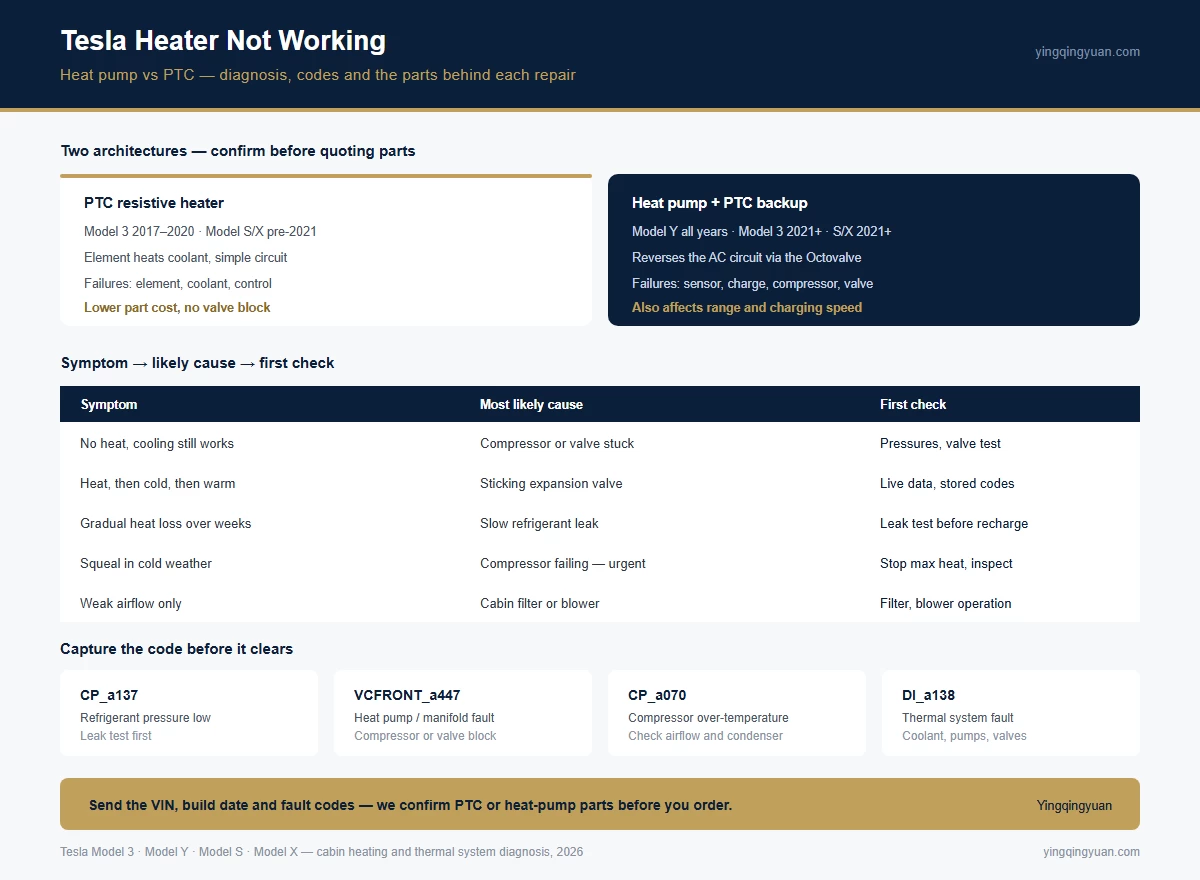
The diagnostic difficulty is that Tesla has used two completely different heating architectures. Early Model S, Model X and Model 3 cars use a resistive PTC heater — effectively an electric element that heats coolant. Cars with a heat pump, from the 2020 Model Y onward and the 2021 Model 3 refresh, use a reversing refrigerant circuit built around the Octovalve and Supermanifold. The symptoms overlap, the fault codes differ, and the parts are not interchangeable.
This guide separates the two systems, maps symptoms to likely causes, lists the codes worth capturing before they clear, and sets out the parts and cost ranges behind each repair.
Step one: identify the heating system
Before diagnosing anything, confirm which system the car has. Ordering a heat-pump part for a PTC car — or the reverse — is the most common and most expensive mistake in this category.
| Model | Build period | Heating system |
|---|---|---|
| Model 3 | 2017–2020 | PTC resistive heater |
| Model 3 | 2021 onward, including Highland | Heat pump with PTC backup |
| Model Y | All years | Heat pump with PTC backup |
| Model S / Model X | Pre-2021 | PTC resistive heater |
| Model S / Model X | 2021 refresh onward | Heat pump with PTC backup |
Build date, not model year, is the deciding factor. Tesla changed the architecture mid-cycle, and a late-2020 car can be either specification. Confirm from the VIN and the vehicle's software screen before quoting parts.
How the heat pump differs from a PTC heater
A PTC heater is simple: electrical current passes through a positive-temperature-coefficient element, heat is transferred to coolant, and the coolant warms the cabin. It is inefficient in range terms but mechanically straightforward, and its failure modes are limited — element failure, coolant loss, control circuit fault.
A heat pump moves heat rather than generating it. The air-conditioning circuit runs in reverse, absorbing heat from outside air, the battery, the drive units or the onboard charger, and releasing it into the cabin. A valve block — the Octovalve, part of the Supermanifold assembly — routes refrigerant and coolant between the cabin, battery and drive-unit loops. Below roughly −10°C, the system supplements with the PTC backup because there is not enough ambient heat to move.
That integration is why a heat-pump fault can present as three different complaints: no cabin heat, reduced fast-charging speed, or unexplained winter range loss. The cabin is simply the symptom the driver notices first.
Symptom patterns and what they point to
| Symptom | Most likely cause | Confirm with |
|---|---|---|
| No heat at all, cooling still works | Heat-pump compressor failure, or a valve stuck in cooling mode | Compressor command and speed, system pressures, valve actuation test |
| Heat works for 15–20 minutes, then cold, then warm again | Sticking expansion valve or intermittent sensor | Live pressure and temperature data through a drive cycle; stored codes |
| Gradual loss of heat over weeks | Slow refrigerant leak (often 15–25% over 18–36 months) | Pressure test, dye or electronic leak detection |
| Sudden loss of heat in extreme cold, often after a cold soak | Pressure/temperature sensor fault causing protective shutdown; historically addressed by software and a service bulletin | Software version, stored climate codes, sensor readings |
| Loud high-pitched squeal from the front in cold weather | Compressor failing — a critical warning, not a nuisance | Stop using maximum heat; inspect before debris contaminates the circuit |
| Heat and cooling both weak, oily residue on lines | Refrigerant leak | Leak detection before any recharge |
| Heat works only at high fan speed, airflow weak | Blocked cabin filter or blower fault, not a heating fault | Filter condition and blower operation |
| No airflow at all, temperature reading normal | Blower motor or controller failure | Fan command vs actual blower operation |
| Heat weak on PTC cars, coolant level low | Coolant loss or air in the circuit | Reservoir level, leaks, bleed procedure |
Two of these are frequently misdiagnosed. Weak airflow with normal temperature is a filtration or blower problem, and replacing the heater will not fix it. A squealing compressor should be treated as urgent: if it fails mechanically, debris travels through the refrigerant circuit and can destroy the replacement unless the system is flushed and the receiver-drier replaced.
Fault codes worth capturing
Tesla fault codes clear themselves from the user-facing screen, so photograph or record them before a reboot. The following codes are commonly associated with climate and thermal faults; they are diagnostic pointers, not a parts list.
| Code | Meaning | Typical direction |
|---|---|---|
| CP_a064 | Compressor communication fault | Wiring, connector or software before condemning the compressor |
| CP_a137 | Refrigerant pressure low | Leak detection and repair, not a simple recharge |
| CP_a070 | Compressor over-temperature | Airflow restriction, condenser blockage, high load |
| CP_a043 | Compressor speed fault | Internal compressor fault or electrical supply |
| VCFRONT_a192 | Cabin heating limited | Multiple causes; requires live data, not code alone |
| VCFRONT_a447 / a531 | Heat-pump compressor or Supermanifold related fault | Compressor or manifold assembly diagnosis |
| DI_a138 | Thermal system fault | System-level; check coolant, pumps and valve operation |
| BMS_a069 | Battery coolant temperature out of range | Coolant level, pump, valve routing, sensor |
Several codes appearing together usually point to a single root cause — commonly refrigerant charge or a sensor — rather than several simultaneous component failures. Diagnose the circuit, not the codes in isolation.
A diagnostic sequence that avoids unnecessary parts
- Check software first. Tesla has resolved some heat-pump shutdowns through over-the-air updates affecting expansion-valve behaviour and sensor logic. Confirm the car is current before spending money on hardware.
- Reboot and re-test. A scroll-wheel reboot clears temporary faults. If heat returns and stays, the fault was software or transient — document it and monitor.
- Verify airflow separately from temperature. A blocked cabin filter or failing blower mimics weak heat. Replace the filter and confirm blower operation before touching refrigerant.
- Read live pressures and temperatures. Compare commanded valve position with actual pressures. A system that cannot build a pressure differential has a compressor, valve or charge problem — not a cabin sensor problem.
- Pressure-test for leaks before recharging. Topping up a leaking system hides the fault for a few weeks and accelerates the next failure. Find the leak first.
- Test the valve block. On heat-pump cars, confirm the Octovalve is moving between modes. A valve stuck in one position produces “heat but no cooling” or the reverse.
- Check the PTC backup. In extreme cold the PTC heater supplements the heat pump. A failed PTC element shows as adequate heat above freezing but none in a deep cold snap.
- Inspect coolant level and condition. Low coolant or the wrong coolant type affects both cabin heat and battery thermal management, and mixing incompatible coolants can gel the circuit.
- Only then condemn the compressor. Confirm command, supply, communication and pressures. A compressor replaced because of a $60 sensor is the most expensive misdiagnosis in this category.
What the repairs cost
Costs vary widely by market, labour rate and whether the work is done at a Tesla service centre or an independent EV workshop. The ranges below are indicative and useful mainly for comparing one route against another.
| Repair | Indicative cost | Notes |
|---|---|---|
| Software update / reboot | No part cost | Always the first step; resolves a meaningful share of intermittent faults |
| Pressure/temperature sensor | Low parts cost, moderate labour | Historically a common cause of sudden heat loss in cold weather |
| Refrigerant leak repair and recharge | Reported around $300–$800 | Depends entirely on leak location; requires evacuation and correct charge weight |
| PTC heater (pre-2021 cars) | Reported around $400–$600 | Simpler system; confirm coolant circuit while apart |
| AC compressor | Reported from roughly $800 to $3,000 | Range reflects part source, labour and whether the circuit needs flushing |
| Octovalve / Supermanifold | Reported around $900–$2,500 | Part is Tesla-proprietary; labour-intensive access |
| Complete HVAC / heater assembly | Can exceed $4,000 out of warranty | Usually the last resort when multiple components have failed |
The pattern is consistent: diagnosis is cheap relative to parts, and the most common expensive mistake is replacing a compressor without confirming the sensor, charge and valve behaviour first.
Parts behind each repair
| Job | Parts to supply | Fitment notes |
|---|---|---|
| Leak repair and recharge | O-rings and seals, receiver-drier, refrigerant, compressor oil where specified | Confirm refrigerant type and charge weight; do not substitute |
| Compressor replacement | Compressor, receiver-drier, seals, refrigerant, oil | Flush the circuit if the old compressor failed mechanically |
| Octovalve / manifold | Valve block or manifold assembly, seals, coolant | Heat-pump cars only; confirm assembly revision by VIN |
| PTC heater | PTC heater element/assembly, coolant, seals | Pre-2021 Model 3/S/X only; not interchangeable with heat-pump parts |
| Airflow restoration | Cabin filter pair, HEPA element and pre-filter where fitted, blower motor if failed | Filter configuration depends on HVAC spec, not just model |
| Coolant circuit | Coolant pump, hoses, reservoir cap, correct-spec coolant | Never mix coolant types; follow the bleed procedure |
Cooling and HVAC catalogues by model: Model 3, Model Y, Model S and Model X. For the system overview, see the cooling and HVAC parts guide; for the winter service context, the winter prep guide covers the rest of the seasonal checklist.
Prevention that actually extends heat-pump life
- Precondition while plugged in. Warming the cabin and battery from mains power avoids a cold-start at maximum load and is the single most useful habit for heat-pump longevity.
- Run the AC for ten minutes a month in winter. It circulates oil through the compressor seals and prevents them drying out.
- Keep the condenser clear. Airflow restriction raises discharge pressure and compressor temperature — the two conditions that shorten compressor life.
- Replace the cabin filter on schedule. A restricted filter reduces airflow across the evaporator, which can cause icing and misleading “no heat” complaints.
- Keep software current. Tesla has changed valve and sensor behaviour through updates; an out-of-date car can exhibit faults that are already fixed.
- Use seat and steering-wheel heating first. They warm the occupant directly with far less energy than heating the whole cabin to maximum.
Frequently asked questions
Why is my Tesla blowing cold air when set to heat?
On a heat-pump car, the most common causes are a refrigerant pressure or temperature sensor fault, low refrigerant charge, a failing compressor, or a valve stuck in cooling mode. On a pre-2021 PTC car, suspect the heater element or low coolant. Check software first, then airflow, then pressures.
How do I know if my Tesla has a heat pump?
All Model Y cars have one, Model 3 from the 2021 refresh onward, and Model S/X from the 2021 refresh. Pre-2021 Model 3/S/X use a PTC resistive heater. Confirm by build date and VIN, because the change happened mid-cycle.
Is a sudden loss of heat in extreme cold a known issue?
Yes. Model 3 and Model Y heat-pump systems have experienced cold-weather shutdowns linked to refrigerant pressure/temperature sensor faults, addressed through technical service bulletins and software updates. If the car is current and the fault persists, it is likely a hardware issue.
Can I just recharge the refrigerant?
Only after a leak test. A system that has lost charge has lost it for a reason, and topping it up without finding the leak hides the fault for a few weeks and can accelerate compressor wear. Refrigerant type and charge weight must match the vehicle specification.
What does an Octovalve do?
It routes refrigerant and coolant between the cabin, battery and drive-unit circuits, allowing the heat pump to scavenge waste heat and switch between heating and cooling modes. A stuck valve produces inconsistent temperatures or a system that heats but does not cool, or the reverse.
Why does my Tesla squeal in cold weather?
A high-pitched squeal from the front during cold-weather preconditioning can indicate the compressor is failing. Stop using maximum heat and have it inspected promptly — a mechanical compressor failure can send debris through the circuit and destroy a replacement.
Can an independent workshop repair a Tesla heat pump?
Yes, with EV-qualified technicians, R1234yf equipment and access to diagnostic data. Refrigerant work and high-voltage components require specific training and tools. Many independent shops handle sensors, filters, coolant and compressor replacement; valve-block and manifold work is more specialised.
Does a heater fault affect range or charging?
It can. Because the heat pump shares the thermal circuit with the battery, a fault can reduce fast-charging speed and increase winter energy consumption. A car with unexplained winter range loss and weak heat should have the thermal system checked, not just the cabin controls.
Send us the model, build date, VIN and the fault codes you have captured, and we will confirm whether the car uses a PTC heater or a heat pump and quote the matching parts — compressor, valve block, PTC element, sensors, filters and coolant. In this category, the right diagnosis is worth more than the fastest shipment.